









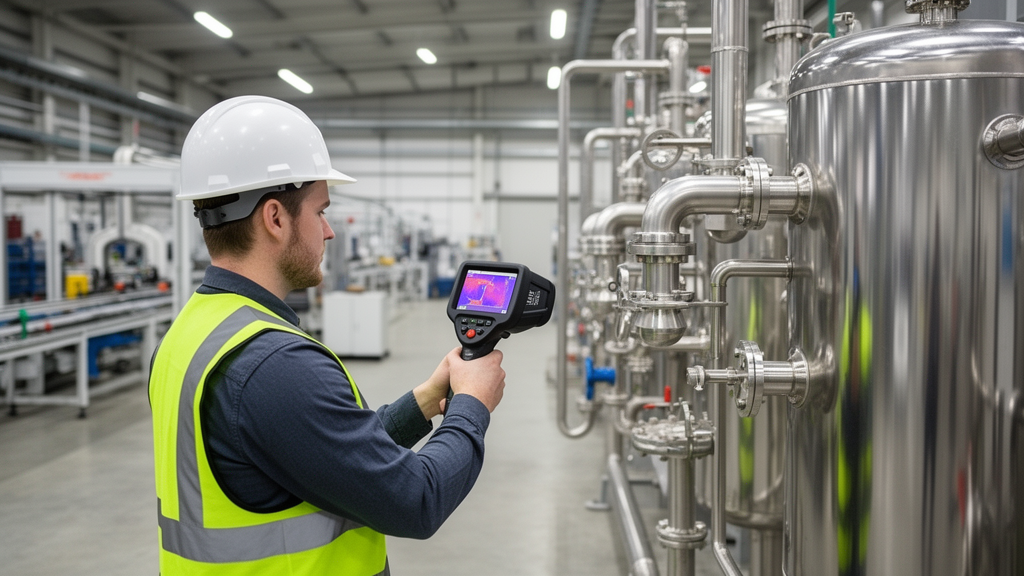
On-site energy audits across 106 industrial facilities in non-energy-intensive manufacturing sectors revealed an average economic energy efficiency improvement potential of 17 percent, corresponding to 303 gigawatt-hours per year in conserved energy. Conducted across 74 firms representing sixteen distinct activity sectors between 2015 and 2024, the comprehensive bottom-up assessments demonstrated that substantial decarbonisation opportunities exist outside heavy industrial sectors. The quantified energy savings comprised 10.1 percentage points from natural gas reductions, 5.9 percentage points from electricity conservation, 0.8 percentage points from other fossil fuel sources like heating oil, and 0.3 percentage points from renewable inputs such as biomass. Out of an aggregate baseline demand of 1,766 gigawatt-hours annually across audited facilities, researchers identified 868 discrete energy efficiency potentials alongside 52 fuel-switching initiatives. These empirical findings challenge existing macro-level decarbonisation projections, which typically estimate potential improvements at between 6 and 15 percent, by establishing that non-energy-intensive enterprises harbour accessible, cost-effective efficiency reserves.
The International Energy Agency has long designated energy efficiency as the critical first fuel in clean energy transitions, noting that global industrial manufacturing accounted for approximately 170 exajoules in 2023, representing roughly 39 percent of global energy demand. While worldwide energy intensity improved at an average rate of 0.8 percent annually between 2000 and 2010 and 1.7 percent between 2010 and 2020, macroeconomic gains remain constrained by rebound effects and persistent informational hurdles. Prior literature frequently documented an efficiency gap wherein enterprises fail to implement demonstrably profitable energy-saving investments due to organisational friction, principal-agent dynamics, unpriced carbon externalities, and split incentives. In addition, existing studies largely relied upon aggregate top-down econometric calculations or narrow single-industry analyses, frequently confusing monetary output variations with genuine physical efficiency improvements at production facilities.
To resolve these analytical shortcomings, the investigation deployed standardised on-site assessments strictly governed by European Norm standards EN ISO 16247 for efficiency audits and EN ISO 50001 for systematic management. The 106 surveyed facilities represented small to medium-scale operations with annual individual energy demands ranging between 1.5 and 60 gigawatt-hours and a median site demand of 4.8 gigawatt-hours. Company-funded site visits were initiated without public subsidy influence, evaluating production processes, auxiliary services, building conditioning, and transport operations. Across the surveyed enterprises, process energy accounted for more than 90 percent of baseline consumption under Energy Efficiency Directive categorisations, whereas building conditioning and transportation represented negligible fractions. During the walk-through investigations, energy engineers collaborated directly with plant managers to trace material flows and systematically record dissipation points. Technical teams noted that comprehensive metering infrastructure was remarkably scarce, with fewer than 10 percent of visited plants possessing sub-meters extending beyond standard utility billing devices.
The technical assessments relied upon rigorous thermodynamic exergy evaluations to identify points of uncaptured heat dissipation, mapping thermal outputs from outgoing process exhaust air, chillers, compressed air systems, and cooling infrastructure. For every identified opportunity, engineering teams documented baseline operational conditions, specific thermodynamic dissipation mechanisms, proposed technical modifications, and practical execution sequences. Feasibility was measured against clear economic benchmarks using annualised return on investment calculations incorporating a 5 percent capital cost, alongside asset depreciation timelines derived from VDI 2067 standards. Measures exhibiting a positive return on investment after capital costs were classified as economically viable, while initiatives exceeding capital charges by more than 8 percentage points received the highest viability rankings. Evaluators also formulated a composite Priority Ranking Number combining operational impact, ease of execution, concept maturity, and economic return, ensuring that recommendations reflected realistic plant conditions while systematically eliminating duplicate counting across mutually dependent technical adjustments.
Categorisation of the 868 efficiency measures demonstrated that thermal interventions delivered the most significant collective reductions across audited operations. Heat recovery measures emerged as the largest single contributor, accounting for 4.2 percentage points of total baseline energy demand savings and delivering 8 percent of overall greenhouse gas emission reductions. Process optimisation followed closely, contributing 3.8 percentage points to overall energy demand savings and 6 percent of carbon reductions, followed by component part renewal at 2.2 percentage points and integrated heating and cooling concepts at 1.5 percentage points. While heat recovery encompassed 109 distinct potentials averaging 0.7 gigawatt-hours in annual savings per measure, process optimisation generated an exceptional 3.1 gigawatt-hours per project across only 22 identified interventions.
Detailed financial data was validated for 785 individual potentials representing 85 percent of the identified portfolio and 273 gigawatt-hours per year in achievable energy savings over a fifteen-year timeframe. Across all evaluated options, the average specific cost of energy savings was 146 euros per megawatt-hour, while the median cost stood at 51 euros per megawatt-hour. Fully executing this viable portfolio would deliver a weighted average net levelised savings of 44 euros per megawatt-hour saved, with a majority of functional categories surpassing net savings of 50 euros per megawatt-hour. Operational categories requiring modest upfront capital, such as ventilation optimisation, energy monitoring, and maintenance protocols, demonstrated rapid financial returns and elevated net savings per megawatt-hour. Conversely, extensive structural interventions such as building insulation and architectural modifications demanded substantial upfront capital expenditure, resulting in negative net financial yields unless justified by mandatory building refurbishments, facility expansions, or external regulatory mandates.
Carbon mitigation calculations evaluated 718 individual potentials that directly decreased greenhouse gas emissions across plants consuming non-renewable energy carriers, identifying a cumulative mitigation capacity of 86 kilotonnes of carbon dioxide equivalent annually. Specific abatement costs averaged 587 euros per tonne of carbon dioxide equivalent with a median cost of 150 euros per tonne, while executing the full spectrum of viable measures generated a weighted average net savings of 122 euros per tonne avoided. Net savings surpassed 110 euros per tonne of carbon dioxide equivalent for more than half of the abated emissions volume. Process modifications and heat recovery options generated exceptional net abatement savings primarily because they displaced carbon-intensive natural gas combustion rather than cleaner energy inputs. On-site fuel switching and self-generation options, which contributed 1.6 percentage points to the aggregate efficiency potential, delivered meaningful emission cuts but occasionally encountered physical roof load limitations that made photovoltaic installations economically unviable without structural reinforcement.
Analysis across sixteen industrial sectors defined by NACE classifications demonstrated marked variations in aggregate energy savings, largely mirroring the operational composition of the sample. Manufacturing facilities represented the dominant sub-sample with 46 inspected sites, generating an 8.3 percent reduction in energy demand solely through heat recovery installations out of 700 gigawatt-hours of total sectoral demand. Accommodation and food services comprised 15 sites, while transport and storage operations accounted for 7 locations. Despite process disparities between discrete manufacturing sectors, primary energy-consuming equipment proved remarkably uniform across the entire sample: electric drives, compressed air systems, and heating, ventilation, and air conditioning accounted for more than 80 percent of overall industrial energy demand. This cross-sectoral technical alignment explains why waste heat dissipation from refrigeration chillers, air compressors, and exhaust systems exhibited similar physical profiles and amenable technological remedies regardless of specific factory products.
Multivariate regression analyses isolated the primary categorical and organisational variables governing technical energy conservation and economic profitability across surveyed facilities. The energy savings model explained 23 percent of variance, proving that facility scale, capital expenditure, and the proportion of natural gas consumption were statistically significant positive predictors of absolute energy conservation. Relative to baseline equipment part renewal, heat recovery added 357 megawatt-hours and process optimisation added 2,623 megawatt-hours of statistically significant incremental savings. In the economic viability model evaluating 632 profitable measures, explaining 38 percent of variance, capital expenditure and facility size significantly enhanced net revenue, while natural gas share showed no statistical significance. Multiple categories outpaced part renewal in net revenue generation, led by process interventions, fuel switching, monitoring, ventilation, compressed air, and heat recovery. These statistical results confirm that substantial savings concentrate within capital-intensive, complex process modifications, explaining why corporate implementation lags behind theoretical potential.
Despite demonstrably favourable financial parameters, implementation gaps persist because firms confront severe shortages of skilled engineering personnel and enforce restrictive internal hurdle rates that routinely demand returns exceeding 8 to 10 percent. When extrapolated across Austria’s approximately 1,900 large commercial enterprises, the 17 percent efficiency potential indicates roughly 6 terawatt-hours per year in achievable energy savings, equivalent to 1.5 percent of gross national energy consumption and 1.7 megatonnes of avoided greenhouse gas emissions. However, study authors highlighted several methodological limitations that restrict unreserved extrapolation across national economies. The investigated cohort was self-selected rather than statistically representative, potentially introducing interest bias, while calculations relied upon static production levels, constant 5 percent capital cost assumptions, and annual average emission factors from Electricity Maps. Furthermore, preliminary technical drafts require comprehensive engineering validation before final commissioning, during which initial profitability projections may occasionally prove unfeasible under dynamic operational realities.
Subject of Research: Economic energy efficiency and decarbonisation potential in non-energy-intensive industrial manufacturing
Article Title: Energy efficiency as an underrated key lever for industrial decarbonisation data from 106 on-site efficiency assessments in the non-energy-intensive manufacturing industry
Article References: Marx, N. O., & Schützenhofer, C. (2026). Energy efficiency as an underrated key lever for industrial decarbonisation data from 106 on-site efficiency assessments in the non-energy-intensive manufacturing industry. Energy, Sustainability and Society, 16(1), Article 29. https://doi.org/10.1186/s13705-026-00576-w
Image Credits: AI Generated
DOI: 10.1186/s13705-026-00576-w
Keywords: industrial decarbonisation, energy efficiency gap, on-site energy audits, non-energy-intensive industry, heat recovery, process optimisation, exergy analysis, EN ISO 16247, EN ISO 50001, net levelised savings, carbon abatement cost, industrial heat pumps, compressed air systems, energy management systems, fuel switching, multivariate regression analysis, return on investment