








Max Haot has a number he wants you to remember. The CEO of Vast says his company builds the primary structure of a space station — the welded aluminum hull, the pressure vessel itself — for less than $5 million. The traditional European module vendor that competitors use charges about 55 million euros and takes four years or more to deliver, he says.
“We build them in six months here,” Haot said on the Core Memory Podcast, walking host Ashlee Vance through Vast’s Long Beach factory. “It’s the iterative playbook, not new — it’s been done in other places in LA. But we think that’s the only way to succeed at creating a sustainable space station for us.”
That single cost ratio is the whole thesis. Everything else in Vast’s pitch — the Q1 2027 launch date, the NASA contract competition, the seven-module spinning station built from Starship launches — hangs on whether vertical integration really produces space hardware an order of magnitude cheaper and years faster than the incumbent model. The claim gets its first real test in about a year.
The hull is 35 panels, a big oven, and 25 CNC machines
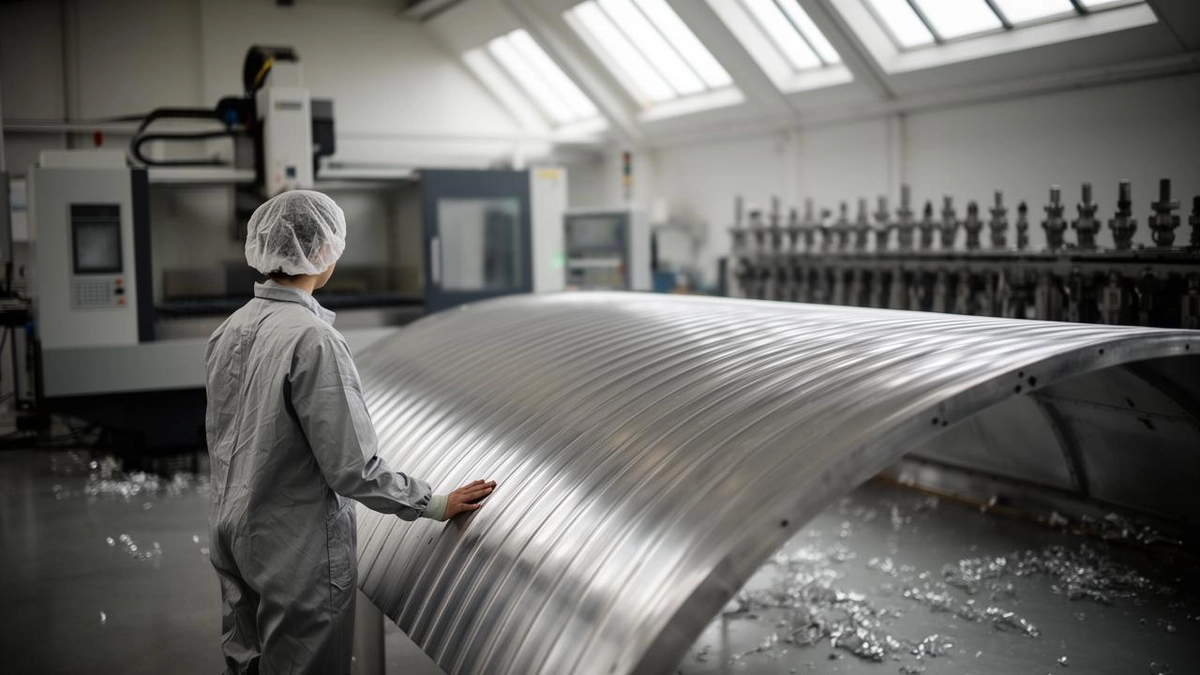
The most concrete part of the tour is manufacturing economics. Vast mills, rolls, and welds Haven 1’s primary structure from 35 aluminum 2219 panels. The hull was pressurized and load-tested at Vast’s Mojave facility, painted, cleaned, and trucked back to Long Beach for integration. The factory runs 25 CNC machines six days a week, from 6 a.m. to 2 a.m., and Vast has bought a larger Multiax machine — about an 18-month lead time — to cut Haven 2’s panel count to roughly 15 and reduce welding.
| Metric | Vast (in-house) | Traditional vendor (per Haot) |
|---|---|---|
| Primary structure cost | Under $5M | ~€55M |
| Build time | ~6 months | 4+ years |
| Panels per hull | 35 (Haven 1) | — |
| Target build time | 4 months, then under 18 months end-to-end | — |
The make-versus-buy line was narrow. Solar panels come from a Spanish supplier; propulsion comes from Impulse Space, Tom Mueller’s company, which supplies 48 thrusters plus COPV tanks. Nearly everything else — avionics, flight computers, MPPT chargers, batteries, valves, the hatch, the window, the control moment gyros — is designed, built, and tested in-house.
Haot is careful to frame the insourcing as a necessity rather than a philosophy. “Not because we wanted to, because there’s no other choice,” he said, citing a shortage of hatch vendors and year-long lead times on bought components. That framing matters for followers: the moat isn’t a clever idea, it’s a building full of machines and the time it takes to learn to use them.

A station sized to the Falcon 9 fairing
Haven 1 is a single-module station with one docking port and 55 cubic meters of pressurized volume — about five times the free-flying Dragon missions. It carries 10 mid-deck-locker-equivalent payload slots and a 1.2-meter curved window that Haot calls the biggest single pane in space. It launches uncrewed on a reusable Falcon 9 using the full fairing, at about 15 tons.
That mass, Haot estimates, will make it the third-largest object in space, after the International Space Station and China’s Tiangong.
The nominal mission is two days transit, 10 days on station, two days back, with crews allowed up to 30 days. The duration is the key upgrade over short free-flyer trips, Haot argues: about half of people get space sickness and need two to three days to recover, leaving little productive time on a three-to-five-day flight. Dragon serves as both transport and lifeboat, and Vast must convince SpaceX with data that the station is safe before a crew is committed. Vast resells the ride as part of its mission package, including SpaceX suit fitting and training.
Connectivity is another differentiator. Haven 1 will carry Starlink laser terminals that connect directly to passing satellites, giving gigabit, low-latency links for crew and payloads — which Haot says beats the ISS’s GEO-relayed link, whose bandwidth is decent but whose latency is the real constraint. He says Vast is the first space station provider to sign a Starlink deal with SpaceX.

A 500-kg demo satellite already proved the hard part
Vast flew a 500-kilogram demo satellite on November 2, 2025, and Haot says it achieved 100% mission success with no anomalies — testing everything except the pressurized volume, hatch, docking, and window. The finale was a controlled deorbit: a 16-minute burn of an Impulse 5N thruster after lowering perigee, targeting a few-hundred-kilometer box near Point Nemo. It hit slightly off-center.
Haot turns that demo into a policy argument. NASA plans to deorbit the entire ISS in 2030 using a dedicated SpaceX-built vehicle — a budget line he calls irresponsible. Vast’s approach is that every module carries its own propellant and propulsion to deorbit itself at end of life. He invokes Skylab, which failed to deorbit controllably and scattered debris over Australia, as the precedent to avoid, and notes the FCC requires proof that ground casualty risk falls within a threshold before launch.
He gives three reasons the ISS ends in 2030: the Russia partnership is geopolitically undesirable; modules are 20 to 30 years old with leaks on the Russian side; and cost — about $4.5 billion a year of NASA’s $25 billion budget, which the agency hopes to cut below $2 billion.
Haot is blunt that the current market is sovereign governments. Vast is competing in NASA’s Commercial LEO Destinations program against Axiom Space and Starlab, with Blue Origin a possible entrant; SpaceX is a mission partner, not a module competitor in his framing. Winning NASA brings the other ISS partners — Japan, Europe, and Canada — which have said they will buy services from whoever NASA selects. He also cites growing demand from Saudi Arabia, the UAE, Poland, and Turkey, and estimates self-funded private missions at just 10–15% of the business. He does not see that private slice as a growing market. What he does see is price elasticity at the sovereign level: Vast is in negotiations to sell modules to foreign governments at what it calls unprecedentedly low prices, opening a buyer class that was previously priced out entirely. The profitability argument follows directly. Even if NASA’s low-Earth-orbit spend halves, a low-cost approach can be profitable on today’s government market alone. That robustness is the point — it lets Vast survive however long it takes for a manufacturing breakthrough to arrive. And a commercial station changes the research market structurally, not just in price. “Because the ISS is a government entity, you can’t skip the line,” Haot said. “You can’t be an entrepreneur or well-funded startup that says, I want to buy the whole capacity of what’s coming up next year.” The long-term prize is in-space manufacturing, and Haot is most excited about drugs that microgravity makes possible, plus stem-cell organoids and cancer-treatment patches. He argues the ISS’s throughput and government queueing rules throttle exactly that research. He names foreign governments buying their own modules, Space Force and allied military habitats, and lunar or Mars habitats as adjacent businesses. He is candid that the timing is unknowable — the killer application could be 2, 5, 10, or 15 years away. “The moment we get one that works, then we are weaning off the government and we are moving into the manufacturing era, where these modules are no longer research labs — they are factories,” he said. Haven 2 is the multi-module station intended to match ISS power and life support, built as derivatives of Haven 1 at a target cadence of at least three modules per year, with each module an improved iteration. The first four Haven 2 modules are targeted by early 2030. The long-term concept, which Vast calls the Stick, is a 7-meter-diameter, 105-meter-long spinning station assembled from seven Starship launches, rotating at four rpm to give 1g at each end, with lunar and Mars gravity bands and microgravity science in the center. Haot’s rationale is a clean piece of reasoning: 1g is proven for a lifetime on Earth, zero-g is tolerable for perhaps a year, and nobody knows whether lunar or Mars gravity sustains health. An artificial-gravity station is how you find out. The tour’s technical core is the argument that vertical integration is also a safety and iteration strategy — the reason Vast can’t simply buy its way to a station. Vast developed its own control moment gyros, which Haot says no competitor has, because no commercial CMG is sized for a station. Six fly on Haven 1, and they have been spinning on test stands for nearly three years to qualify bearing life. Using CMGs instead of thrusters keeps attitude control on solar power rather than finite propellant. Valves are the recurring failure point Haot calls out, referencing Starliner’s valve problems. Vast buys where it can — a Marotta valve — and designs the rest in-house, including oxygen and pressure-relief valves. The redundancy standard: two-fault tolerance to loss of crew, one-fault tolerance to loss of mission. Propulsion uses 48 thrusters with duplication so a single valve failure is survivable. Micrometeorite protection uses a multi-layer Whipple shield over the pressure hull. Vast fires roughly 1-millimeter aluminum projectiles at 7.5 kilometers per second — Haot’s comparison is about 20 times a handgun bullet — at a test article showing the outer layer spraying into a cone that the ballistic layer stops before the pressure wall. Vast bought its own orbital-velocity gun because outside test capacity was insufficient. Every electronics box goes through thermal cycling — Haot cites swings of +100°C to −100°C every 90 minutes — and vibration tables in-house. Drew Feustel, Vast’s lead astronaut with 226 days in space across two shuttle missions and a six-and-a-half-month ISS stay, walks through the full-scale interior mockups and describes where experience changed the design. The clearest example: engineers originally built a cover over the inter-module ventilation duct for aesthetics. Feustel rejected it, because the crew must be able to throw the duct aside and close the hatch fast in a fire or depressurization. It was redesigned as a flexible duct. Other specifics: four sleep quarters, two overhead and two in the floor, with an inflatable bladder system Feustel helped design that presses the sleeper against a soft wall to mimic a weighted blanket — replacing the bungee-cord tethering astronauts use on the ISS. Lighting shifts from blue-rich morning light to red night light to protect circadian rhythm from the 35-minute orbital day-night cycle. The toilet flies on a pallet and is moved into Dragon for use, with Dragon’s own toilet reserved for ascent and descent. Feustel stresses that Haven 1’s interior is roughly ISS-module diameter, about 4 meters, and length, 10 to 11 meters, but with hardware and stowage tucked into the walls rather than “growing from the inside” as on the 25-year-old ISS — and with a planned three-year vehicle refresh cycle. “You can’t ever trade aesthetics for safety, right? Safety is paramount. That’s the number one thing. And the hierarchy is you save the crew, you save the spacecraft, you save the mission,” Feustel said. Haot names time as Vast’s main rival. No company has yet operated a commercial space station, so he counts zero current entrants and expects Vast to be “one of one” if Haven 1 flies first. He puts more than $1 billion invested to date, with more to be spent before Haven 1 flies, as the barrier that makes the position hard to follow. “It took us more than a billion dollar of investment to get here and by the time Haven One flies it’ll be beyond that, and so it’s not an easy thing to follow,” he said. On China, he says the commercial habitat scene is still government-dominated, unlike launch, and that docking standards diverge — NASA published the International Docking Standard openly, Russia uses its own, and China’s may draw on the NASA standard. Integration should finish by late summer or early fall 2026, followed by vibration and thermal-vacuum testing at NASA’s Plum Brook station in Ohio, whose vacuum chamber and shake table are large enough for a 15-ton station. The launch campaign at the Cape follows, targeting Q1 2027. That schedule is the whole investment case in miniature. The $5 million hull, the six-month build, the three-year CMG qualification, and the Q1 2027 date are all self-reported and pre-launch, and they all get their first real test at Plum Brook and the Cape. If Haven 1 launches and a Dragon crew docks on schedule, the NASA competition and the module-sales pipeline to foreign governments become live, and Vast becomes the reference customer for a class of sovereign buyers that has never had one. If the schedule slips, the “profitable on today’s government market” argument is what keeps the company funded while it waits for a manufacturing breakthrough Haot himself says could be 2, 5, 10, or 15 years away — and a $1 billion head start is only a moat for as long as nobody else decides the wait is worth it.The customer is governments — and that’s the point
From one module to a seven-Starship spinning station
The safety case is built from in-house parts
An astronaut overruled the engineers on one design
Time is the only real competitor