









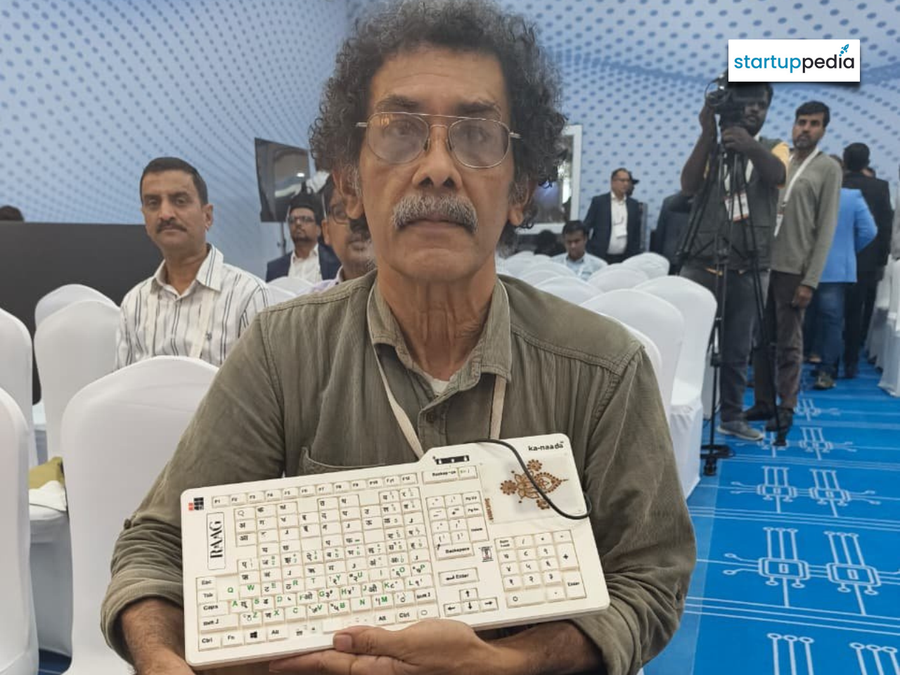
For millions of Indians, using a computer in their mother tongue can be difficult, especially when the keyboard in front of them is primarily designed for typing in English.
While software allows users to type in regional languages, learning unfamiliar key combinations or switching between different typing layouts can create difficulties for those who are not comfortable with English keyboards.
To address this problem, Bengaluru-based Kanaada Phonetics has developed a hardware keyboard that allows people to type in multiple Indian languages using a common phonetic layout based on swaras (vowels) and vyanjanas (consonants).
Showcased at Bengaluru Tech Summit 2026

The keyboard was recently showcased at the Bengaluru Tech Summit 2026 held from November 17 to 19 by Dr Guru Prasad, a former ISRO scientist and founder of the startup.
The startup highlighted its potential to help artisans, local vendors, and small-business owners use computers, communicate with customers, and access AI-based tools in their mother tongues.
Motivation behind Kanaad Phonetics
Guru Prasad, a mechanical and aerospace engineer from Udupi, Karnataka, previously worked at ISRO.
He moved to Orlando, Florida, in 1989 and later worked in robotics, simulation, and advanced computing, including at Lockheed Martin Advanced Technology Laboratories.
In 2009, while teaching his children their mother tongue in the US, he began exploring why Indian languages lacked a dedicated, easy-to-use computer keyboard.
After years of research and experimentation, he established Kanaada Phonetics in Bengaluru in October 2017.
About the multilingual keyboard
The keyboard is designed primarily for Indian languages written in scripts derived from Brahmi. Its layout groups characters by sound, providing a common arrangement across different writing systems.
The startup’s website lists language input options including Hindi, Kannada, Telugu, Malayalam, Bengali, Gujarati, Odia, Punjabi, Assamese, and Tulu.
How does the keyboard work?
Users connect the hardware keyboard to a computer through a USB port and install the language layouts they need.
A dedicated language-switch key allows them to choose among installed languages without changing the physical keyboard.
For example, a user with a Hindi-labelled keyboard can select a Kannada layout and type in Kannada using the same arrangement of phonetic keys.
Mechanism involved
Instead of organising letters around English spelling, the keyboard uses groups of vowels and consonants found across Indian languages.
Its layout was developed around nine phonetic clusters. When a user presses a key, the installed language layout converts that input into the corresponding Unicode character, which can appear in compatible computer applications.
At the summit, the startup also described a two-line command system for typing across languages, although its full technical operation was not publicly explained.
Price and the future plans
The startup’s online store lists Hindi-English, Kannada-English, and Tulu-English multilingual keyboard models at Rs 2,000 each.
Kanaada is now seeking government support, marketing assistance, and training infrastructure to expand adoption across India, particularly among users and businesses who want to work in their mother tongues.