








Texas A&M University has a long history of advancing space exploration — and it’s building on that legacy with new momentum. Through the new Texas A&M Space Institute and expanding opportunities in space engineering and space medicine, Texas A&M is helping shape the future workforce, technologies and discoveries driving the growing space economy.
Aggie-led space research spans decades, tracing back to the earliest days of the U.S. space program. From engineering that supports spacecraft and human spaceflight to innovations that improve astronaut health and performance, Texas A&M researchers are tackling the challenges of living and working beyond Earth. Just as importantly, these breakthroughs deliver benefits here on Earth — strengthening industries, communities and national capabilities.
As a NASA-designated space-grant institution since 1989, Texas A&M helps expand access to hands-on learning, research and partnerships that connect students and faculty to aeronautics and space projects across the nation. The university’s aerospace engineering laboratories drive innovation in propulsion, hypersonics and next-generation satellite technologies. Its Cyclotron Institute is a national leader in cosmic ray and space radiation research, providing vital data for both robotic and human missions.
Today, nearly 300 space scientists and investigators contribute to Texas A&M’s space enterprise. Their work spans Earth and planetary sciences, human spaceflight research, and planetary surface engineering and construction — advancing knowledge, enabling missions and preparing the next generation of leaders to take Texas A&M further, faster.
Texas A&M astronomers are helping answer some of the biggest questions in the universe through leadership roles on the James Webb Space Telescope. Department of Physics and Astronomy faculty, including Dr. Casey Papovich, Dr. Justin Spilker and Dr. Jonelle Walsh, use NASA’s flagship observatory to investigate phenomena such as galaxy formation and evolution, supermassive black holes and the early universe and to address fundamental questions that are reshaping our understanding of cosmic history.
Why space research?
Space research touches almost every aspect of our lives, from agriculture and transportation to medicine and communications. If you’ve ever used GPS or your cellphone in a remote area, you’ve benefited from space research. Communication is probably one of the most visible signs of space research, but there is much more to it.
The incredible ingenuity, precise calculations and innovative technology required to propel a craft into space — not to mention to carry humans there and back safely — have implications for medical research back on Earth.
The challenges of surviving and operating in space have led to the development of new materials, advanced robotics and cutting-edge medical technologies. Many of these innovations find application on Earth, improving our daily lives.
And if something can survive in the harsh space environment, chances are it will also work on Earth.


Texas A&M is a hub for space research — and talent
Over the decades, Aggies have contributed not only as engineers and scientists but also as astronauts on landmark missions. Col. Michael E. Fossum ’80, Dr. Steven Swanson ’98 and other Texas A&M former students have flown aboard the space shuttle and International Space Station. In addition, Texas A&M faculty have served on NASA advisory boards, shaping national space exploration strategies.
Texas A&M is known for its outstanding faculty, which is pushing for solutions to some of the world’s most pressing problems. The faculty currently includes five retired astronauts, as well as several members with a long history at NASA.
One such faculty member was Aaron Cohen, who graduated from Texas A&M in 1952 and later had a significant impact on the U.S. space program. He managed the Apollo Command and Service Module, helping to ensure the success of critical Apollo missions and the Skylab program. Cohen was instrumental in the Apollo–Soyuz mission and later took on major roles with the space shuttle program, eventually becoming director of the Johnson Space Center.
Following his career at NASA, Cohen joined Texas A&M as a professor and eventually became dean of the College of Engineering. In that role, he mentored many Aggies over the years through the senior design project class he taught, including future NASA engineers Trey Perryman ’99 and Ronny Baccus ’94. Cohen was instrumental in helping both Aggies get their start at NASA.
More recently, NASA roboticist Dr. Robert Ambrose joined the faculty of Texas A&M after retiring in 2021. At NASA’s Johnson Space Center, he was the chief of the Software, Robotics and Simulation Division, where he led the development of advanced robotic systems for space missions. Ambrose headed to Texas A&M that same year, bringing with him decades of experience in robotics and an impressive portfolio of work.
Like Cohen before him, Ambrose shares his enthusiasm for space and space research with his students, who are training to become the next generation of space engineers and researchers.
The university’s space research enterprise also extends well beyond spacecraft and astronauts. Texas A&M researchers are key contributors to major ground-based astronomy initiatives, including the Giant Magellan Telescope, the MOONS (Multi-Object Optical and Near-infrared Spectrograph) collaboration and the Vera C. Rubin Observatory, helping develop next-generation tools and observations that expand humanity’s understanding of the cosmos.
Space-based observations are also advancing knowledge closer to home. Department of Atmospheric Sciences faculty members Dr. Anita Rapp, Dr. Courtney Schumacher and Dr. Ping Yang are influencing the current and future design of space-based Earth-observing missions and leveraging data from satellites and other space-based platforms to improve weather forecasting and Earth-system research, while helping inform the design and application of future space missions.
Texas A&M scientists have also played critical roles in exploring our planetary neighbors. Researchers in the Department of Geology and Geophysics have contributed to multiple Mars rover missions, helping analyze surface processes, geology and environmental conditions that deepen our understanding of the red planet and support future exploration efforts.
Undergraduate opportunities in space
Students at Texas A&M have opportunities not only to work with renowned experts in space-related fields but also to explore exciting new degrees and programs. The Naresh K. Vashisht College of Medicine offers an innovative Aerospace Medicine program focused on space health research and education. Space travel is hard on the human body, and factors such as microgravity, exposure to space radiation and even isolation on long-duration missions can all negatively affect astronauts’ health. Research in these areas is critical to ensuring the health of astronauts and the success of future space missions.
This fall, the College of Engineering launched its new undergraduate degree in space engineering to meet the workforce demands of Texas’ growing space industry. The first cohort of 40 students is expected to graduate in 2031. The college also offers a Master of Space Engineering degree.
The college’s Human Systems Integration and Bioastronautics graduate certificate program prepares professionals in engineering, human physiology and medicine to address the growing challenges of both civil and commercial human spaceflight. The program within the Department of Aerospace Engineering was developed in response to demand from NASA and private space companies.
Beyond technical education, The Bush School of Government and Public Service at Texas A&M equips students with the tools to address space law, economic development and policy. Faculty and students collaborate on the legal, governance and industry aspects of space, helping to guide the global space economy.
Texas A&M faculty and students are also working together on a multitude of space-related research projects, including creating better spacesuits, developing robots for the lunar surface, researching microgravity manufacturing, exploring the effects of weightlessness on astronauts and figuring out how to build habitats for sustainable life in space.
A standout example of such collaboration comes from the AggieSat Lab, which is operated by Texas A&M students and faculty. Teams from the lab design, build and fly satellites through NASA partnerships. These student-led missions — including CubeSat projects — give Aggies practical experience in spacecraft autonomy and on-orbit servicing, ensuring graduates are ready for real-world space challenges.
Texas A&M faculty and students are also making advances in artificial intelligence — applying it to satellite operations, asteroid monitoring and planetary exploration. Patented materials, sensors and pharmaceuticals developed at the university are finding use both on NASA missions and in everyday life.
“The opening of the Texas A&M University Space Institute demonstrates how we can pursue cutting-edge frontiers like human space exploration and national defense while remaining rooted in our commitment to public service,” said Dr. Robert Bishop ’79, vice chancellor and dean of Texas A&M Engineering. “Similarly, our new master’s degrees in space engineering and microelectronics and semiconductors reflect our dedication to equipping the next generation for the challenges ahead while serving the immediate needs of Texas industries and the national interest.”
But Texas A&M’s commitment to space-related education extends beyond the student body and into the surrounding communities. The university offers K-12 STEM camps, teacher workshops and Science Olympiad programs, and the George H.W. Bush Presidential Library and Museum hosts public lectures and planetarium events, further cementing Texas A&M as a catalyst for inspiring future space explorers.
Collaboration is key in space research
While engineering plays a large role in space research, it is far from the only discipline involved. Tackling the challenges of not only launching astronauts into space but also ensuring their health along the way requires many people from different backgrounds working toward a common goal.
It also requires collaboration with entities outside of higher education. That’s why Texas A&M has built strong relationships not only with NASA but also with other space-related agencies, research universities and private industries. The university maintains partnerships with leading commercial firms such as SpaceX, Boeing and Blue Origin and works with international research teams on planetary geology, materials science and environmental technology. These collaborations expand opportunities for faculty and students alike.
Furthermore, Texas A&M’s status as a hub for space research is reflected in large federal grants from NASA, the National Science Foundation and the U.S. Department of War. This funding supports groundbreaking studies in areas such as robotics, space weather and mission simulation.
Texas A&M is part of a multi-university team on a major research project to track objects orbiting the moon. The Air Force Research Laboratory-funded Space University Research Initiative aims to develop new capabilities to improve space domain awareness. Currently, NASA and the Air Force can monitor objects like satellites, asteroids and debris in low Earth orbit.
Texas A&M is also helping shape the future of gravitational-wave astronomy through participation in one of the world’s most ambitious space missions. Astrophysicist Dr. Krista Smith serves as one of only six U.S. scientists on the European Space Agency/NASA LISA (Laser Interferometer Space Antenna) Science Team, which is developing the first space-based gravitational-wave observatory to detect ripples in space-time caused by some of the most extreme events in the universe.
Earlier this year, Texas A&M announced TAMU-SPIRIT (the Texas A&M/Aegis Aerospace Multi-Use Space Platform Integrating Research and Innovative Technology), a partnership with Aegis Aerospace, whose CEO and chairman is former student Stephanie Murphy ’00, ’14. The partnership will provide space for experiments aboard the Express Logistics Carrier 3 on the International Space Station, enabling Texas A&M faculty, researchers and students to conduct experiments in the unique environment of low Earth orbit. TAMU-SPIRIT can accommodate a wide variety of projects and experiments, including advanced materials manufacturing, robotics testing, space surveillance, tracking technologies and in-space research.
With the increase in government and commercial space exploration, including NASA’s return to the moon, tracking objects in higher orbit is critical. The systems currently being used for space domain awareness are limited, so the research from this project will be instrumental in developing advanced technology and systems to track objects influenced by the moon’s gravity.
NASA and Texas A&M have partnered for nearly 20 years to ensure astronauts have nutritious food while in space. The Texas A&M Food Technology Facility for Electron Beam and Space Food Research supplies about 30% of the food astronauts eat when they’re away from Earth.
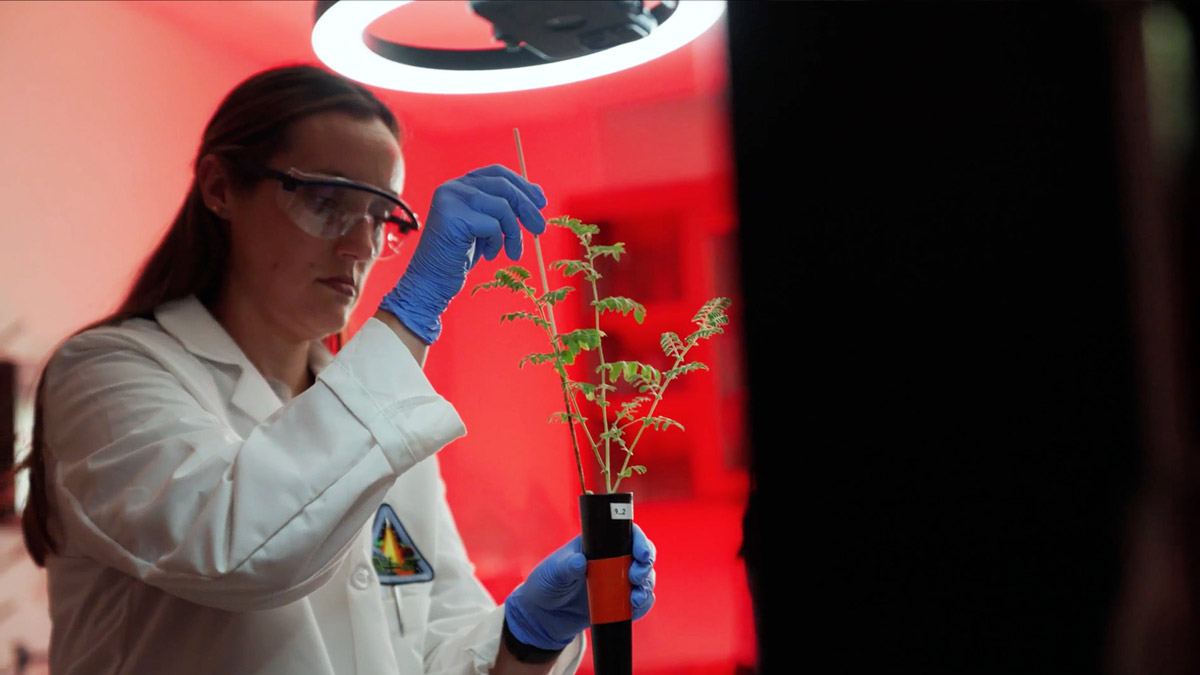
Another area of food research focuses on how to grow food in space. A Texas A&M research project recently tested growing chickpeas in simulated moondust. The team grew chickpeas in mixtures of up to 75% moondust. The ability to grow crops in space could be a long-term solution for cutting waste and reducing the need for resupply missions.
Innovative Space Research
Growing Chickpeas In Moondust
By adding fungi and worm manure to simulated moondust, Texas A&M researchers were able to achieve a world’s first — growing a small crop of the protein-rich legumes, offering hope for future lunar farming efforts.
National defense in the stars
At Texas A&M, collaborations extend beyond research and technology and into national defense. The university is working with the U.S. Space Force’s Space Training and Readiness Command (STARCOM) to prepare the next generation of leaders in the space domain.
In January, the university hosted the first Captain’s Leadership Course at the Bush School, and roughly two dozen mid-level Space Force officers, known as Guardians, began the inaugural four-week leadership-focused course. A team of STARCOM instructors and faculty members with expertise in relevant fields led classes on space readiness, communication and multiservice integration, complementing and enhancing the Guardians’ already extensive knowledge of space launches, space intelligence, orbital mechanics and acquisition.
“The Captain’s Leadership Course will help officers hone their leadership skills to make bigger impacts as advocates for space capabilities, warfighters within the space domain and professionals in the national security arena,” said Col. (Ret.) Kevin Parker, director of the National Security Leadership Program at the Bush School. “When the Space Force looked across the entire country for a university partner to help develop its officers as leaders, they chose Texas A&M.”
By September, Texas A&M had conducted six cohorts of the Captain’s Leadership Course, and the Space Force announced that the university would continue this important work through 2036. Beginning in fiscal year 2027, as many as 420 Guardians — seven 60-student cohorts — will complete the course at Texas A&M annually. The two institutions formalized the partnership through a 10-year intergovernmental support agreement and may even pursue additional training and education services.

Members of the inaugural cohort of the U.S. Space Force Captain’s Leadership Course stand ready to begin their official training after the assumption of command ceremony.
Credit: Abbey Toronjo/Texas A&M University Division of Marketing & Communications
The future of space research
Bringing together the public and private sectors in one location, the Texas A&M Space Institute will be at the epicenter of collaborative space research and is poised to become a game changer in space and space-related research, revolutionizing the way space researchers work.
Researchers will have access to two massive simulation spaces — one for the surface of the moon and one for Mars. These lunar and Martian landscapes will provide unprecedented testing areas for researchers in spaces the size of Kyle Field.
It will be the first building in NASA’s new Exploration Park, a 240-acre commercial property located next door to the Johnson Space Center in Houston.
“I think it’s going to be game-changing for Texas A&M,” said Fossum. “I think we’re going to harness that Aggie Network, that Aggie brainpower and roll up our sleeves with the can-do attitude at Texas A&M to help solve some of the intractable problems that we have.”
The new institute is led by Dr. Nancy Currie-Gregg, a former NASA astronaut and current professor of practice in the College of Engineering. The associate director is Ambrose, an expert in space robotics and the J. Mike Walker ’66 Chair Professor in the Department of Mechanical Engineering.


Going back to the moon — and on to Mars
Current space research targets two goals: returning to the moon and finally making it to Mars. The moon is about three days away from Earth; Mars is nearly nine months away.
That immense difference in time and distance requires incredible preparation and research to ensure not only that the spacecraft reaches Mars but also that the astronauts remain safe throughout the arduous journey there and back.
“Mars is really hard because once you light those engines to leave Earth’s orbit and go all the way to Mars, you’ve committed. You don’t turn around, and that’s what’s so hard,” said Fossum. “The systems that you have need to be very, very reliable — all of the systems to keep you healthy, the air-cleaning systems, the oxygen generation systems, the water purification systems.”
Another part of the challenge is keeping astronauts physically fit during extended periods in space.
“The bone loss that you can have over long periods of time without even the exercise of walking up there. And you know, we’ve proven how to do that on large equipment on the space station,” Fossum said. “But we haven’t proven the prototype’s ability to keep humans healthy over long periods of time, and so we’re still using the space station as a test bed today, and it’s really important.”
It will take a lot of people working together to ensure astronauts can make that trip. And Texas A&M has the expertise and collaborative spirit to lead the charge in making that dream a reality. In fact, Texas A&M’s biomedical researchers are already pioneering new solutions for astronaut health, including therapies targeting bone loss, immune system adaptations and behavioral resilience in microgravity. One day, these crucial innovations will help safeguard crew members on long missions to the moon, Mars and far, far beyond.