






Chinese rivals that once pushed Korean display makers out of LCDs are now turning to them for premium OLED panels
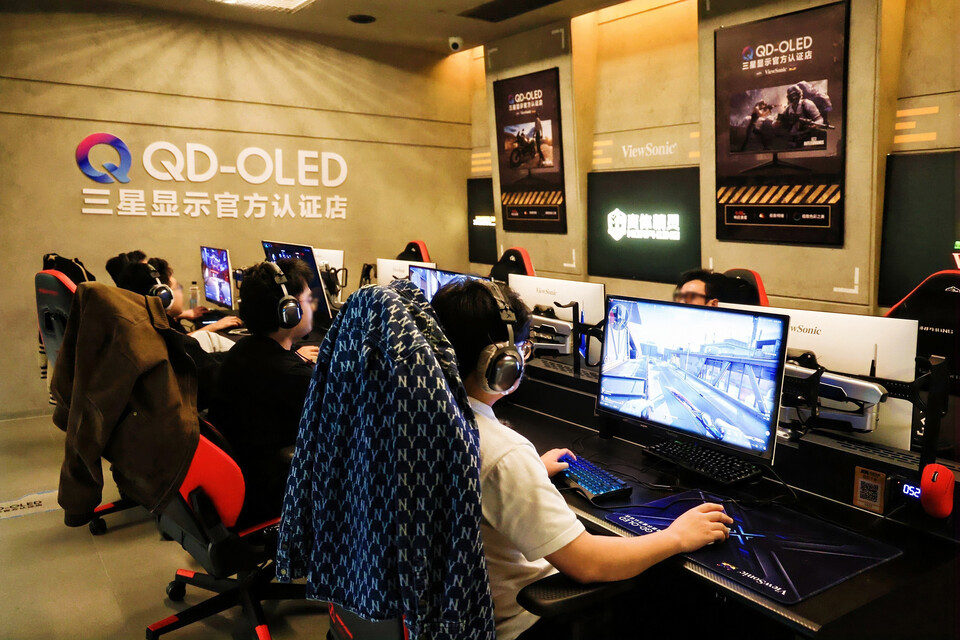
Samsung Display and LG Display are stepping up efforts to expand their organic light-emitting diode panel business for premium gaming monitors in China, the world’s largest gaming market.
The two Korean display makers are winning orders from Chinese monitor brands with their advanced OLED technologies while turning to premium internet cafes and gaming hotels to reach local consumers. But the growing presence of Chinese panel makers in OLED production could eventually challenge their technological edge.
According to market research firm IDC, gaming monitor sales in China more than doubled from 4.93 million units in 2023 to 11.12 million last year and are projected to reach 12.9 million by 2030.
That represents growth of about 16 percent between 2025 and 2030, far outpacing the broader Chinese monitor market, which is expected to grow just 3.7 percent from 30.1 million to 31.2 million units over the same period.
The premium segment is expanding even faster. Sales of self-emissive monitors, including OLED models, surged roughly 22-fold from 25,000 units in 2023 to 560,000 last year. Despite the rapid growth, they still accounted for only about 5 percent of China’s gaming monitor sales, leaving considerable room for wider adoption.
OLED technology offers high contrast ratios and fast response times, making it well suited for demanding games. China had 684 million gamers as of the first half of this year, according to the China Audio-video and Digital Publishing Association, while revenue from PC client games jumped nearly 28 percent from a year earlier.
Samsung Display is seeking to capitalize on the trend by bringing its quantum dot OLED technology directly to Chinese gamers.
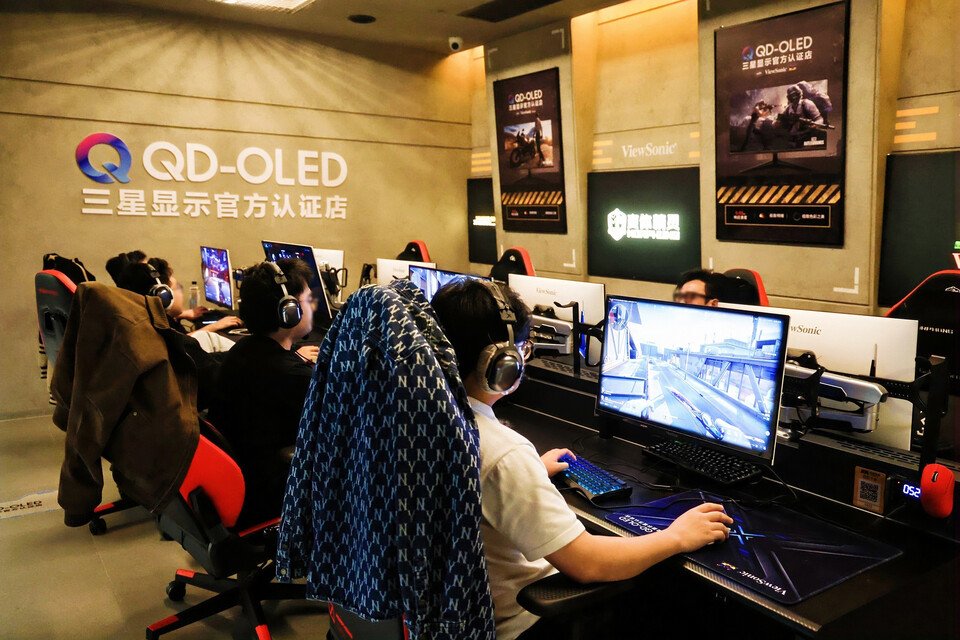
The company has partnered with six monitor brands, including HKC, Asus and AOC, to establish certified QD-OLED locations at premium internet cafes, known locally as i-cafes, in major cities such as Beijing and Shanghai.
Under the program, Samsung Display selects popular i-cafes equipped with at least 30 QD-OLED monitors and provides branded signs and promotional materials. It had designated 10 locations by the end of October and plans to increase the number to 60 by year-end.
The cafes serve as both bulk buyers of gaming monitors and places where consumers can try high-end displays before purchasing their own, giving Samsung Display a way to promote its panel technology beyond traditional retail channels.
LG Display is pursuing a similar strategy through partnerships with Chinese monitor makers, using its fourth-generation tandem white OLED technology to strengthen its position in the premium segment.
In September, AntGamer, the premium gaming brand of Chinese monitor maker HKC, unveiled a 27-inch gaming monitor featuring LG Display’s latest tandem WOLED panel at a product launch in Zhuhai. The monitor supports a 240-hertz refresh rate at 4K resolution and up to 480 Hz at full HD.
Chinese electronics giant TCL has also turned to LG Display for the tandem WOLED panels used in its recently launched 27-inch and 32-inch OLED monitors, despite having its own panel manufacturing subsidiary, TCL CSOT.
While Chinese manufacturers have built a strong position in conventional display panels, TCL’s decision reflects Korean suppliers dominance in the high-performance OLED technology needed to compete in the premium gaming market.
LG Display also plans to work with AntGamer’s i-cafe business and local gaming hotel networks to give more consumers access to OLED monitors.
Such venues are becoming an increasingly important sales channel. According to the Internet Society of China, the number of i-cafes and gaming hotels in China rose from 90,000 in 2023 to 122,000 last year and is forecast to reach 133,000 this year.
For Korean panel makers, partnerships with established Chinese brands provide access to their extensive sales networks. Chinese manufacturers, in turn, can expand their premium monitor lineups without waiting for domestic OLED production to catch up.
The arrangement marks a reversal from the LCD era, when Chinese manufacturers used their scale and cost advantages to push Korean rivals out of the market.
Samsung Display sold its LCD operations in Suzhou, China, to CSOT in 2021, while LG Display completed the sale of its Guangzhou LCD plant last year. Both have since shifted their focus toward higher-value OLED products.
Some of the Chinese companies that displaced Korean suppliers in LCDs have become OLED customers.
Korean firms’ advantage, however, may prove difficult to sustain as Chinese manufacturers step up investment.
TCL subsidiary CSOT recently began moving key equipment into its 8.6-generation inkjet-printed OLED plant in Guangzhou, a 29.5 billion yuan ($4.42 billion) project scheduled to begin mass production in the fourth quarter of 2027.
The facility will produce medium-sized OLED panels for laptops, tablets and monitors, putting CSOT in a position to compete more directly with Korean suppliers if it can achieve competitive production yields, performance and costs.
While Chinese panel makers still face technological and manufacturing hurdles, greater domestic OLED capacity could give monitor brands more sourcing options and weaken Korean suppliers’ bargaining power. Companies such as TCL, which already operate their own panel businesses, would be particularly well placed to shift orders as local alternatives improve.
“Chinese monitor brands aren’t waiting for domestic OLED suppliers to catch up before moving into the premium gaming market,” an industry source said. “That gives Korean panel makers a valuable head start, but the real test will come when those same customers have competitive Chinese alternatives to choose from.”
yeeun@heraldcorp.com