









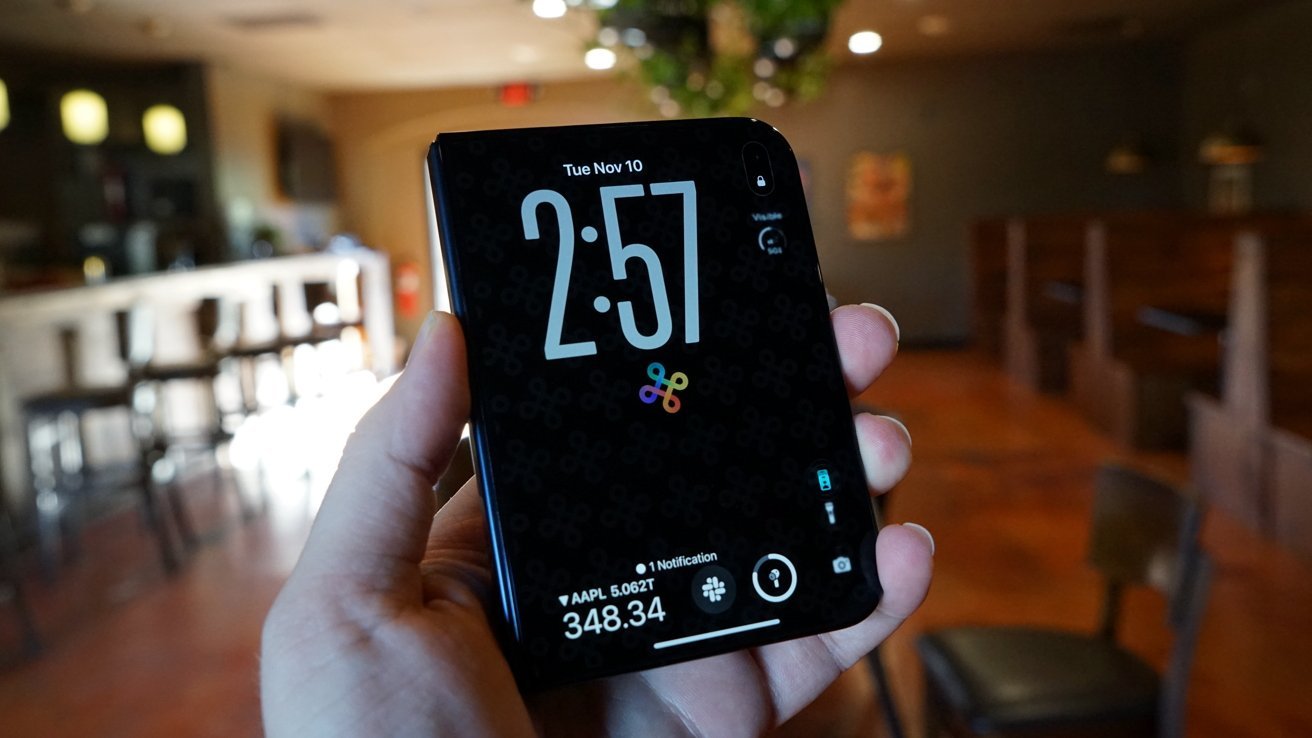
The main complaint about iPhone Duo is the lack of Face ID and the convenience it offers, so Apple has introduced a less secure face recognition option that can’t be tricked with a photo.
When Apple introduced Face ID, it showed off how even complex Hollywood masks couldn’t fool the system thanks to proof-of-life algorithms. Android smartphones have offered face recognition for years, but many were easily fooled by a 2D photograph.
Thanks to the highly insecure nature of face recognition that doesn’t rely on infrared dot scattering and 3D mapping, it seemed Apple would never implement it. Then, as it started pushing for more advanced systems powered by Secure Exclaves, the feature popped up in Apple HomeView and then was added to iPhone Duo.
While it hasn’t been confirmed whether face recognition is being powered by the Secure Exclave in iPhone Duo, it seems likely. The system appears to be much more advanced than simple AI facial recognition and image matching software.
iPhone 18 Pro already uses images in the Secure Exclave to help supplement it’s under-display Face ID.
Apple is incredibly concerned with how secure its devices can be, so much so it took a global pandemic for it to use Apple Watch as a fallback option. An advanced version of Apple Watch unlock was introduced for iPhone Duo, seemingly based around the unlock mechanism used for Apple Watch on Mac.
The thinking there was that since Apple Watch was always authenticated as long as it remained on the wrist, it could serve as a different authentication tool on iPhone. It works great and can sometimes be faster than even Face ID, but it requires always wearing an Apple Watch.
Users complained that Touch ID felt like too much of a step down from Face ID. It seems Apple listened, though I’m not so sure that this wasn’t always in the works and was simply pushed forward due to demand.
These kinds of features don’t just appear overnight.
Anyway, face recognition is now an option for unlocking your iPhone Duo. Here’s how that works and why you shouldn’t worry about it being less secure than Face ID.
iPhone Duo face recognition setup and use
I already had Apple Watch unlock set up for my iPhone Duo and have had zero complaints. I always wear an Apple Watch, so I rarely find myself needing Touch ID outside of payment authentication.

Set up Unlock with Front Camera in Settings
Apple lets you use Apple Watch unlock alongside face recognition on iPhone Duo. It seems that the systems work together to determine which method should be used.
Toggle on Unlock with Front Camera by going to Settings, Touch ID & Passcode, then select the feature. It only works with the front camera likely due to resolution and fidelity.
The description reads as follows:
Use the front camera, along with a recent Touch ID or passcode authentication, to quickly unlock iPhone Duo when it’s closed. Face recognition data never leaves your device. To use Apple Pay or to access your passwords, Touch ID is still required.
These three unlock features work independently of the other. The iPhone Duo looks to see if a finger is present on the Touch ID sensor, then, failing that, it unlocks with Apple Watch automatically.
If a face is in view, I notice it’s a seemingly random chance on which unlock you’re going to get. A little face appears in what is usually a thumbprint indicator when face unlock is used.

A little face indicator shows when face recognition is being used
You know which is used since the Apple Watch still taps you when unlocking via that method. I haven’t tested it yet, but I would love to see the Apple Watch unlock feature fail if it sees a face that isn’t mine trying to unlock the device.
It hasn’t been a problem, but since turning on Unlock with Apple Watch and letting people try out my iPhone Duo, I’ve noticed it just unlocks for them. I’m right there and can see what they’re doing, but I don’t like that my device can unlock in their hands.
I plan to keep all three methods of unlocking turned on, as I don’t really fear any of them leading to a security event. Apple seems to have really thought through the system to ensure it is secure.
The concern with face recognition
Apple users, especially the nerds that care enough to compare Android smartphones, have spent years making fun of the travesty that is face recognition unlock on Android devices. Security researchers have found that as many as 72% of the hundreds of devices they tested would unlock with a 2D photo.

Apple’s Secure Exclaves help keep recognition and analysis data separate from the OS
That research was updated in 2026 to show a slight drop down to 63%, but the situation on Android is still dire. From my testing so far, Apple’s implementation seems foolproof when it comes to photos or videos.
I expect that there’s a very big difference in execution that allows one to be better than the other. Apple already has a ton of security built into its devices that Android manufacturers don’t bother with due to expense, but there are also performance considerations and new hardware.
The iPhone Duo has a Secure Exclave, which initially was used simply to control when microphone or camera indicators should be shown. By having those features controlled by a Secure Exclave, Apple could prevent software or hackers from attempting to turn off the privacy indicators.
The Secure Exclave has also been used in Apple Watch for Audio Intelligence and Apple HomeView for facial recognition. Focusing on HomeView, that device uses a rolling feed of footage that isn’t technically recorded to determine who is using the device.

Siri Recaps show up on iPhone but are powered by Apple Watch
While Apple has yet to publish a paper on the iPhone Duo face recognition software, I expect that it is performing a similar action. Instead of simply capturing a 2D photo then comparing it to face data stored in the Secure Enclave, it is relying on live video and AI analysis.
I tried tricking the iPhone Duo into unlocking with various photos of me and a video of me looking at the camera and moving around. Neither worked.
In fact, when the face recognition failed, I was required to use Touch ID. There was no retry, even when showing my real face.
While I will wait for people to try and brute force the system with more sophisticated means, I expect they’ll either fail or require incredible methods. As it stands now, I am confident in Apple’s implementation in a way I was never able to be with Android’s.
Face ID is coming in version 2
While some are calling this a stopgap measure until Face ID can debut in iPhone Duo 2, I’d like to counter that a bit. Sure, that is the case on paper, but most people that own the first iPhone Duo won’t be running out for version 2 a year later.

Touch ID is less convenient but secure and easy to use
We’re talking about a $2,000 smartphone at the starting price. People are leasing these devices over years and likely want to keep them for years after that.
Sure, a next-generation model is coming with Face ID, likely in 2027, but let’s not forget that doesn’t help the millions that already own iPhone Duo. This is an excellent feature that appears to be quite secure and convenient in one.
Yes, Face ID is more secure, but unless you’re under threat of attack from sophisticated adversaries, I doubt you need to worry. Though, it would be nice if Apple could allow users to combine face recognition with Apple Watch Unlock as a kind of two-factor system.
You’ll want all three methods turned on since face recognition does not occur on the inner camera. It’s interesting how Apple has approached this, and I’m quite glad it’s here.
Apple is expected to release iOS 27.3 to the public in December. The feature is available in beta today, but AppleInsider still strongly advises against installing beta OS on critical hardware.