








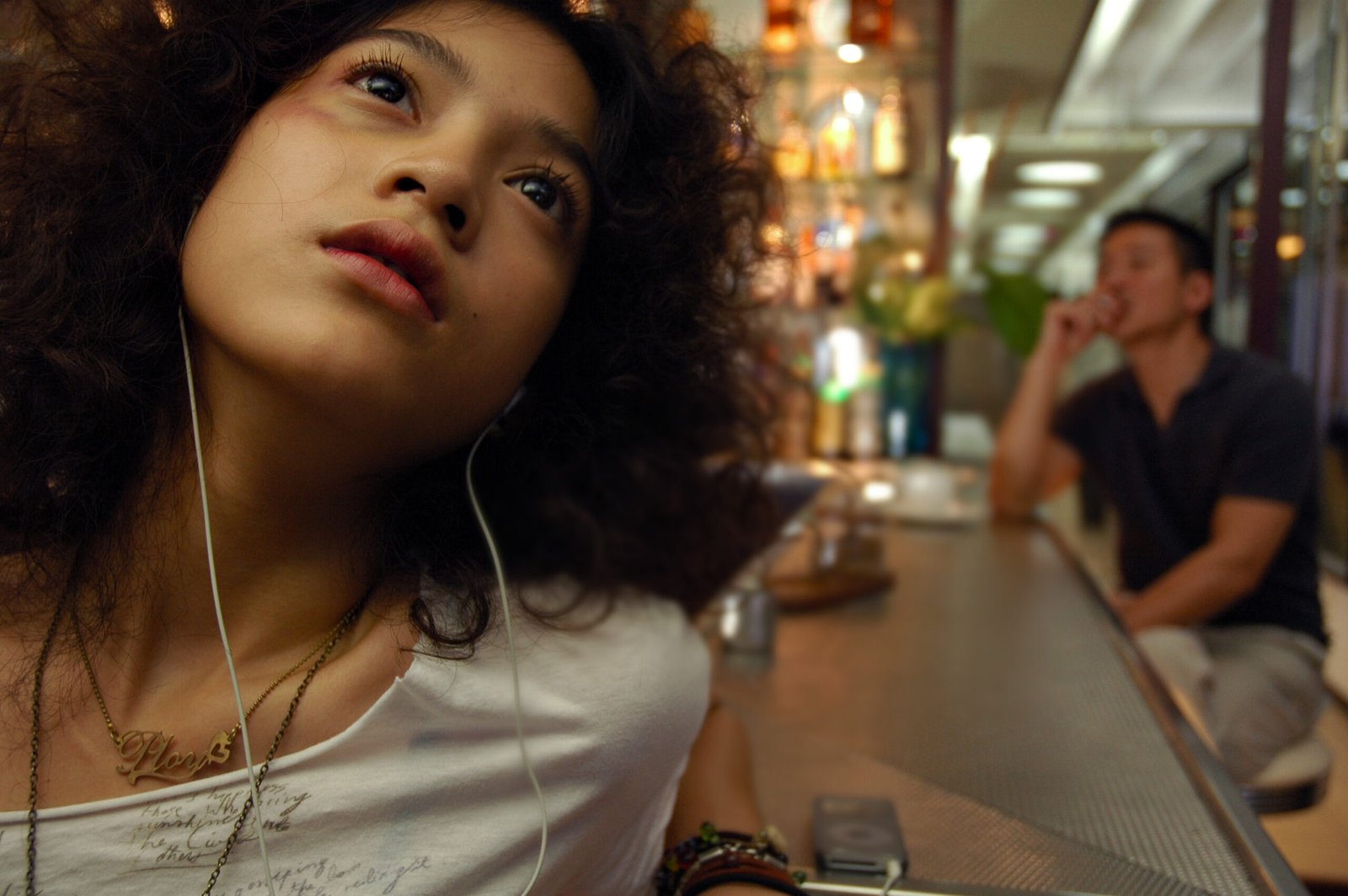
Ploy is a popular Thai female name meaning something rare and precious. Ploy is a synonym of the words scheme or trick. Ploy is also the title of Pen-ek Ratanaruang’s feature film, which premiered at the Cannes Film Festival in 2007. The film was screened at the 3rd edition of the Five Flavours Asian Film Festival (3. Film Festival “Cinema in Five Flavours”) as part of the unofficial Ratanaruang Retrospective. Now, celebrating the 20th edition of the festival, the film returns to the Polish silver screen as part of the Anniversary Section.

Wit (Pornwut Sarasin) and Dang (Lalita Panyopas) return to Bangkok after 10 years of living in the United States to attend the funeral of a relative. They are both jet-lagged and tired – Dang tries to sleep it off, while Wit, on the other hand, drinks it off in the hotel bar. It is there that he meets Ploy (Apinya Sakuljaroensuk), a 19-year-old girl who is waiting for her mother. Not wanting the girl to wait alone in the lobby, Wit invites her to take a shower and a nap in their room. That, however, does not sit well with his wife, which gradually leads to the uncovering of hidden jealousy, unspoken frustrations, and oneiric desires.
While the three characters locked in the room of 603 are on the on-and-off journey through sleeping, just a few rooms away, in room 609, the bartender from the hotel bar and the maid are having a sensual sex session that comes and goes on screen throughout the narrative. When one person wakes up, something else either stops or starts happening, leaving viewers confused about what is actually real and what is just part of the characters’ dreams. Ratanaruang’s “Ploy” was censored in Thailand, and most of the sex scenes between the bartender and the maid were cut, which perhaps made the it feel less dreamlike than the uncensored version.
The whole film is rather slow and quiet – one could easily drift off just like the characters, especially if jet-lagged or tired like them. But at the same time, the unspoken tension between some characters, and the surprisingly tensionless atmosphere between others, can easily immerse viewers in the narrative without boring them. “Ploy” is, after all, anything but boring.
It’s quiet – but not soundtrackless. The ambient-like sound by Hualampong Riddim and Koichi Shimizu fits smartly with what is happening on screen: in some scenes meditative, in others sensual or even suspenseful. There are also moments when actual music plays through the headphones as the characters listen to it. And then the piercing quietness is interrupted by Job Bunjob’s 2000 reggae song “Luem Mai Long”.
“Ploy” is intimate – but not revealing. That’s because of the camerawork by Chankit Chamnivikaipong, whose many shots were filmed from the outside or from behind. When Dang is preparing the bed, we see her doing it from outside the hotel window; when she talks on the phone, half the frame is hidden behind the wall; when Wit meets Ploy for the first time in the bar, the camera stands far away, as if wanting to give them some privacy before revealing all their secrets to the audience. This decision creates a certain distance between the characters and the viewers, while also turning the viewers into voyeurs.
The film is alluring – but not lustful. The characters are restrained in their desires, and the actors subtly portray them without unnecessary melodramatic outbursts. The most surprising is Apinya Sakuljaroensuk’s portrayal of Ploy. During the shooting, the actress was only 16 years old, which is why costume designer Visa Khongka decided to style her hair in an afro to make her look older. Her young age didn’t stop her from playing a serious, half-innocent, half-scheming girl. Her natural chemistry with Pornwut Sarasin, who plays Wit, also added to the feeling of tensionless tension – everything feels safe and comfortable between them, even though the relationship between an older man and a barely adult girl shouldn’t feel that way. All of this was spiced up by Lalita Panyopas’s performance of Dang, who is calmly frustrated and hopelessly naive, but at the same time the most rational of the three. Or so she thinks.
“Ploy” is ultimately a film that, even after 19 years, doesn’t feel old at all. Ratanaruang mentioned that he wanted to tell the story of people returning to their own country and no longer feeling at home – having stayed in the hotel instead of their own house makes them, after all, almost strangers. Being in between – in a hotel, jet-lagged, not sleeping during the waking hours – can create a feeling of not fitting in anywhere. Through accidental meetings, hellos and goodbyes, and with the opening and closing scenes being almost parallel, Ratanaruang managed to achieve this oneiric feeling – of being both asleep and awake, neither quite local nor quite a stranger – with great success.