







Agentic Artificial Intelligence in Retail & Ecommerce Market
Rockville MD, November 17, 2026
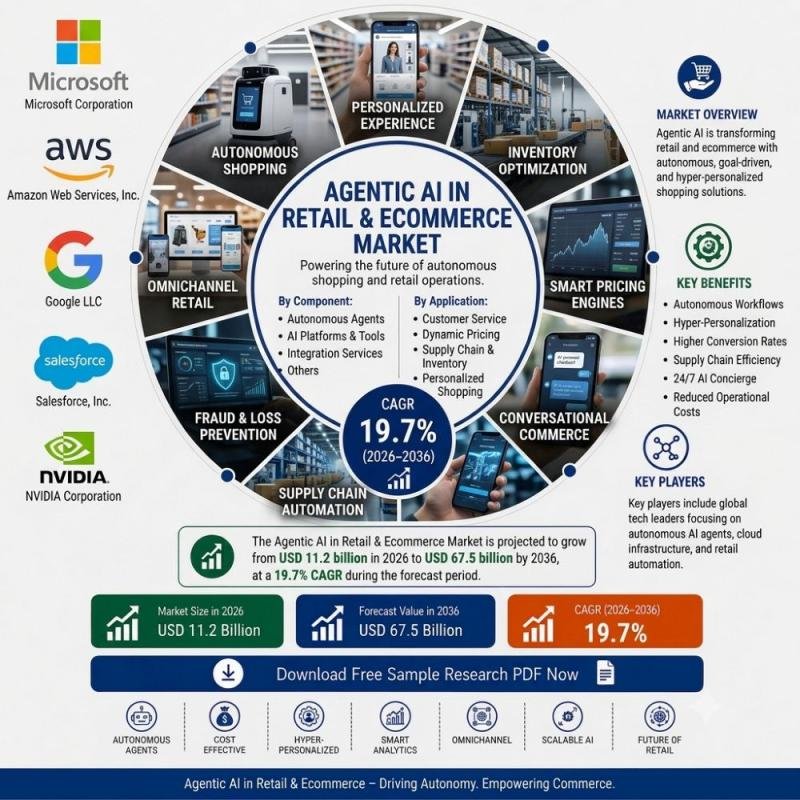
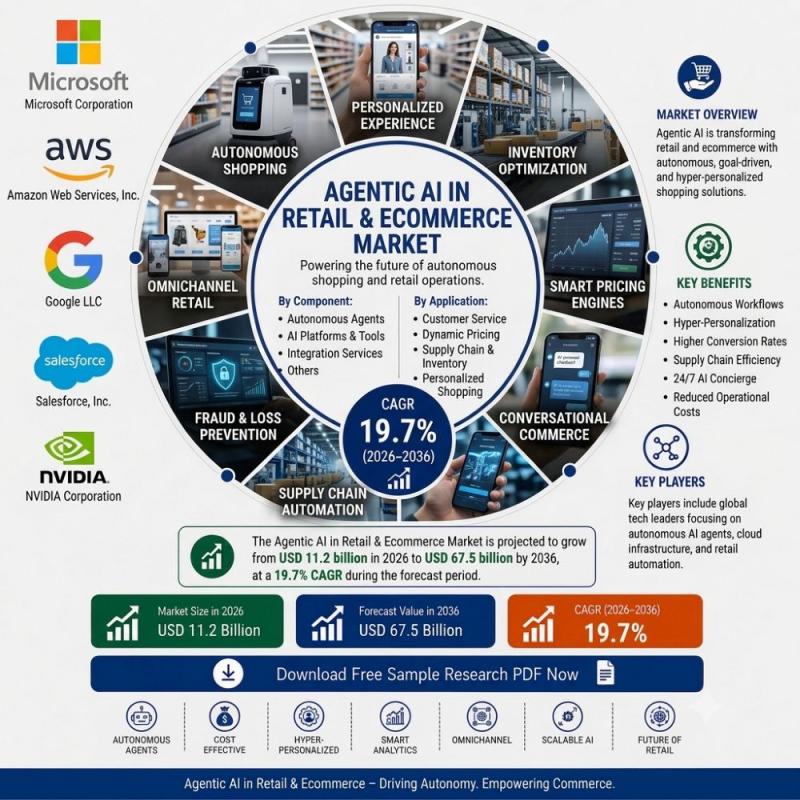
The global Agentic Artificial Intelligence in Retail and Ecommerce Market is valued at USD 11.2 billion in 2026 and is projected to reach USD 67.5 billion by 2036, expanding at a 19.7% CAGR from 2026 to 2036, according to Fact.MR. Growth is being driven by rising AI-mediated shopping traffic, increasing demand for personalized product discovery, growing ecommerce activity, and the integration of AI agents into commerce workflows. For retailers, ecommerce platforms, and technology providers, demand is shifting toward governed AI agents that can connect product discovery with transactions, customer service, fulfillment, and other measurable retail outcomes.
Request a FREE Sample Report: https://www.factmr.com/connectus/sample?flag=S&rep_id=15994
The Short Version
USD 11.2 billion to USD 67.5 billion: The Agentic Artificial Intelligence in Retail and Ecommerce Market is projected to expand at a 7% CAGR from 2026 to 2036, supported by AI-mediated shopping, ecommerce expansion, and agent integration.
Shopping Assistant Agents lead: Shopping Assistant Agents represent the leading AI Agent Category with a 0% share in 2026, while Personalized Shopping accounts for 37.0% of demand within Retail Function.
USA leads country growth at 21.4% CAGR: The USA records the highest country-level CAGR disclosed by Fact.MR, followed by the UK at 20.6% and Singapore at 19.9%.
Three Numbers That Matter
USD 67.5 billion by 2036 – The projected market value highlights the expanding commercial role of agentic AI as retailers connect autonomous systems with product discovery, customer engagement, transactions, and service workflows.
40.0% Shopping Assistant Agents share – Shopping Assistant Agents represent the leading AI Agent Category in 2026 because they sit closest to product discovery and purchasing decisions.
21.4% USA CAGR – The USA records the fastest country-level growth rate disclosed by Fact.MR, supported by high transaction volumes and the adoption of agentic AI through commerce platforms and cloud programs.
Market Segmentation and Demand Analysis
The Agentic Artificial Intelligence in Retail and Ecommerce Market covers AI systems, services, and software across AI Agent Category, Retail Function, End-use Sector, Customer Type, Deployment Framework, and Region. Key AI Agent categories include Shopping Assistant Agents, Inventory Intelligence Agents, Marketing Automation Agents, and Order Fulfillment Agents.
Shopping Assistant Agents represent the leading AI Agent Category with a 40.0% share in 2026. These agents can translate broad shopper intent into product criteria, compare available assortments, use current inventory and customer context, and support product selection closer to the point of purchase.
By Retail Function, Personalized Shopping leads with a 37.0% share. Agentic systems can ask follow-up questions, adjust search strategies, and explain why products fit a customer’s stated requirements.
E-commerce Retailers dominate the End-use Sector with a 46.0% share in 2026, reflecting the digital nature of online product discovery and transactions. Large Retail Enterprises lead the Customer Type segment with a 43.0% share, while Cloud-native AI Agents hold a 49.0% share within the Deployment Framework segment.
Where Growth Is Strongest
USA
The USA records a 21.4% CAGR from 2026 to 2036, making it the fastest-growing country among the markets with country-level forecasts disclosed by Fact.MR.
Large American retailers are purchasing agentic AI through commerce platforms and cloud programs that can be tested against high transaction volumes. Ecommerce accounted for 16.9% of U.S. retail sales in the first quarter of 2026, providing retailers with a substantial transaction and data base for governed shopping and service agents.
UK
The UK is projected to expand at a 20.6% CAGR through 2036, supported by the integration of customer-facing AI with established omnichannel and consumer-service processes.
Retailers can connect new agentic technologies with existing commerce infrastructure, creating opportunities for product discovery, customer engagement, and service applications.
Singapore
Singapore is projected to register a 19.9% CAGR, supported by a concentrated digital ecosystem and expanding AI adoption among businesses.
The country’s digitally mature environment provides a base for retailers to move from packaged AI tools toward more specialized agents capable of supporting commerce and customer workflows.
Explore the Full Market Research Report: https://www.factmr.com/report/agentic-artificial-intelligence-in-retail-and-ecommerce-market
Market Dynamics: Drivers, Trends and Challenges
Growth Drivers
Retailers need to convert conversational intent into product discovery and completed transactions. Agentic AI can move beyond providing information by connecting customer requests with product data, recommendations, cart actions, and transaction workflows.
AI-mediated shopping traffic is creating a measurable basis for agent investment. Rising traffic from AI sources gives retailers new opportunities to evaluate agentic experiences against conversion and engagement metrics.
Commerce platforms are embedding agents and connectors into retail workflows. Platform providers are increasingly giving retailers access to agentic capabilities that can integrate with existing commerce and customer-service systems.
Rising ecommerce activity is broadening the base of retailers capable of deploying transaction-ready AI agents.
Emerging Trends
The market is moving toward agent-ready product catalogs and governed transaction tools that allow AI systems to ground answers in approved product information and pass selected items into checkout or service workflows.
Personalized and conversational shopping is another major trend. Unlike conventional recommendation engines, agentic systems can ask follow-up questions, adjust search strategies, and explain product fit based on customer context.
Retailers are also exploring interoperable agent frameworks, identity controls, permissions, audit logs, and multi-system integration as autonomous systems become more closely connected with commercial records.
Challenges and Opportunities
The gap between demonstrations and controlled production deployment remains a major restraint. Fragmented product data, inconsistent permissions, and weak control over autonomous actions can delay enterprise approval.
Integration and monitoring costs can also exceed the value created by a targeted workflow. Retailers therefore need to connect agent deployments with measurable outcomes such as conversion, service time, fulfillment, and returns.
Who Is Moving
The competitive landscape includes cloud providers, commerce platforms, enterprise application vendors, customer experience providers, AI infrastructure companies, and transformation specialists.
Key companies identified by Fact.MR include Microsoft Corporation, Amazon Web Services, Inc., Google LLC, Salesforce, Inc., Oracle Corporation, IBM Corporation, Adobe Inc., SAP SE, NVIDIA Corporation,and Infosys Limited.
Competition is increasingly centered on cloud scale, commerce applications, enterprise connectors, customer data, experience orchestration, AI infrastructure, and implementation services.
Recent Developments
Fact.MR highlights several developments shaping the agentic retail ecosystem. Salesforce announced Agentforce for Retail in January 2025, while Adobe launched Experience Platform Agent Orchestrator in March 2025.
NVIDIA announced a blueprint for AI retail shopping assistants in January 2025. Google Cloud and PayPal introduced an agentic commerce solution for merchants in October 2025.
Where to Act / Where to Be Careful
Where to Act
Prioritize Shopping Assistant Agents for product discovery and conversational commerce.
Target Personalized Shopping, the leading Retail Function segment.
Build agent-ready product catalogs and governed transaction tools.
Connect AI agents with identity, permissions, and audit systems.
Measure deployments against conversion, service time, fulfillment, and returns.
Explore the USA’s 4% CAGR opportunity alongside the UK and Singapore.
Develop interoperable systems that connect AI reasoning with commercial-record platforms.
Where to Be Careful
Account for fragmented product data and inconsistent permissions.
Evaluate integration and monitoring costs before expanding deployments.
Establish controls before allowing agents to take autonomous commercial actions.
Avoid deploying agents without clear business metrics.
Ensure AI systems can work with existing retail, commerce, and enterprise infrastructure.
Analyst Perspective
The supplied Fact.MR report identifies Ganesh Pai, Principal Consultant, as the lead analyst for the study. The report also provides an analyst opinion from Shambhu Nath Jha, Senior Consultant at Fact.MR.
The report states: “Retail is where agentic AI most directly meets revenue, because product discovery creates a measurable link between an agent interaction and a purchase.” It further emphasizes the need for agent-ready catalogs, governed transaction tools, and interoperable frameworks as retailers move from demonstrations toward controlled production deployment.
Questions for Your Next Planning Meeting
Which retail workflows can connect agent activity directly to conversion, service time, fulfillment, or returns?
Is product and customer data sufficiently structured for agents to operate within approved business rules?
Which deployment framework can provide the required balance between autonomy, integration, permissions, and auditability?
Top Trending Reports
Related Fact.MR Reports:
Time-Sensitive Networking Modules Market https://www.factmr.com/report/time-sensitive-networking-modules-market
C-Band LNB Market https://www.factmr.com/report/c-band-lnb-market
Screen-Free AI Learning Devices Market https://www.factmr.com/report/screen-free-ai-learning-devices-market
Optical Transceiver Modules Market https://www.factmr.com/report/optical-transceiver-modules-market
Fact.MR
11140 Rockville Pike, Suite 400
Rockville, MD 20852, United States
Email: sales@factmr.com
Tel: +1 (628) 251-1583
Fact.MR is a market intelligence and business research firm providing market intelligence, competitive analysis and forecasting across global industries. Its research combines desk research with supplier, buyer and expert validation to assess market boundaries, adoption patterns, pricing, competitive positioning and regional demand.
This release was published on openPR.