







The M.S. in Environment and Sustainability Management (ESM) program – jointly offered by Georgetown’s McDonough School of Business and Earth Commons Institute – is a 10-month, STEM-designated program that combines environmental science with business management. It consistently brings together students with a wide range of academic backgrounds, international perspectives, and shared ambitions to address environmental and sustainability challenges.
Entering its fifth academic year, the ESM program explores topics ranging from climate impact measurement and environmental data analysis to sustainable operations, finance, and business strategy. The class of 2027 contains 39 students that represent 12 countries and speak 22 languages.
The average age of incoming students is 26, and they boast an average undergraduate GPA of 3.6 with 2.4 years of professional experience.

Statistics about the newest ESM program class that includes lists of average demographics, common undergraduate fields of study, and the industries represented.
“The incoming Georgetown ESM class offers different experiences, perspectives, and areas of expertise, creating opportunities to learn from one another both inside and outside the classroom,” said Nita Swinsick, associate dean of graduate and executive program admissions. “In sustainability management, where addressing complex challenges requires collaboration across disciplines, industries, and cultures, that diversity of thought is especially valuable. Learning alongside peers with different backgrounds and viewpoints allows students to broaden their understanding of the issues and approaches needed to create meaningful change.”

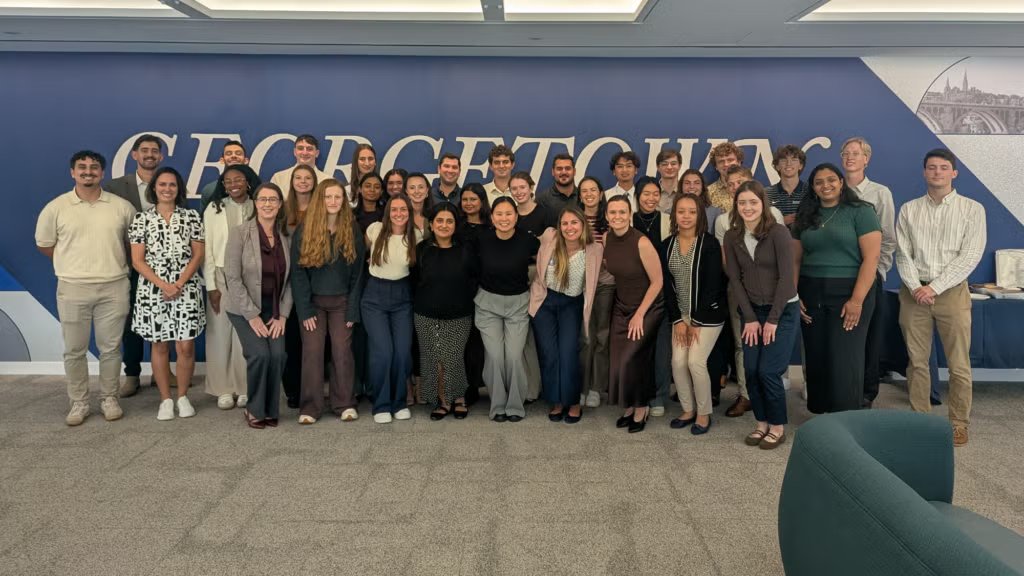
Group photo of 2027 ESM cohort
From Classroom Learning to Real-World Impact
Throughout the program, students apply their learning to practical challenges. The capstone course brings students together in teams to work with partner organizations: identifying opportunities and developing solutions to sustainability-related business problems. The experience allows students to integrate their scientific and business knowledge while strengthening their problem-solving, analytical, and communication skills.
Where Our Students Land Jobs
|
Top Industries |
Top Functions |
|---|---|
|
Consulting |
व्यवसाय |
|
Energy |
Consulting |
|
Government and NGOs |
Data Analytics |
|
Manufacturing |
General Mangement |
| Nonprofit |
Logistics |
| Supply Chain Management |
Operations |
| प्रौद्योगिकी |
Strategic Planning |
Based on Georgetown’s Capitol Campus in downtown Washington, D.C., the program also connects students with a university community spanning business, environmental research, and policy. Students benefit from individualized career coaching and a dedicated career services director through the McDonough Career Center, which prepares graduates to enter a variety of fields. The following statistics reflect averages within six months of degree conferral:
$82,676Average SalaryClasses of 2023, 2024, and 2025
$90,00075th PercentileClasses of 2023, 2024, and 2025
$85,713For-Profit Sector Average SalaryClasses of 2023, 2024, and 2025
$77,957Non-Profit SectorClasses of 2023, 2024, and 2025
There are also opportunities to engage with organizations and experts working across the sustainability landscape through the Business of Sustainability Initiative, which offers co-curricular programming, networking opportunities, and events to further enrich their professional and academic development.
Together, the program’s interdisciplinary curriculum, experiential learning opportunities, and close-knit cohort prepare graduates to pursue careers at the intersection of environmental sustainability and business, helping organizations create value while addressing pressing global challenges.
An Interdisciplinary Foundation for Sustainability
The incoming class reflects the interdisciplinary nature of sustainability itself. More than half of students earned undergraduate degrees in environmental, sustainability, and life sciences fields. The full list of academic backgrounds in this program include:
- environmental, sustainability, and life sciences (59%)
- economics (15%)
- social and behavioral sciences (10%)
- engineering (5%)
- communications and journalism (5%)
- business (3%)
- other fields (3%)
This breadth of experience aligns with the ESM program’s core mission: equipping future leaders with the scientific knowledge and business acumen to develop practical solutions to environmental challenges.
“Georgetown’s ESM program is distinctive for its intentional integration of environmental science and business principles, preparing students to understand sustainability challenges and translate that knowledge into action,” said Kerrie Carfagno, program director of the ESM program. “Through a rigorous curriculum and hands-on capstone experience with real-world organizations, students develop the analytical and strategic skills to help organizations navigate complex sustainability issues and advance meaningful solutions.”
Learn more about Georgetown’s M.S. in Environment and Sustainability Management.