









Listen to this article
Estimated 3 minutes
The audio version of this article is generated by AI-based technology. Mispronunciations can occur. We are working with our partners to continually review and improve the results.
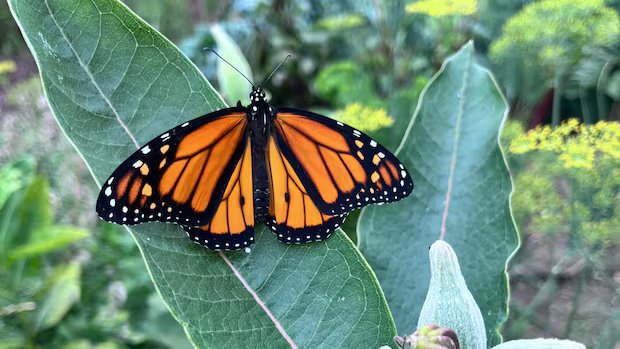
A monarch butterfly from Manitoulin Island, Ont., has become a local celebrity after completing a historic journey across North America that ended in Mexico this month.
Travelling more than 3,300 kilometres in 70 days, the majestic insect achieved a feat that scientists previously thought impossible: flying over two Great Lakes.
The young female butterfly, referred to as MAN26021, was among dozens tagged by researchers with Environment and Climate Change Canada and the Canadian Wildlife Federation on Manitoulin Island in late August.
It was part of a study to observe the insects’ migratory behaviours and flight patterns.
Tags attached to their thorax transmitted information through solar-powered radio transmitters.

A monarch butterfly tagged with a solar-powered radio transmitter, a tiny device weighing less than a grain of rice. (Manitoulin Nature Club)
Joe Shorthouse, a retired entomologist from Laurentian University and long-time butterfly researcher, said he and his colleagues were able to track MAN26021 through the Project Monarch app.
This young monarch — about the same weight as a paper clip — flew across Lake Huron and Lake Michigan before traversing the U.S. to reach the Reserva de la Biosfera Mariposa Monarco overwintering site, about 100 kilometres northwest of Mexico City.
Shorthouse called it a tremendous success story in the natural world.
“We learned for the very first time in history that they can fly across the Great Lakes,” he said. “That comes as a huge surprise to everyone.”
Over its 10-week journey, the butterfly would have avoided dangers that kill most monarchs —including vehicles and poor weather — Shorthouse noted.
Throw in some travel over a couple Great Lakes, and the odds of this achievement are even more baffling, he said.
“It’s one of the world’s most puzzling and complex stories that we still do not understand. How can it fly that far and how do they know how to get there?”
The Manitoulin Nature Club, which has been operating on the island for 47 years, expressed pride in hosting the starting point in the butterfly’s long expedition.
The club’s president Phyllis Cacciotti said the feat is a reminder of how powerful nature can be, even in its tiniest forms.
“It’s very inspiring. They’re warriors,” she said.
“We’re very fortunate here on Manitoulin Island because we have beautiful biodiversity, and we need to protect and preserve it for future generations.”

Monarch butterflies were measured and tagged on Manitoulin Island over the summer before journeying towards Mexico for the winter. (Manitoulin Nature Club)
The Manitoulin butterfly is now among thousands settling down for the winter in the oyamel fir trees within the mountains of Mexico.
Shorthouse said hopefully their prized butterfly will mate in the spring and fly as far north as Texas where she would lay her eggs and then die.
But her legacy would live on.
The butterfly’s offspring would travel north, perhaps as far as the upper U.S. states, before repeating the same cycle.
“It will be the grandchildren of MAN26021 that we’ll see on the shores of Manitoulin Island in May of 2027.”