








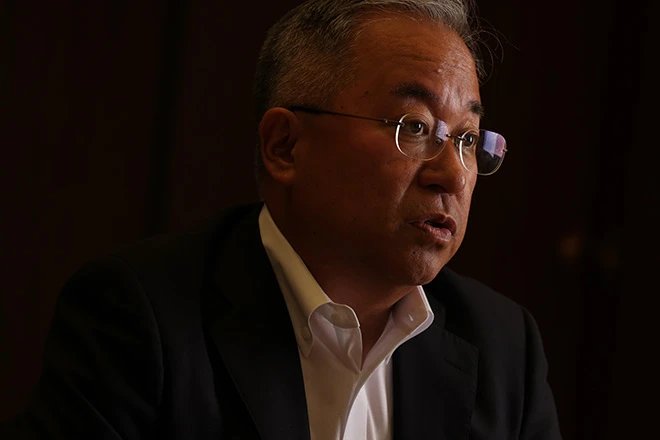
The former highest-ranking uniformed officer in the Self-Defense Forces said as the United States is increasingly prioritizing its own national interests, he believes that U.S. politics has become a “variable.”
In an interview with The Asahi Shimbun, Yoshihide Yoshida talks about what course Japan should follow in an era marked by the growing prevalence of “rule by force” exhibited by the major powers.
Yoshida formerly served as chief of staff of the Joint Staff, the first officer educated at a civilian university to hold the post.
In April this year, he became the first career SDF officer to be appointed president of the National Defense Academy.
Excerpts of the interview follow:
PREVENTING ’HOT WAR’ IN THE INDO-PACIFIC
Question: Wars and conflicts are erupting across the globe. Having watched these crises unfold from the front lines, how do you view the current era?
Yoshida: Since 2022, when Russia launched its invasion of Ukraine, the international community has entered what can be described as an era of power politics, in which major powers increasingly prioritize the use of force.
I believe we may be entering a period reminiscent of The Twenty Years’ Crisis, in which the British historian E. H. Carr depicted the interwar period between World War I and World War II.
There is a saying that “history does not repeat itself, but it rhymes.” We stand at a watershed moment that will determine whether we repeat the tragic history experienced a century ago.
During the U.S.-Soviet Cold War, Europe was indeed in a state of “cold war.” In Asia, however, there were hot wars such as the Korean War and the Vietnam War.
The Middle East also experienced four major wars. Today, with hot wars already underway in Europe and the Middle East, our greatest security challenge through the middle of the 21st century is how to prevent a hot war from breaking out in the Indo-Pacific.
U.S. POLITICS HAS BECOME A ‘VARIABLE’
Q: The United States, Japan’s only treaty ally, has appeared increasingly inconsistent in its strategic approach under the Trump administration.
A: The United States formulated a National Security Strategy at the end of last year and stated that its highest strategic priority is the Western Hemisphere.
In that sense, its recent strike on Iran could be viewed as a departure from its stated grand strategy. For many years after World War II, the United States served as the leader of a value system that sustained the liberal international order.
Today, however, it places less emphasis on that value system and increasingly prioritizes national interests, frequently resorting to the use of force. In that sense, I personally believe it is fair to say that U.S. politics has become a variable.
Q: A variable?
A: However, as China continues to rise, it is also true that the U.S. military commitment to the Indo-Pacific remains indispensable to the balance of power in the region. If that commitment were lost, the balance of power would collapse and our security could no longer be assured.
For Japan, the highest strategic priority is how to keep the United States engaged in this region.
Q: The Japanese government is set to revise the three security strategy documents that underpin its defense buildup later this year.
A: At a time when the United States is increasingly concerned about the burden of its alliance commitments, Japan needs to take on a larger share of responsibilities within the alliance and further strengthen its defense capabilities.
At the same time, alongside the Japan-U.S. alliance, we must deepen cooperation with like-minded partners. The Indo-Pacific has already seen the emergence of various multilateral networks, including Japan-U.S.-ROK cooperation, the Japan-U.S.-Australia-India framework, and Japan-U.S.-Australia-Philippines cooperation.
In addition, closer cooperation with Europe, including NATO member states, is necessary.
PRINCIPLE OF A ‘STRATEGIC DEFENSIVE POSTURE ESSENTIAL’
Q: Under the Japan-U.S. alliance, the Self-Defense Forces have traditionally served as the “shield,” while U.S. forces stationed in Japan have functioned as the “spear.”
However, the SDF is now assuming some missions previously performed by U.S. forces and is acquiring strike capabilities such as long-range missiles. Will Japan’s long-standing policy of exclusively defense-oriented defense, rooted in Article 9 of the Constitution, still be maintained?
A: I believe that maintaining a strategic defensive posture is critically important. The most important principle is that Japan must remain a country that does not itself pursue a strategy of offensive operations against foreign nations.
VALUES-BASED REALISM ADVOCATED BY FINNISH PRESIDENT
Q: Some have called for a review of the Three Non-Nuclear Principles, Japan’s long-standing policy of not possessing, not producing, and not permitting the introduction of nuclear weapons into its territory. Based on your experience, do you believe such a review is necessary?
A: Japan’s National Security Strategy clearly states that “the basic policy of upholding the Three Non-Nuclear Principles will remain unchanged.” I believe that says it all. What is important is how we can ensure the credibility of extended deterrence provided by the United States, including the nuclear umbrella.
To that end, we should focus our efforts on strengthening extended deterrence by expanding the areas in which Japan can act independently through conventional capabilities and by pursuing appropriate Japan-U.S. joint escalation management in the event of a contingency.
Q: The international community increasingly resembles a jungle where might makes right, as major powers undermine the rule of law and resort to coercion. What do you see as Japan’s grand strategy for navigating such an environment?
A: When I met Finnish President Alexander Stubb, he spoke about the importance of “values-based realism.” In an era of power politics, the center of gravity naturally shifts toward realism, which places greater emphasis on power.
However, rather than abandoning liberalism and its emphasis on values such as the rule of law, we should work, in cooperation with the international community, toward the revitalization of liberalism itself while seeking a balance between realism and liberalism. I believe that is what is important.
* * *
Born in 1962, Yoshihide Yoshida graduated from the University of Tokyo’s Faculty of Engineering in 1986 and joined the Ground Self-Defense Force the same year. He served as a Cabinet counselor at the National Security Secretariat and as chief of staff of the Ground Self-Defense Force before serving as chief of staff of the Joint Staff from 2023 to 2025. He became president of the National Defense Academy in April 2026.