






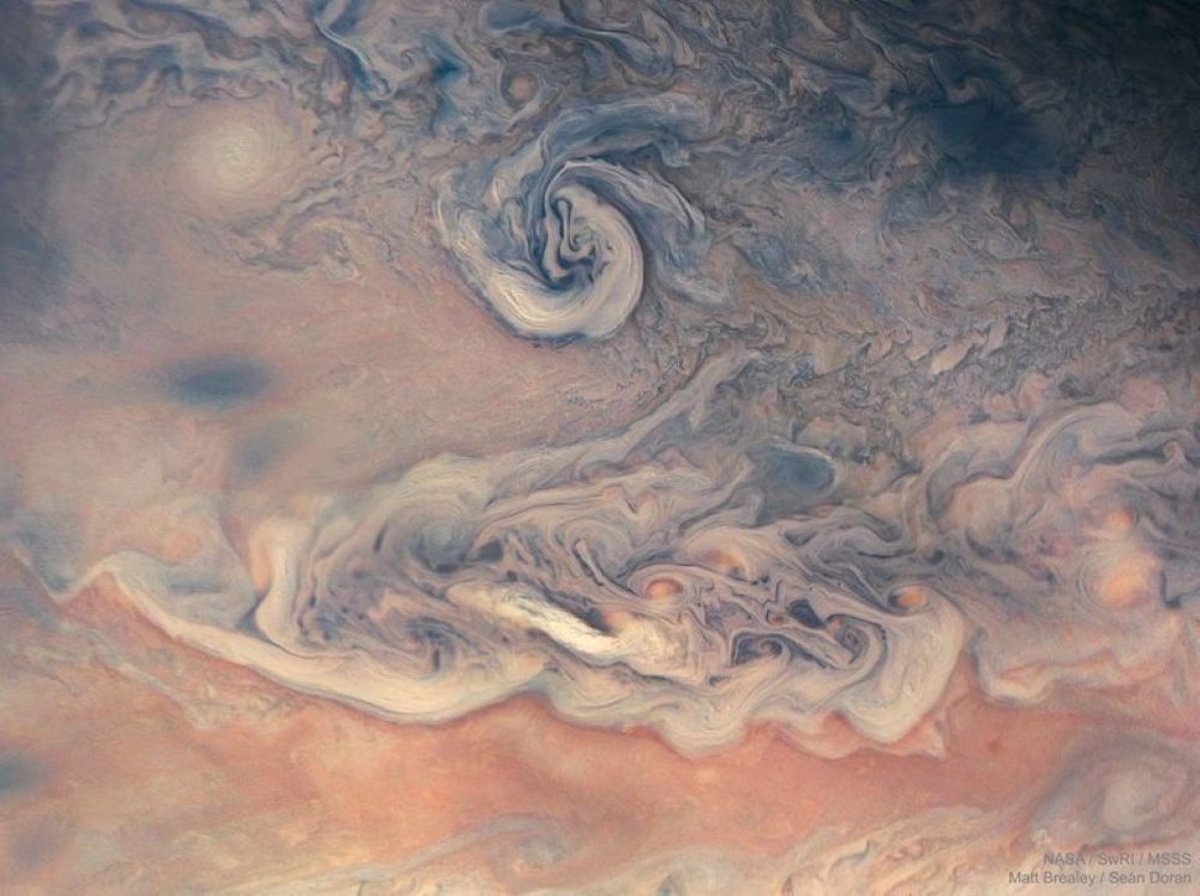

NASA’s Astronomy Picture of the Day for Sunday, Nov. 22, reruns a Juno spacecraft image of Jupiter’s clouds from 2018, and its caption still says which trace molecules provide the planet’s colors remains a topic of research. The caption’s chemistry has not changed since 2018, but research posted in 2025 and 2026, including a February Great Red Spot model and a July equatorial cloud analysis, has split that one open question into two: which compound colors the clouds, and how deep in the atmosphere it sits.
For readers, the practical upshot is narrow but useful: lighter clouds usually sit higher than darker ones in Juno pictures, but the molecule behind the red and brown hues remains debated among researchers, so a picture’s colors mark chemical differences without naming the chemicals.
NASA Reran Its Nov. 21, 2018 Juno Picture With Two Caption Updates
The image file name, title, credits and caption match the Nov. 21, 2018 entry, apart from two updated details. Both versions credit NASA, Juno, SwRI and MSSS for the data and Matt Brealey and Seán Doran for processing, under a CC BY-NC 3.0 license. The 2018 caption said Juno took the picture earlier that year and passes close to Jupiter every 53 days; the 2026 caption says it was taken in 2018 and that Juno passes every 33 days. Flybys of Jupiter’s moons during Juno’s extended mission shorten its orbit.
The caption describes light clouds swirling around reddish regions toward the lower right and appearing to cover darker areas toward the upper right. NASA’s release for a different image from the same pass, taken at 1:28 a.m. ET on July 16, 2018, puts Juno about 4,900 miles (8,000 kilometers) above the cloud tops at 36 degrees south latitude. Other outlets at the time gave different closest-approach distances: GeekWire reported about 2,200 miles (3,500 kilometers) and Space.com about 3,900 miles (6,000 kilometers).
On the 2026 page, the link labeled “topic of research” opens a stock photo of a dog rather than a paper; the 2018 version linked to an image file named Dog_teacher.jpg.
Hydrogen and Helium Carry No Color, So Trace Chemistry Must
Jupiter’s atmosphere is mostly hydrogen and helium, which are colorless at cloud-top temperatures, so trace compounds must supply the color. Chemists call the color-carrying part of a molecule a chromophore: it absorbs some visible light, and the eye sees what remains. In one 2026 model, chromophore particles cause the blue absorption seen at visible wavelengths.
Color also tracks cloud height. A 1981 Journal of Geophysical Research analysis ranked white clouds, presumably ammonia ice, highest, with tawny and brown clouds lower and tentatively tied to ammonium hydrosulfide. A preliminary 2026 model places an upper cloud about ten times less opaque than the main deck near 0.55 bar (8 psi), above a thick lower deck near 1 to 2 bar (15 to 29 psi) that holds most of the cloud opacity; one bar approximates Earth’s sea-level air pressure.
What Gives Jupiter’s Clouds Their Colors? Three Chemical Families Compete
A 2025 conference abstract first-authored by Lora Jovanovic says the identity of Jupiter’s red chromophore is still debated after more than 50 years of spacecraft and telescope observations. It sorts the candidates into three groups: sulfur compounds, phosphorus compounds, and organic compounds from methane and ammonia photochemistry.
The same abstract calls the organic compound that Carlson and colleagues made in 2016 by shining ultraviolet light on ammonia and acetylene the most promising candidate, while warning that it remains uncertain because aerosol properties can trade off in radiative-transfer models and earlier measurements were limited. The team made two new analogs in NASA Ames’s COSmIC chamber and measured how they absorb and scatter light to test that comparison.
Ammonium Hydrosulfide Lab Spectra Match Great Red Spot Only Partly
NASA’s caption names ammonium hydrosulfide as one leading candidate, though only small amounts are thought to be present. A 2016 Icarus paper by Mark Loeffler, Reggie Hudson, Nancy Chanover and Amy Simon irradiated ammonium hydrosulfide ice, chilled to 120 kelvins (about -244°F), with protons at a dose the authors equate to roughly 150 years of Jovian cosmic-ray exposure. The sample developed new light absorption and looked green until warming to about 200 kelvins (about -100°F) erased that color.
The lab spectra resembled Hubble spectra of the Great Red Spot at bluer wavelengths but looked less orange than the real storm, so the authors say another component may be needed, and they describe researchers as still lacking agreement on a single chromophore. Loeffler, an astrochemist at Northern Arizona University, told Space.com in 2018 that models predict the salt is the third most abundant cloud component, behind ammonia and water; the outlet called it a primary suspect, not a confirmed cause, and noted it decomposes quickly under typical Earth conditions, which makes it hard to study.
Ammonia-Acetylene Product Became Favorite, Then February 2026 Model Questioned Supply
A 2017 Icarus study by Sromovsky and colleagues fit Cassini spectra of the Great Red Spot and other features using a thin layer of small particles of that lab-made ammonia-acetylene product sitting just above the main cloud layer. The model reproduced color differences among the belts, the equatorial zone and the Great Red Spot, yet its title says “possibly” universal, and whether the compound is the real coloring agent stayed tentative.
A 2019 analysis by Ashwin Braude and colleagues of Very Large Telescope MUSE data found that a single chromophore could fit the blue absorption in both the North Equatorial Belt and the Great Red Spot, though it needed a steeper blue-absorption gradient than the Carlson compound provides. The abstract places the particles no deeper than about 0.2 bar (3 psi) in the storm and about 0.7 bar (10 psi) elsewhere, and a universal chromophore could not explain variability in green light.
A February 2026 preprint by Asier Anguiano-Arteaga and eight co-authors simulated the reddish haze above the Great Red Spot and found that sustaining it needs production rates above what standard ammonia-acetylene photochemistry at 0.1 to 0.2 bar (1.5 to 3 psi) supplies, with a lower limit of 7 years to form the haze. The authors describe that route as the most popular chromophore pathway in recent literature.
Competing Models Disagree on Which Cloud Depth Holds Color Carriers
The Crème Brûlée model, from Baines and colleagues in 2019, places the chromophore in the upper cloud, formed where upwelling ammonia meets acetylene sinking from above and photolysis produces the color-maker, according to Irwin’s 2026 preprint description.
On July 28, a preprint by Patrick Irwin and 10 co-authors, combining Very Large Telescope, Cassini, NASA Infrared Telescope Facility and Juno data, instead places the blue-absorbing particles inside the thick lower cloud of Jupiter’s equatorial region, most likely in a region near 1.5 to 1.7 bar (22 to 25 psi), and says no separate upper photochemical haze is needed. The authors call the lower cloud’s identity speculative, saying its spectral properties are only possibly consistent with water ice.
That depth does not settle the chemistry. A companion abstract from the same group says the sharp drop in ammonia at the lower cloud may reflect a water-ammonia “mushball” cloud, an ammonium hydrosulfide cloud, or both, and it flags the attribution as tentative. Depth and composition remain separate questions, so NASA’s 2018-era suspect is neither confirmed nor ruled out.
JunoCam Builds Color From Spinning Filters, and Volunteers Shape the Final Look
JunoCam is a pushframe imager fixed to the spinning spacecraft: each rotation sweeps filter strips across the scene, and red, green and blue filters supply the color, alongside a methane-band filter centered at 889 nanometers. The APOD page credits MSSS, Malin Space Science Systems, alongside NASA, Juno and SwRI for the image data.
The camera’s color bands were chosen partly for public color reconstruction. JunoCam team head Candy Hansen said the goal was to involve the public in every aspect of what an imaging team ordinarily does, and volunteers such as Brealey, who said in 2016 he was attempting to use software from the visual-effects industry, turn raw frames into the pictures NASA features. Their choices differ: some processors aim to make storms and cloud features easier to see, while others aim for artistic appeal.
The APOD page labels this picture color-enhanced, and a 2022 NASA release says color variation in Juno images results from differing chemical composition. One 2022 version of a Juno frame boosted saturation and contrast, so hue works as a flag for chemical differences, not as a measurement of which chemicals are present.
Team Abstracts Describe Juno’s Second Extended Mission, Planned for October 2025
Juno’s previous extension ran through Sept. 30, 2025, and a U.S. government shutdown began the next day, when NASA said it could not confirm whether the spacecraft was still operating; Space.com also reported that Juno was zeroed out in the President’s fiscal 2026 budget request.
Scott Bolton’s 2025 abstract said a second extended mission would begin in October 2025 and last three years, while noting that the proposal was still under review at the time. Steve Levin’s 2026 abstract refers to new results obtained during that second extended mission. A March 24, 2026 AIAA summary of Ars Technica reporting said NASA officials had not said whether they would approve another extension. The second extended mission is documented here through team conference abstracts rather than a NASA announcement.
Cloud Brightness Signals Altitude While Hue Still Does Not Signal Chemistry
For readers, Sunday’s picture is a rerun of a 2018 image, not new Juno data and not a new rendering. It supports one settled idea, that brighter clouds generally sit higher, and one open question that has become more specific since the caption was written: whether the color-maker is a sulfur compound, a phosphorus compound or an ammonia-acetylene organic, and whether it sits in a thin upper haze or inside the thick lower cloud. Both 2026 papers cited here are arXiv postings, so their conclusions have not necessarily cleared journal review, and neither identifies the chromophore; until one does, the caption’s description of the question as open remains accurate.
Frequently Asked Questions
What gives Jupiter’s clouds their colors?
Scientists have not identified the compound or compounds. Hydrogen and helium are colorless at cloud-top temperatures, so trace chemistry must supply the hues, and a 2025 abstract calls the ammonia-acetylene organic compound the most promising of three candidate groups.
Is NASA’s Nov. 22 Jupiter picture new?
No. NASA used the same image file, title and processing credits on Nov. 21, 2018, and the picture was taken during Juno’s 14th low pass over Jupiter in 2018.
How deep in Jupiter’s clouds does the color-making chemistry happen?
Models disagree. A 2019 fit put the chromophore no deeper than about 0.2 bar (3 psi) in the Great Red Spot and about 0.7 bar (10 psi) elsewhere, per its abstract, while a July 2026 preprint puts the blue-absorbing particles inside the thick lower cloud, most likely near 1.5 to 1.7 bar (22 to 25 psi), in the equatorial region.
Are Juno’s pictures true color?
Not exactly. NASA’s APOD page labels this picture color-enhanced, and volunteers who process the raw frames make their own choices, some to reveal cloud features and others for artistic appeal.