









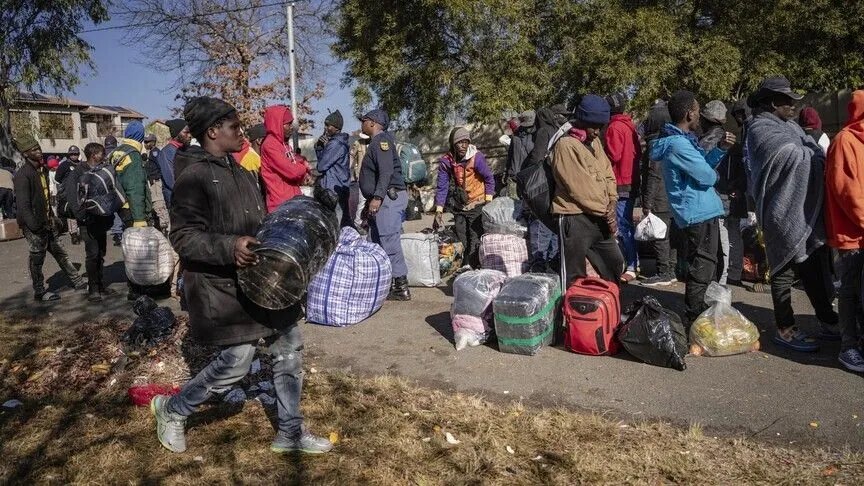
Five EU countries and Rwanda announced Monday that they are exploring the establishment of a return hub for migrants facing removal from Europe, aiming to begin transfers by 2027 and raising questions over legal safeguards and responsibility for those sent outside the bloc.
Germany, Austria, Denmark, Greece and the Netherlands said in a joint statement that they would pursue a “step-by-step approach” to reaching an arrangement with Rwanda.
The governments said the arrangement would comply with “EU, Rwandan and international law,” including human rights obligations.
Austrian Interior Minister Gerhard Karner said: “Starting today, concrete negotiations with partner country Rwanda will begin for the implementation.”
The initiative follows the EU’s adoption of new return rules allowing member states to establish facilities outside the bloc, subject to international human rights obligations.
Who could be transferred to Rwanda?
Under the EU’s new Return Regulation, adopted by the European Council on Oct. 1, member states may transfer non-EU nationals who have no legal right to remain and have received return decisions to facilities in third countries.
The regulation excludes unaccompanied minors from such arrangements.
According to the joint statement, the proposed Rwanda hub would be limited to migrants staying illegally in one of the five participating countries who are subject to enforceable return or removal decisions.
The governments said those transferred would neither qualify for international protection nor have another legal basis to remain in the participating countries.
Unlike non-EU member Britain’s canceled Rwanda scheme, which involved sending asylum seekers abroad for their claims to be processed, the European initiative targets migrants already subject to return procedures.
However, a rejected asylum application does not automatically remove an individual’s entitlement to protection against persecution or serious harm.
What happens after migrants arrive?
Return hubs are generally intended to accommodate people outside EU territory while arrangements are made for their eventual return to their countries of origin.
Under the proposed model, migrants transferred to Rwanda would have an opportunity to integrate into Rwandan society.
They could also voluntarily travel to their countries of origin or another country where they can legally reside or settle.
The joint statement said international organizations and the East African country would support both integration and voluntary return.
The International Organization for Migration (IOM) is providing technical input and, at Rwanda’s request, is prepared to assist migrants with appropriate safeguards, it added.
However, the statement did not specify accommodation arrangements, freedom of movement, employment rights, or how long individuals could remain in Rwanda.
Questions remain over what would happen to migrants unable to return to their countries of origin or settle in Rwanda, including which authorities would be responsible for their legal status and any subsequent removals.
The joint statement also did not specify how many migrants could be transferred to Rwanda under the proposed arrangement.
What does EU law allow?
The Return Regulation permits member states to establish return hubs through agreements or arrangements with non-EU governments.
However, the council says such agreements may only be concluded with countries that “respect international human rights standards, including the principle of non-refoulement.”
The EU Agency for Fundamental Rights (FRA) has stressed that return hubs cannot operate outside fundamental rights protections.
The agency says each transfer requires an individual assessment and effective legal safeguards, including protection against arbitrary detention and access to judicial remedies.
Therefore, the existence of an EU legal framework does not automatically establish that transfers to Rwanda would be lawful.
The joint statement also said the European Commission took part in discussions as an observer, contributing to consideration of how the relevant provisions could be implemented in accordance with EU law.
Can migrants still seek asylum or challenge their transfer?
Access to international protection remains a central legal consideration.
Even after an asylum rejection, new evidence or changed circumstances may require authorities to reassess whether removal would expose an individual to prohibited treatment.
Authorities must assess applicable protection obligations before carrying out a transfer.
Under the EU Charter of Fundamental Rights and the European Convention on Human Rights, individuals must have access to effective remedies to challenge removal decisions that could expose them to torture or inhuman or degrading treatment.
Where an arguable risk of such treatment exists, an effective remedy must be capable of preventing removal before the complaint is examined.
This raises questions about access to legal assistance, independent review, and whether transfers could proceed while relevant legal challenges remain unresolved.
What does international law say?
The central principle is non-refoulement, which prohibits transferring individuals to places where they face persecution, torture, or other prohibited treatment.
The obligation is reflected in the 1951 Refugee Convention, the UN Convention against Torture, and European human rights law.
It also prohibits indirect or chain refoulement, in which individuals are sent to an intermediary country that subsequently transfers them somewhere they face serious harm.
Rwanda previously agreed to receive asylum seekers under a British government scheme, but the UK’s Supreme Court ruled the arrangement unlawful in November 2023.
The judges found substantial grounds for believing there was a “real risk of refoulement” due to deficiencies in Rwanda’s asylum procedures.
Although the European proposal differs from the British arrangement, governments must still assess the safety of transfers and the protections available after arrival.
– Who would be legally responsible?
Responsibility for managing return hubs and providing services to migrants is distinct from legal accountability for potential human rights violations.
Rwanda could assume responsibility for accommodation and certain immigration procedures under the agreement, while European governments could retain obligations arising from their transfer decisions or continued involvement.
The FRA has warned that member states and EU agencies may remain accountable for rights violations connected to return hubs and subsequent transfers.
The UN refugee agency UNHCR has recommended that return hubs be used as temporary measures when return to a person’s country of origin cannot be achieved within a reasonable period, while emphasizing “full and fair” assessment of protection claims.
According to the joint statement, UNHCR is advising the participating governments on compliance with international human rights standards, while seeking to preserve access to international protection for those in need in the five EU states.
Council of Europe Human Rights Commissioner Michael O’Flaherty in July also urged participating governments to establish safeguards, including risk assessments, independent monitoring, and judicial scrutiny.
The joint statement did not specify how responsibility for individual cases, monitoring, or legal remedies would be divided between Rwanda and the European governments.
While the five EU countries described the initiative as a “huge breakthrough,” its ultimate impact and legality will depend on the terms of the agreement, individual transfer decisions, and whether human rights safeguards are implemented in practice.