








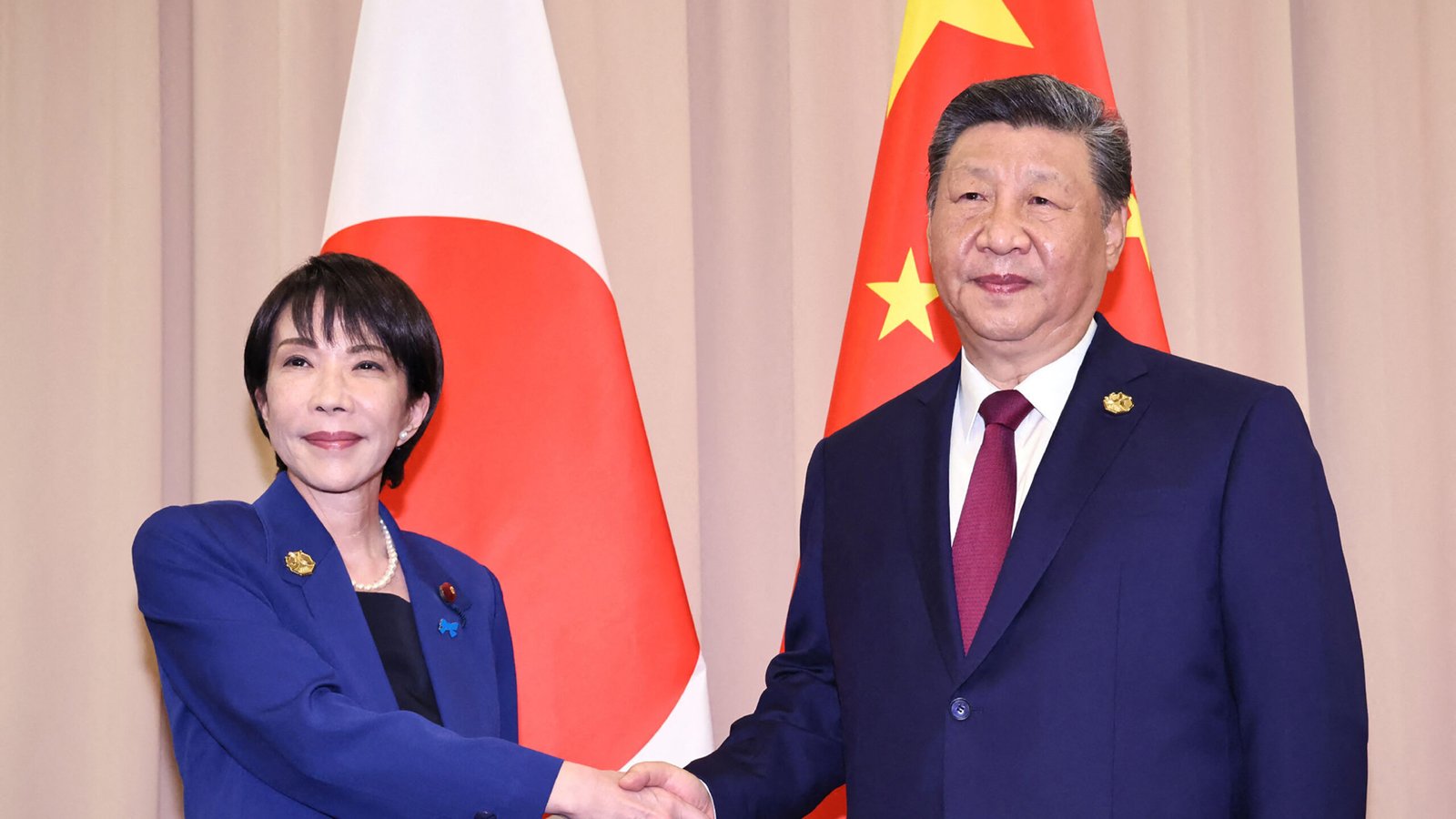
Chinese officials and experts are concerned that Takaichi will loosen the restrictions on Japan’s military use of force and its defense policy.
China’s actions also fit within a broader anti-Japanese narrative pushed by Beijing. This September, Beijing commemorated its China-centric version of the 80th anniversary of the end of World War II: its victory in the “Chinese People’s War of Resistance against Japanese Aggression and the World Anti-Fascist War.” This involved not only showcasing China’s growing power but also releasing films such as Dead to Rights that document the atrocities that Japan committed in Nanjing in 1937. As part of this campaign, China’s Ministry of Foreign Affairs pointed out that “Japan once again faces questions about its past and present” and that Japan must “face history squarely, reflect deeply upon its crimes of aggression, make a clean break with militarism and pursue the right path of peaceful development, good neighborliness and friendship.” Some Chinese commentators are counting down the days until December 26, when many suspect Takaichi will visit the Yasukuni Shrine, an action which China has long condemned. Takaichi regularly visited the shrine in the past, including during her time as economic security minister, but she has so far refrained from doing so as prime minister.
How China Has Escalated
In the past month since Takaichi’s statement in front of the Japanese parliament, China has escalated using a variety of diplomatic, economic, military, and informational means (see Table 1), and this represents only the tip of the iceberg in terms of what it could do in the future. Thus far, the most notable aspects of Chinese measures against Japan include the following:
- Signaling of Opposition to Japan from Across the Chinese Government: Over half a dozen Chinese government ministries and actors—including the Ministry of Foreign Affairs, Ministry of National Defense, State Council Taiwan Affairs Office, Ministry of Commerce, and Ministry of State Security—have issued public statements or taken public positions against Japan. Wang Yi’s warning that Japan has crossed a red line is also unprecedented. Within the People’s Liberation Army, military units from all five theater commands have broadcasted their views. These activities showcase the intensity of Chinese opposition and criticism of Japan and Takaichi. It also suggests that Beijing is willing to escalate significantly beyond what it is already doing.
- Global PRC Diplomatic Campaign Against Japan and Takaichi: To date, China has most strongly emphasized diplomatic and political pushback against Japan and Takaichi. This involves not only painting Japan as the aggressor but also characterizing Takaichi as unqualified to lead Japan, in hopes of weakening her ability to govern and rule the country. China sent two letters to the United Nations criticizing Japan, and it has leaned on Russia and North Korea to publicly denounce Japan. Xi subtly encouraged the United States to rein in Japan during his November phone call with President Donald Trump by emphasizing the recent positive trajectory of U.S.-China relations. China also appears to be supporting South Korea’s claim to the Takeshima/Dokdo islets, which is disputed by Japan.
- Economic Punishment of Japan: In contrast, Beijing has not yet embraced more extreme economic options against Japan, though China’s Ministry of Commerce warned on December 4 that if Takaichi does not retract her comments immediately, “Japan must bear sole responsibility for all consequences.” On the economic side, China has called on its citizens to refrain from traveling to Japan and to reconsider studying abroad there. It has reinstated a de facto import ban on Japanese seafood products that was lifted in June, and there have been postponements of Japanese film releases and cancellations of Japanese performances. However, Beijing has neither restricted the exports of rare earths nor slowed the flow of goods to and from Japan, measures China embraced in prior crises. Beijing has not called for boycotts of Japanese products, and there have been reports of some officials trying to assuage the concerns of Japanese companies in China.
- Limited Military Action Against Japan: Although the People’s Liberation Army (PLA) and China Coast Guard (CCG) have engaged in a variety of activities against Japan, they have been relatively small in scale, involving only a couple of assets at a time. China’s publicly broadcasted military exercises have also been far from Japan in the Yellow Sea and Bohai Gulf, instead of in the East China Sea. China has, however, sent the CCG to the Senkaku/Diaoyu islands to enforce its claims and confront Japanese vessels. This has led to the beginning of a standoff between the two countries.
- Rhetoric related to the Use of Military Force: In contrast to its limited military actions, China has ramped up its rhetoric. Chinese censors, for example, have allowed the publication of an article that recommends using 72 nuclear weapons to destroy Japan’s military and defense industry. Diplomatically, China appears to be setting the stage to justify potential use of military force against Japan. Beijing is falsely claiming that the UN Charter’s “enemy state clauses”—UN Charter Articles 53, 77, and 107—allow founding UN members such as China to “take direct military action if any of the former enemy states of the World War II, including Japan, attempts to carry out a policy of aggression.” Japan has pushed back against Chinese claims, noting that China supported a 1995 UN General Assembly resolution demanding removal of the clauses and that the clauses do not state countries can use military force, but that regional organizations can take “enforcement measures.”
Overall, this means that China has left ample room for escalation. Chinese media and past Chinese actions also suggest several areas where Beijing could press next, including
- cutting off exports to or sanctioning Japanese defense industry companies as supporters of Japanese “militarism”;
- further disrupting Japan-China trade and economic cooperation, including restricting rare earths and disrupting highly specialized industrial supply chains;
- detaining Japanese citizens;
- engaging in military activities against Yonaguni Island, Japan’s territory closest to Taiwan;
- significantly ramping up Chinese military or paramilitary activities around the Senkaku/Diaoyu islands, and establishing new, routine Chinese operating behaviors around or above the disputed features; and
- engaging in larger-scale Chinese military exercises in the East China Sea, Sea of Japan, or Pacific Ocean closer to Japan.
Deescalation Difficulties and New “Normals”
Regardless of what China decides to do next, it is unlikely that tensions between Japan and China will dissipate soon. And even if relations are mended, there is a good chance that Beijing will use this crisis as an opportunity to press its interests vis-à-vis Japan. On the Japanese side, Tokyo has learned from past episodes of tension with Beijing and taken many steps to try to bolster its resilience against Chinese coercion—a trend that is now likely to further accelerate.
Historically, it has taken months, if not years, for relations between the two countries to stabilize after a crisis; however, after each episode, Japan-China relations never fully returned to where they were before. In 2010, after a Chinese fishing boat rammed into two Japanese Coast Guard vessels near the Senkaku/Diaoyu Islands in early September, China escalated and sought to punish Japan through a rare-earths export ban and other measures. It was not until the end of November 2010 that diplomatic ties between the two countries were restored, and China resumed rare-earth shipments. Tensions were even more difficult to calm after September 2012, when China escalated after the Japanese government purchased the Senkaku/Diaoyu Islands. It took over two years for the two sides to agree to gradually resume diplomatic and security dialogues.
In each instance, China further “normalized” its operations in the East China Sea (see Table 1). In 2010, China’s maritime law enforcement established a regular presence around the Senkaku/Diaoyu Islands. This was a major change—China had not sent any government ships to the islands since the 1970s, with the exception of one incident in 2008.
This was also the case after the Japanese government’s purchase of the islands in 2012. Beijing increased law enforcement maritime operations within the 12 nautical-mile territorial waters around the islands. China began deploying assets inside the territorial waters on a regular basis to challenge Japan’s administrative control. PLA warships also passed through Japan’s contiguous zone south-southeast of Yonaguni Island for the first time. By December 2012, China violated Japan’s territorial airspace over the Senkaku/Diaoyu Islands for the first time with a PRC Y-12 patrol aircraft. In January 2013, a Chinese navy frigate locked its fire-control radar on a Japanese Maritime Self-Defense Force helicopter and destroyer in the East China Sea. Six months later, China sent four vessels from its newly created coast guard bureau to the Senkaku/Diaoyu Islands to pressure Japan, and a Chinese Y-8 aircraft flew for the first time through international airspace between Okinawa and Miyako. In November 2013, China announced the establishment of an East China Sea air defense identification zone. Since 2012, the number of CCG and other vessels that have entered Japan’s contiguous zone or the territorial sea surrounding the Senkaku/Diaoyu islands has remained continuously elevated, never returning to pre-2012 levels.