







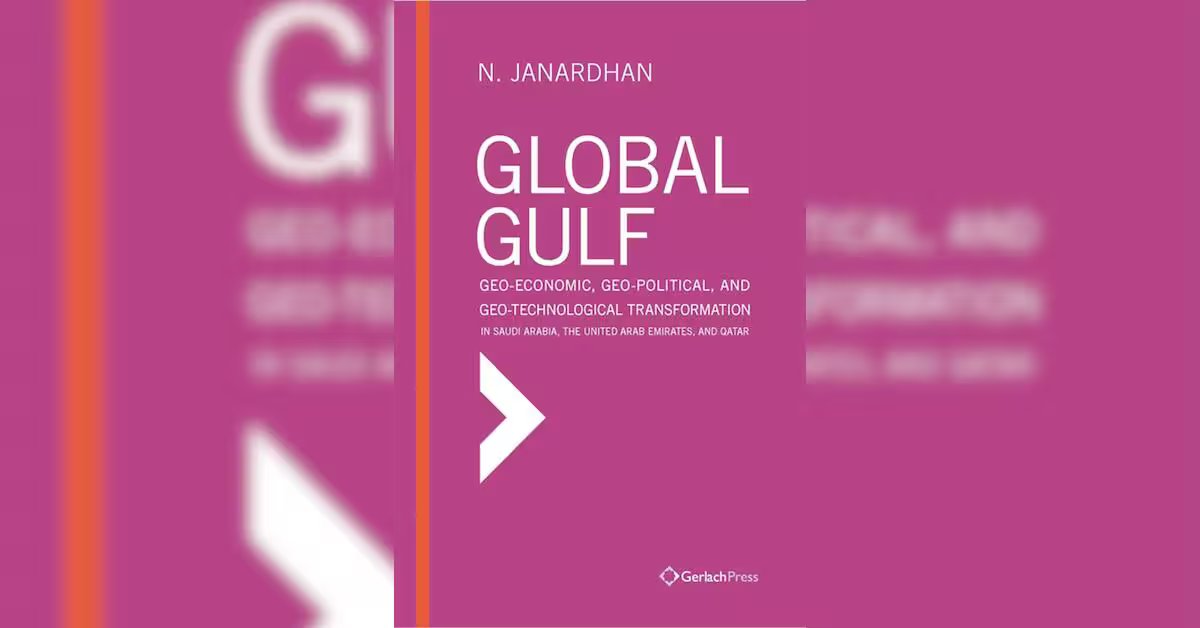
Global Gulf: Geo-Economic, Geo-Political, and Geo-Technological Transformation in Saudi Arabia, the United Arab Emirates, and Qatar
by N Janardhan Published by
Gerlach Press
207 pages ₹18,878
The UAE-based scholar, N Janardhan, has robustly pointed out in this pioneering work that, over the past 25 years, the six countries of the Gulf Cooperation Council (GCC) — Saudi Arabia, Oman, the UAE, Qatar, Bahrain and Kuwait — have thoroughly transformed themselves from being energy suppliers to emerging as significant players on the global stage in the areas of trade, investment, technology, critical minerals mining, renewables, and connectivity — physical, financial and digital.
The related figures are staggering: The six countries have a combined gross domestic product of $2 trillion, which could rise to $9-13 trillion by 2050. The sovereign wealth funds of these countries are expected to control assets of $18 trillion by 2030, a 50 per cent increase from 2024. Given that they control about 30 per cent of global seaborne oil exports and 20 per cent gas exports, as global demand for conventional fuels continues to rise, they will continue to remain central to the global energy economy, a role that will be buttressed by substantial investments in their green transition.
The tools the Gulf Cooperation Council (GCC) states are using as part of their global engagement, Dr Janardhan points out, are: Trade, investments and joint ventures, connectivity initiatives and digital technology projects. The states have thus emerged as middle powers that seek to promote peace and stability through adroit mediation efforts, while affirming strategic autonomy by refusing to join any one political camp. The GCC states have asserted their strategic autonomy by becoming partners in diverse multilateral groupings such as the US-sponsored I2U2 (the US, Israel, the UAE and India) and the India-Middle East-Europe Economic Corridor (IMEEC), as also non-Western entities like the Belt and Road Initiative, and Brics.
They have substantial trade engagements across the world, including (in 2024): China ($288 billion); European Union ($190 billion); India ($162 billion), Asean ($123 billion), the US ($120 billion); Africa ($121 billion), and Latin America ($35 billion). These trade links are backed by numerous transnational investments and joint ventures by their sovereign wealth funds and extensive sea and air operations: UAE’s DP World operates ports in 70 countries, while UAE’s airlines are connected to 600 cities, carrying 120 million people annually.
But what is remarkable is that GCC states, particularly the UAE, Saudi Arabia and Qatar, have forayed into new areas such as Africa and Latin America. Having invested about $100 billion in Africa in 2012-22, there has been a surge in GCC investments from 2023, when foreign direct investments in 73 projects worth $53 billion were announced. The UAE alone has invested $110 billion in 2019-23.
The premier areas of interest for GCC states are agriculture, infrastructure and logistics, and, above all, critical minerals. Unlike the earlier colonial scramble for Africa, most of the GCC initiatives entail projects for national development in African countries themselves, particularly in green energy and irrigation and agribusiness ventures in different countries.
Obviously, port development and management have important strategic implications. Thus, the UAE’s management of about 20 ports along the African coastline has made it a major influence in the fraught politics of the Horn of Africa, besides giving it strong links to hinterlands that are rich in agricultural and mineral resources.
The GCC outreach to Latin America is about a decade old, but there has already been a surge in trade, which was about $35 billion in 2024. The UAE has taken the lead in investments in the logistics sector, including corridors that link the Atlantic with the Pacific Ocean. This includes the Capricorn Bioceanic Corridor that goes from Brazil to Chile, through Argentina and Paraguay, while DP World is developing ports in Peru and Ecuador. These initiatives are part of the GCC’s effort to expand and diversify economic links globally.
The most important aspect of the “Global Gulf” is what the author has called its “Tech Take-off”. Saudi Arabia is pursuing “Foresight for Tomorrow” that includes emerging as a major player in advanced technology, data analytics and artificial intelligence (AI). The UAE on its part is seeking to become the “smartest in Smart Technology worldwide”. Qatar sees technology as the key to achieving its economic diversification plans by developing data centres and data management capabilities.
This book had already gone to print when the author had to hastily review the text to take into account the impact of the Iran war on the GCC’s development model. In response to the US-Israel attacks, Iran retaliated by closing the Strait of Hormuz and raining drones and missiles on US and regional targets.
With the US military presence totally unable to provide either deterrence or protection, the entire model of the “Global Gulf” is now called into question. Given that the US and Israel exercise no restraint on their collaboration or on the exercise of the military option, the GCC states now face unprecedented security challenges.
Dr Janardhan’s answer is to advocate a fresh look at “the framework of regional engagement” that would be founded on shared economic interests and propelled by a new “strategic imagination”. Despite the carnage and ruin across the region, he remains an incorrigible optimist, reposing faith in the resilience of the resident community — citizens and expatriates — and the wisdom of regional leaders. Hopefully, this wisdom will seep into the corridors of power in Washington and Tel Aviv.
The reviewer is a former diplomat