






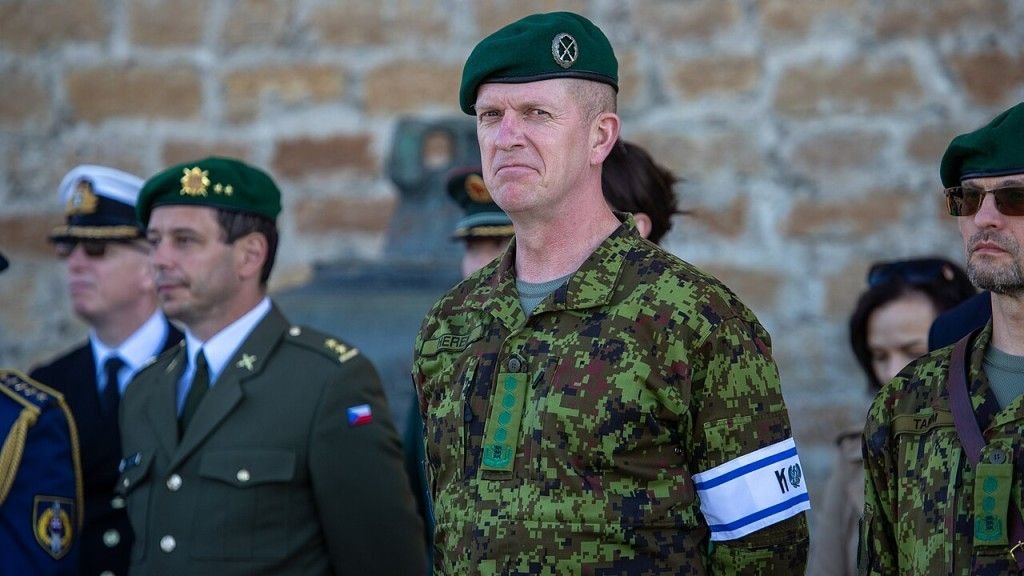

Photo. Kaitseliit / Wikimedia Commons / CC BY 2.0 (https://creativecommons.org/licenses/by/2.0/)
Russia is unlikely to attack the Baltic states while its forces remain heavily engaged in Ukraine, but the situation could change rapidly if the war ends or significantly slows down. Estonia’s new Minister of Defence, Martin Herem, warns that Moscow could use military aggression to undermine NATO’s credibility and force European countries to accept Russian demands. In an exclusive interview with Defence24, he explains why Poland is essential to Baltic defence, why Estonia needs rapid Allied reinforcements rather than simply more permanently stationed troops, and what NATO must do to deter Russia.
Martin Herem took office as Estonia’s Minister of Defence on 16 September 2026, having previously served as Commander of the Estonian Defence Forces between 2018 and 2024. Unlike most defence ministers, he comes directly from the military rather than party politics. His priorities include preparing Estonian society for potential aggression, strengthening regional defence cooperation and ensuring that NATO can deploy and sustain significant military forces in the Baltic region.
Aleksander Olech, Defence24.com: What are Estonia’s main defence priorities for the next two to three years, and what capabilities does the government consider most urgent to strengthen?
Martin Herem: First, I did not take this position after an election. I am serving until the next election in March 2027. I have never been interested in running for office. I was motivated by the security situation and the confusion it has created regarding the management of national defence.
What I want to do or initiate is better addressed in the following question about the threat. However, we need to prepare the country for possible military aggression. I’m talking about the state as a whole – society, government agencies and companies. Of course, this includes the Defence Forces, but they are already working on this. First and foremost, we need to raise general awareness of military threats, including their specific nature, and show ways to reduce or mitigate these threats.
How does Estonia currently assess the risk of a direct Russian military attack against the Baltic states? Do you see any realistic scenario in which Moscow could test NATO militarily in the region?
As long as Russia is militarily engaged in Ukraine, aggression against us is unlikely. However, if the war in Ukraine were to subside and Russia no longer had to commit the same level of resources to fighting there, its military capability would increase drastically. What is currently consumed every day could instead be used to build up its forces. Add the Kremlin’s rhetoric and likely desire to exert influence over its neighbours, along with Russian society’s willingness to comply with its leaders’ decisions, and military aggression becomes a possibility. Its purpose would be to create mistrust and instability, forcing us to choose between a costly military conflict and accepting Russia’s demands. There is no point in describing a specific scenario. Military aggression could itself be the objective – inflicting losses and destruction that undermine trust within our society and among allies, which in turn would create favourable conditions for accepting Russia’s demands.
How do you see defence cooperation with Poland developing, particularly in the areas of the eastern flank, air and missile defence, military mobility and defence industry cooperation?
Although the term “eastern flank” is widely used, in military terms, a flank implies our opponent is to the north or south. But we are right in the thick of it. We are not the flank – we are the centre. Poland is an extremely important partner for the three Baltic states (3B). First, it is essential to keep our lines of communication across the Baltic Sea open at all times. Poland undoubtedly plays a major role in this, both at sea and in the air. Secondly, Russia could launch air strikes against us from the direction of Kaliningrad, and Poland is also well positioned to help counter these threats. Thirdly, Poland is undoubtedly a key transit country for Allied reinforcements moving to the Baltic states. Poland’s role in terms of ground forces and defence industry cooperation is also important, but the specifics depend on procurement decisions and operational plans.
What role should Allied forces stationed in Estonia play in the coming years? Is Estonia seeking a larger or more permanent Allied military presence?
A larger permanent presence requires additional resources from both the troop-contributing nations and Estonia. In this case, Estonia would have to invest hundreds of millions of euros in infrastructure and also expand its existing training areas. The necessary resources are probably not available for either. I think Estonia should develop the capacity to receive rapid reinforcements when necessary. This applies to land, naval and air forces, as well as intelligence, fires and air defence.
Does the increasing involvement of Türkiye on NATO’s eastern and northern flanks make a meaningful difference from Estonia’s perspective? Where could Turkish capabilities be particularly useful?
Moving Turkish ground forces from the “southern flank” to the “northern flank” would not necessarily make sense, because Türkiye is also effectively facing Russia. At the same time, Türkiye can rapidly reinforce our region with air assets. Türkiye also has significant defence-industrial capabilities.
Estonia hosts Allied troops, but could Estonia itself take on a larger role abroad? Do you envisage deploying more Estonian personnel to other frontline Allied countries, for example Finland, as regional defence plans become more integrated?
Our most likely adversary is Russia. Shifting frontline forces from right to left, or vice versa, won’t counter this threat. Reinforcements must come from strategic depth. Russia will not be deterred simply by displaying numerous national flags in different countries. Only a credible military force capable of sustaining operations for weeks or months and defeating aggression can deter Russia. To achieve this, we need to move forces from the rear to the front, not sideways along the front. If Estonia is needed elsewhere, we are always ready to contribute. However, from a military perspective, I do not consider it reasonable to move Estonian units to Finland or anywhere beyond northern Latvia.
More broadly, how should the Baltic states, Poland and Finland divide responsibilities in the defence of the region if a major crisis occurs?
Firstly, we need to cooperate on the Baltic Sea. Not merely through cooperation between individual countries, but within the framework of CTF Baltic, which was established for precisely this purpose. Our objective must be to keep the maritime routes under our control at all times. This involves operations at sea, on land and in the air.
Secondly, we all have specific responsibilities for defending our land borders. Poland has a role in facilitating the arrival of Allied reinforcements and, potentially, in reinforcing the Baltic states with its own forces.
In addition to the maritime mission mentioned above, Polish air and ground forces may also have missions on or near our territory.
Martin Herem has served as Estonia’s Minister of Defence since 16 September 2026. A career military officer and former Commander of the Estonian Defence Forces (2018–2024), he previously served as Chief of Staff of the Defence Forces Headquarters (2016–2018) and Commandant of the Estonian Military Academy (2013–2016). Between 2024 and 2026, he worked as a military adviser to defence industry companies. He holds a Master’s degree in Military Science and completed the Higher Command Studies Course at the Baltic Defence College. During the 2026/2027 academic year, he is also a Visiting Professor at the University of Tartu.