







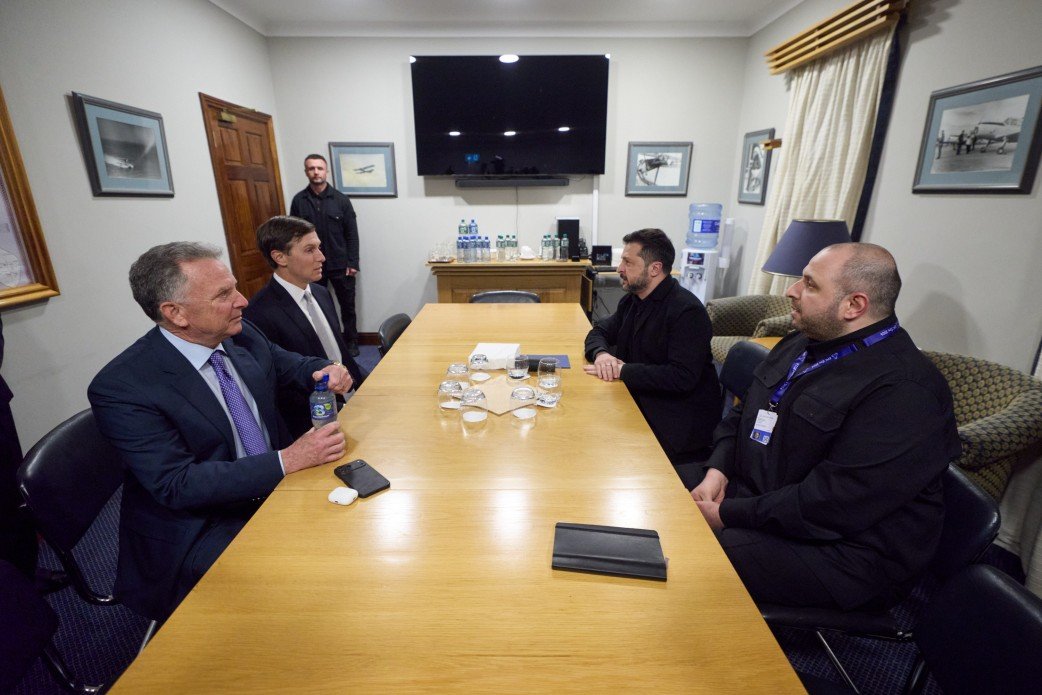
The suggestion that Ukraine could relinquish its remaining territory in Donbas in exchange for NATO membership raises a fundamental question about the direction of American-led peace negotiations. Would such an agreement end Russia’s war, or simply provide Moscow with territorial gains in exchange for a security commitment Washington cannot deliver alone?
Ukrainian President Volodymyr Zelenskyy has revealed that American negotiators have, for the first time, raised the possibility of Ukraine withdrawing from the Ukrainian-controlled part of Donbas in exchange for membership of NATO.
Meanwhile, US President Donald Trump’s special envoy and son-in-law, Jared Kushner, has suggested that new ideas have emerged from recent negotiations which could lead to a diplomatic breakthrough. He argued that media coverage had concentrated on the maximalist positions of the parties rather than the compromises being explored privately.
No formal NATO membership offer has been confirmed. Nevertheless, the question reportedly put to Zelenskyy exposes a contradiction at the heart of the negotiations: it assumes that Russia might accept Ukrainian membership of the very alliance it has spent decades attempting to prevent its neighbours from joining.
What Russia has been fighting to prevent
Moscow’s conduct since the dissolution of the Soviet Union provides little evidence that its territorial ambitions can be separated from its determination to restrict the sovereignty of neighbouring countries.
In Moldova, the Russian military presence in Transnistria has sustained a territorial dispute for more than three decades, despite Moldova’s constitutional neutrality.
In Georgia, Russian military intervention in 2008 was followed by Moscow’s recognition of Abkhazia and South Ossetia as independent states. Russia continues to consolidate its control over both territories.
Ukraine became the next target in 2014.
It is frequently overlooked that Ukraine was pursuing an official policy of military non-alignment when Russia seized Crimea and intervened in eastern Ukraine. As NATO’s own historical account confirms, Kyiv abandoned its non-aligned status only after Russian aggression had begun.
The immediate political confrontation concerned Ukraine’s proposed Association Agreement with the European Union, not imminent NATO membership.
Russia’s invasion subsequently strengthened Ukrainian public support for Euro-Atlantic integration, making the pursuit of NATO membership a consequence of Russian aggression as much as a source of confrontation with Moscow.
A contradiction at the negotiating table
As EU Today reported on Saturday, Russia’s latest negotiating demands reportedly include a prohibition on further NATO enlargement, restrictions on Western military assistance to Ukraine and the reversal of allied military deployments in Eastern Europe.
Against this background, the suggestion that Vladimir Putin might exchange his opposition to Ukrainian NATO membership for control of Donbas appears particularly difficult to reconcile with Moscow’s strategic objectives.
In June 2024, Putin explicitly demanded both Ukraine’s withdrawal from four Ukrainian regions and the abandonment of its NATO ambitions.
There is no publicly established evidence that the Kremlin has abandoned either objective.
Furthermore, Ukrainian accession would require the unanimous agreement of NATO’s members under Article 10 of the North Atlantic Treaty. Washington cannot confer membership unilaterally.
The danger is that Ukraine could be persuaded to make an irreversible territorial concession in exchange for a commitment whose implementation remains dependent upon numerous governments and future political decisions.
Even a Ukrainian agreement in principle could subsequently be used to establish territorial concessions as the starting point for further negotiations.
Ukraine’s constitutional limits
There is also a substantial legal obstacle.
Article 2 of the Ukrainian constitution establishes the inviolability of the country’s territory. Article 157 prohibits constitutional amendments directed towards violating its territorial integrity.
Although Article 73 provides for an all-Ukrainian referendum on changes to national territory, Ukraine’s 2021 referendum legislation specifically prohibits proposals aimed at violating the country’s sovereignty or territorial integrity.
Referendums are also prohibited under existing martial law legislation.
Zelenskyy’s suggestion that a comprehensive peace and security package might be submitted to the Ukrainian electorate cannot, therefore, be treated as a straightforward mechanism for transferring Ukrainian territory to Russia.
A military withdrawal, a ceasefire line and the legal recognition of Russian sovereignty over occupied territory are three fundamentally different propositions.
Conflating them would risk transforming a temporary military arrangement into a permanent political concession.
The risk for Europe
The consequences extend beyond Ukraine.
If territorial concessions become the price of obtaining collective defence guarantees, Russia could acquire a means of influencing the security arrangements of neighbouring countries through military aggression.
For Europe, the principle at stake is whether sovereign states retain the freedom to determine their own alliances, or whether that freedom must first be negotiated with Moscow.
American diplomacy may yet produce a viable settlement. However, its credibility will depend on obtaining enforceable Russian commitments rather than securing Ukrainian agreement to progressively greater concessions.
The central question is not how much territory Ukraine must surrender to obtain protection.
It is why Russia should be permitted to determine the conditions under which that protection becomes available.
Views: 1,112