








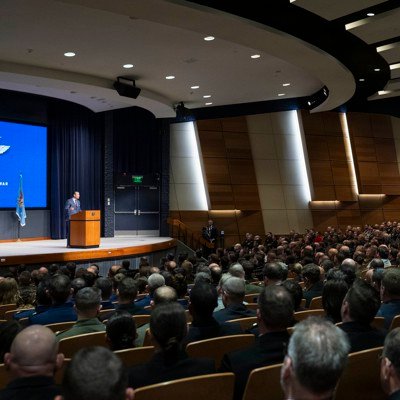
The debate over impeaching Defense Secretary Pete Hegseth has largely drowned out discussion of the professional military education (PME) reforms he rolled out on Monday in a 33-point memorandum and a companion speech at the Naval War College.
For the uninitiated, PME is the blanket term for a series of educational opportunities provided to service members as they progress through their military careers. For officers, this educational sequence extends from commissioning—whether from a military academy, the Reserve Officers Training Corps (ROTC), or Officer Candidate School—all the way up through capstone programs for generals and flag officers. These educational experiences prepare our military leaders for the growing responsibilities they will shoulder as they move up the ladder, from commanding a couple dozen service members as a junior officer to a few thousand as a colonel or a Navy captain.
Secretary Hegseth rightly understands that the PME institutions, especially at the intermediate and senior levels, play a critical role in shaping the strategic culture of U.S. military leadership. However, the Secretary’s guidance misdiagnoses what needs to change about that culture.
Since becoming a professional military, U.S. fighting forces have repeatedly demonstrated extraordinary operational competence. American military units are peerless as warfighters, and they have frequently achieved their immediate military objectives with remarkable efficiency, as was the case in both Iraq and Afghanistan. However, the United States has struggled to translate those battlefield accomplishments into meaningful political outcomes, which is the true measure of military effectiveness.
The ongoing conflict with Iran offers another illustration. American and Israeli forces easily penetrated Iran’s defenses, eliminated its senior leadership, and degraded the country’s missile and naval capabilities. However, nearly nine months after the conflict began, Iran’s governing regime remains in power, the Strait of Hormuz remains too dangerous for commercial shipping, and the Trump administration has failed to translate its immense military advantage into a durable political settlement aligned with U.S. interests.
Unfortunately, Secretary Hegseth’s guidance perpetuates this fundamental misunderstanding of what senior military leadership requires—and the shortcoming in American military performance that most urgently needs to be addressed. American military leaders aren’t lacking for training in how to conduct field maneuvers or win battles. No one underestimates the U.S. military’s lethality across all domains. But our adversaries almost certainly believe that America’s national security establishment fails to understand the fundamentally political nature of warfare, which dictates that tactical success is necessary but not sufficient to defend and advance U.S. interests in an increasingly contested global security environment.
In reiterating ad nauseum that “the fundamental purpose of the Armed Forces of the United States is to fight and win our Nation’s wars,” Secretary Hegseth displays a limited understanding of the role the military should play in deterring conflict in the first place, which requires more sophisticated thinking, and a wider range of coursework, than executing traditional battlefield maneuvers or even overseeing a theater-level military campaign.
Indeed, sustained deterrence represents the apex of military effectiveness. It requires understanding adversaries, anticipating their calculations, managing escalation, communicating resolve, and integrating military capabilities with diplomatic, economic, and informational instruments of national power. Preparing military leaders to advise civilian defense officials and contribute meaningfully to whole-of-government decision-making on the most consequential matters of state requires a much broader intellectual foundation than training them to carry out operational orders.
Consider Taiwan, a potential flashpoint for a confrontation between the United States and China. Deterring Beijing from imposing a blockade of the island, or even launching a full-scale invasion, is not simply a matter of developing the operational capabilities that would be required to respond in such a contingency. Effective deterrence requires understanding Beijing’s perceptions of American resolve, the political calculations of Chinese leadership, Taiwan’s domestic politics, the economic consequences of a conflict, and the credibility of American commitments to regional allies. U.S. military leaders who cannot think strategically across these dimensions, no matter how proficient they may be at operational planning and execution, will struggle to provide effective options to civilian defense leaders on averting what would almost certainly be a catastrophic military conflict.
These criticisms aside, there are several worthwhile ideas embedded in Secretary Hegseth’s direction, although many of its supposed innovations are already standard operation procedure at command and staff and senior service colleges. For example, emphasizing “jointness” among the services in PME is hardly a new idea. When I served on the teaching faculty at the National War College from 2019 to 2021, I did so as the Office of the Secretary of Defense Chair alongside several talented Warfighter Chairs seconded from the respective military services. And far from being “stagnant,” as Secretary Hegseth alleges, the PME environment surprised me with its agility. It continuously adapted its curricula, incorporating key lessons from recent case studies and experimenting with new approaches to preparing officers for an increasingly complex security environment—all while pivoting to a virtual learning environment amid a global pandemic.
Of the genuinely new proposals in the Secretary’s guidance, the most promising include deepening focus on the role of artificial intelligence in modern warfare; incorporating a new mid-career “PME 1.5” requirement that would bridge the gap between field-grade operational experience and senior school attendance; better using private-sector expertise in PME curricula; and using simulations, tabletop exercises, and competitive wargames to evaluate students under conditions that approximate the uncertainty, time pressure, information asymmetries, and competing demands of actual command.
The greatest danger associated with this new guidance concerns the risk of further politicization of the institutions responsible for cultivating strategic judgment in senior military leaders. Shifting oversight of PME from the Joint Staff’s J7—a three-star military billet—to the Undersecretary for Personnel and Readiness—a presidentially-appointed, Senate-confirmed position—isn’t objectionable on its face. However, it hands more control over what is taught at the PME institutions to political appointees, some of whom may be tempted to use their perch to pursue ideological agendas. Likewise, doing away with tenure for civilian faculty, and making these hires subject to political preferences, will reduce and may even eliminate the unique expertise that civilian scholars bring to bear with respect to history, international relations, economics, political science, technology, and regional studies. More broadly, the challenge that a relative outsider can pose to the conventional wisdom of experienced military officers is among the most valuable contributions a civilian professor can make to a serious war college.
The military’s strategic culture cannot be remade every four years. To be effective, PME institutions require continuity, intellectual independence, and the freedom to challenge prevailing assumptions—including those of the sitting administration. Senior officers must understand and execute civilian policy, but they must also possess the intellectual independence to identify flawed assumptions, offer candid advice, and challenge strategies they believe will fail. That requires an educational environment in which disagreement is encouraged as a mechanism of arriving at better decisions.
Ultimately, the measure of a successful PME system is not simply whether it produces officers who can win battles. It is whether it produces strategic leaders who can communicate complex ideas to civilian policymakers, deter our adversaries, and overcome the most consequential shortcoming in the American way of war: translating military strength into enduring national advantage.
Greg Pollock served in leadership positions in the Office of the U.S. Secretary of Defense from 2010 to 2025, including twice as an acting Deputy Assistant Secretary of Defense. He taught at the National War College from 2019 to 2021, and he is now an Adjunct Professor at Georgetown University’s School of Foreign Service and a non-resident Senior Fellow at the Center for Climate and Security. His work has featured previously in The Washington Post, Foreign Policy, The National Interest, and other leading publications.