








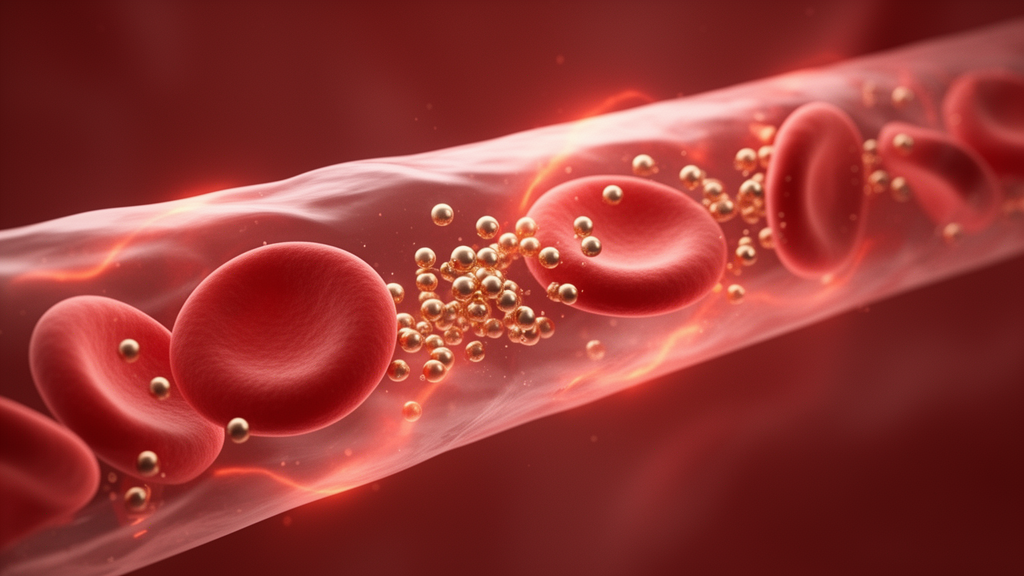
Computational researchers have developed a validated mathematical and neural network modeling framework demonstrating that adding dilute concentrations of gold nanoparticles to blood flow over a stretching surface significantly alters boundary-layer transport dynamics. According to the investigation, dispersing a four percent volume fraction of gold nanoparticles into a non-Newtonian blood carrier fluid increases the wall heat-transfer rate by 8.0 percent while reducing the streamwise wall shear stress by 17.9 percent. The computational analysis established that the reduction in surface friction arises directly from enhanced thermal buoyancy, as metallic gold possesses a substantially higher product of density and thermal expansion compared to base blood. To model and rapidly screen these complex fluid dynamics, the authors coupled high-order numerical collocation with compact artificial neural networks, achieving rapid evaluations that reproduce boundary-layer profiles across continuous physical parameter ranges with high mathematical accuracy.
The study investigates the physical mechanics governing the steady, laminar, two-dimensional boundary-layer flow of a Casson blood-gold nanofluid moving over an impermeable linearly stretching sheet. In applied biomedical and transport settings, non-Newtonian fluid rheology governs materials whose shear stress does not vary linearly with strain rate. Blood exhibits non-Newtonian characteristics including a distinct yield stress and a plug-like core, which are effectively captured by the Casson constitutive rheological model. The modeled physical system integrates multiple interacting transport phenomena, incorporating an applied transverse uniform magnetic field, secondary cross-flow induced by the Hall effect, Rosseland thermal radiation for an optically thick medium, internal heat generation, and a first-order temperature-activated Arrhenius chemical reaction. Nanoparticle behavior is simulated through a hybrid framework that evaluates bulk thermophysical mixture properties using the Tiwari-Das approach while capturing local particle concentration deviations through Buongiorno slip mechanisms driven by Brownian diffusion and thermophoresis.
To formulate the mathematical model, the investigators expressed the conservation equations for mass, momentum, thermal energy, and nanoparticle concentration in vector notation before simplifying them under boundary-layer approximations. The fluid moves over a flat sheet coinciding with the plane y equals zero, which stretches along the horizontal axis with a velocity proportional to distance from the emergence slot. Fluid occupies the semi-infinite region above the sheet, while an external magnetic field is applied normal to the moving surface. By invoking generalized Ohm’s law with Hall currents, the formulation accounts for the generation of an electrical current density that exerts Lorentz body forces in both the primary streamwise direction and the lateral transverse direction. This cross-coupling generates a secondary velocity profile across the boundary layer, transforming the flow into a three-dimensional boundary-layer problem governed by coupled nonlinear partial differential equations.
The governing equations incorporate seven dimensionless property ratios that scale fluid density, dynamic viscosity, heat capacity, thermal conductivity, electrical conductivity, and thermal and solutal buoyancy relative to base blood. The authors evaluated base blood and solid spherical gold properties at dilute nanoparticle loadings up to a maximum volume fraction of 0.04. Bulk density and heat capacity follow linear mixture rules, dynamic viscosity increases according to the Brinkman relation, and thermal and electrical conductivities are evaluated using Maxwell models. Under these relations, introducing a two percent gold loading raises effective mixture density by 34.8 percent, effective viscosity by 5.2 percent, and thermal and electrical conductivities by 6.1 percent. Concurrently, the thermal buoyancy ratio increases almost fourfold at two percent loading and rises from 1.0 to 6.7 at four percent loading, reflecting the massive disparity between the thermal expansion coefficient of gold and that of blood plasma.
Applying a similarity transformation via a defined stream function reduces the partial differential system to an exact ordinary boundary-value problem defined on a semi-infinite spatial coordinate. The resulting system couples third-order and second-order differential equations governing the dimensionless streamwise velocity, transverse velocity, fluid temperature, and relative nanoparticle concentration. The authors established that exact similarity holds because the imposed wall velocity is linear, allowing convective, viscous, magnetic, and buoyancy forces to scale proportionally. Buoyancy effects are treated using local similarity, where thermal and solutal Grashof numbers act as localized Richardson parameters. At the boundary surface, no-slip velocity conditions match sheet motion, wall impermeability sets vertical velocity to zero, and uniform heated surface temperature and nanoparticle concentration conditions are prescribed, while ambient fluid far from the surface remains undisturbed and quiescent.
The nonlinear boundary-value problem was resolved numerically using a fourth-order, three-stage Lobatto IIIA collocation method equipped with adaptive residual control, implemented through the SciPy solver routine. Computational domain independence testing verified that setting the outer edge coordinate to 15 ensured that velocity, temperature, and concentration perturbations decayed to zero within strict numerical tolerances well before the domain boundary. Numerical accuracy was rigorously verified across three independent benchmark comparisons. In the non-magnetic, pure-fluid Newtonian limit, computed wall heat transfer agreed with classic Khan and Pop benchmark data across Prandtl numbers from 0.07 to 70 within a maximum difference of 0.00027. For coupled Brownian and thermophoretic transport, reduced Nusselt and Sherwood numbers matched Khan and Pop values to four decimal places. Furthermore, momentum solutions under non-zero Casson parameters, magnetic fields, and nanoparticle loadings matched an analytical closed-form solution to within a tolerance of ten to the power of negative six.
Using the verified collocation code, the authors generated a comprehensive dataset comprising 17,710 converged input-target pairs distributed across ten distinct physical scenarios to train artificial neural network surrogates. In each scenario, one governing physical parameter was swept across eleven uniform levels while holding all other parameters at baseline values, sampling 161 spatial points across the boundary layer. The researchers designed compact multilayer perceptron architectures containing two input nodes representing the spatial coordinate and the swept parameter, a single hidden layer composed of twelve tan-sigmoid neurons, and a single linear output neuron. Network training utilized the second-order Levenberg-Marquardt optimization algorithm, which alternates adaptively between gradient descent and Gauss-Newton updates using exact Jacobian matrices. Across all scenarios, the network parameters consisted of 49 total weights and biases, selected after neuron-optimization sweeps demonstrated that twelve hidden units minimized held-out interpolation errors without inducing overfitting.
Performance assessments demonstrated that the Levenberg-Marquardt trained neural surrogates matched numerical solutions with exceptional precision, achieving test mean squared errors ranging between 7.5 times ten to the power of negative eleven and 1.1 times ten to the power of negative eight in physical units. Regression analysis showed correlation coefficients exceeding 0.99999996 across all subsets, with error histograms tightly clustered near zero. When evaluated against held-out parameter levels omitted entirely from the training procedure, the neural network maintained maximum absolute errors below 0.00095. For arbitrary interior profiles evaluated on fine 321-point evaluation grids, peak absolute errors remained below 0.0011. Optimizer benchmarking revealed that Levenberg-Marquardt training yielded test mean squared errors two to five orders of magnitude lower than the Adam optimizer and 3.5 to six orders lower than stochastic gradient descent with momentum under equivalent computational budgets. Once trained, the surrogate evaluated complete boundary-layer profiles in 0.00002 seconds, representing a speedup several thousand times faster than direct numerical collocation.
Analysis of the computed velocity fields showed that non-Newtonian plasticity, electromagnetic forces, and buoyancy strongly govern boundary-layer thickness and surface drag. Increasing the dimensionless Casson parameter from 0.2 to 2.0 decreases the effective fluid viscosity, which reduces momentum diffusion into the ambient fluid, thins the momentum boundary layer by approximately 47 percent, and lowers the streamwise skin-friction magnitude by 62.9 percent. Conversely, increasing the magnetic parameter from 0.5 to 3.0 strengthens the retarding Lorentz force, thinning the primary boundary layer and increasing the streamwise wall shear stress by 86.5 percent. Increasing the Hall parameter from zero to 1.5 progressively weakens the primary resistive Lorentz drag, causing primary velocity to increase and streamwise shear to fall by 23.9 percent. Concurrently, Hall currents drive a distinct transverse cross-flow whose peak velocity shifts closer to the surface under stronger magnetic fields, while transverse skin friction exhibits a characteristic non-monotonic maximum near a Hall parameter value of 1.0.
Thermal and mass transport analyses revealed contrasting influences from radiation, nanoparticle slip, and chemical reactions. Increasing the Rosseland radiation parameter from 0.1 to 1.5 provides an effective radiative thermal conductivity that thickens the thermal boundary layer, more than doubling the total wall heat flux with an increase of 112 percent. In contrast, increasing the Brownian motion parameter from 0.1 to 0.4 creates an internal distributed thermal energy source arising from random particle collisions, flattening near-wall temperature gradients and reducing the wall Nusselt number by 90.5 percent while boosting the Sherwood number by 107 percent. Increasing thermophoresis drives particles away from the heated wall toward cooler regions, lowering the Nusselt number by 41.3 percent. When thermophoresis significantly exceeds Brownian diffusion, the steep thermal gradient induces a pronounced nanoparticle concentration overshoot adjacent to the wall, reaching peak concentrations 23 percent above ambient levels. Furthermore, intensifying the Arrhenius reaction sink thins the concentration boundary layer and increases the surface mass transfer rate by 133 percent.
Evaluating the explicit engineering coefficients of skin friction, Nusselt number, and Sherwood number established clear operational distinctions between hydrodynamic and thermodynamic controls. Streamwise shear is governed predominantly by solutal buoyancy, Casson rheology, and magnetic damping, whereas the Nusselt number remains largely insensitive to pure hydrodynamic parameter variations, shifting by less than three percent across wide ranges of Casson, magnetic, and Hall values. This decoupling occurs because blood has a high Prandtl number of 21, making the thermal boundary layer substantially thinner than the viscous layer. Introducing gold nanoparticles enhances wall heat flux moderately by 4.0 percent at two percent loading and 8.0 percent at four percent loading, driven by enhanced bulk thermal conductivity. The accompanying 17.9 percent reduction in wall drag is entirely attributable to gold-induced thermal buoyancy; an exact analytical momentum solution confirmed that in the absence of buoyancy forces, dense gold loading would instead increase surface wall friction.
The authors explicitly outlined several important mathematical and physical limitations governing the scope of their results. The investigated configuration models steady, laminar boundary-layer flow over an idealized flat deforming surface, which does not reproduce the pulsatile, three-dimensional flow, compliant elastic boundaries, or geometry found in biological vascular systems. Furthermore, achieving order-one magnetic parameters in blood requires substantial laboratory magnetic inductions paired with very slow deformation rates, while the Hall parameter for biological electrolytes remains physically small under physiological states. The thermophysical model assumes non-interacting, spherical particles without aggregation or interfacial surfactant layering and relies on small concentration perturbation assumptions to combine Tiwari-Das and Buongiorno formulations. In addition, the neural surrogates are verified exclusively for smooth single-parameter interpolation within prescribed training limits rather than multidimensional extrapolation, and validation relies on published numerical benchmarks rather than direct experimental fluid measurements.
Subject of Research: Numerical and neural network modeling of Casson blood-gold nanofluid transport under magnetic and thermal radiation effects
Article Title: ANN-assisted analysis of Hall-MHD Casson blood–gold nanofluid flow over a stretching sheet
Article References: Choudhary, S. K., Dehingia, K., Zulqarnaian, R. M., Alburaikan, A., & Khalifa, H. A. E.-W. (2026). ANN-assisted analysis of Hall-MHD Casson blood–gold nanofluid flow over a stretching sheet. Discover Nano, 21(1), Article 615. https://doi.org/10.1186/s11671-026-05044-0
Image Credits: AI Generated
DOI: 10.1186/s11671-026-05044-0
Keywords: Casson fluid, blood-gold nanofluid, stretching sheet, Hall effect, magnetohydrodynamics, artificial neural network, Levenberg-Marquardt algorithm, Lobatto IIIA collocation, bvp4c, thermal radiation, Brownian motion, thermophoresis, Arrhenius reaction, Nusselt number, Sherwood number, skin friction