



Russian units of foreign companies seized by the Kremlin are helping to pay for President Vladimir Putin’s war in Ukraine.
Businesses whose operational management was transferred to local managers from their international owners are spending billions of rubles to fund the army, according to data compiled by Bloomberg and reports in Russian media.
Most of the payments went to the People’s Front, an organization founded at Putin’s initiative in 2011 that set up an “Everything for Victory!” project once the war in Ukraine began. Corporate donations have been used to buy drones, vehicles, communications systems and other equipment for Russian troops.
Dozens of international businesses have been placed under temporary management on Putin’s orders. Russia created a mechanism in 2023 allowing the state to take operational control of units belonging to companies from so-called unfriendly countries, while leaving formal ownership with the foreign parent.
While European and Japanese assets have been caught up in the geopolitical confrontation with Moscow, major US businesses in Russia have been largely spared from seizure so far. That’s as the Kremlin has sought to build warmer ties with President Donald Trump’s administration.
Russian officials are also wary of retaliation from the US and fear Washington’s ability to pursue sanctioned individuals and companies globally, a person close to the Kremlin said, declining to be identified because the information is not public.
While the payments for the military pale in comparison to the massive state spending on the war, which is expected to exceed 17 trillion rubles ($206 billion) this year, they give the managers of the businesses a highly visible way to demonstrate support for the state.
In one example, Putin transferred temporary management of the local unit of Danish insulation maker Rockwool A/S in December to a little known company set up in Moscow only a few months earlier.
It donated 600 million rubles to the People’s Front weeks later, according to a press statement on the organization’s website. The funds were earmarked for all-terrain vehicles, communications equipment, reconnaissance drones and electronic-warfare systems.
Rockwool’s new management company is run by Timur Amirov, a 33-year-old businessman who was born in Russia’s Bashkortostan, according to local media reports.
Putin later handed Amirov the management of the Russian businesses of Dutch paint manufacturer Akzo Nobel NV and Italian-owned electrical-equipment producer DKC Europe Srl.
They subsequently donated a combined 3 billion rubles to fund the purchase of equipment for the Russian military, according to data from the charities and media reports.
“We have lost all visibility of the activities of the Russian companies,” a spokesman for AkzoNobel said. “We’ve read about the story in media.” DKC’s European parent companies didn’t respond to a request for comment.
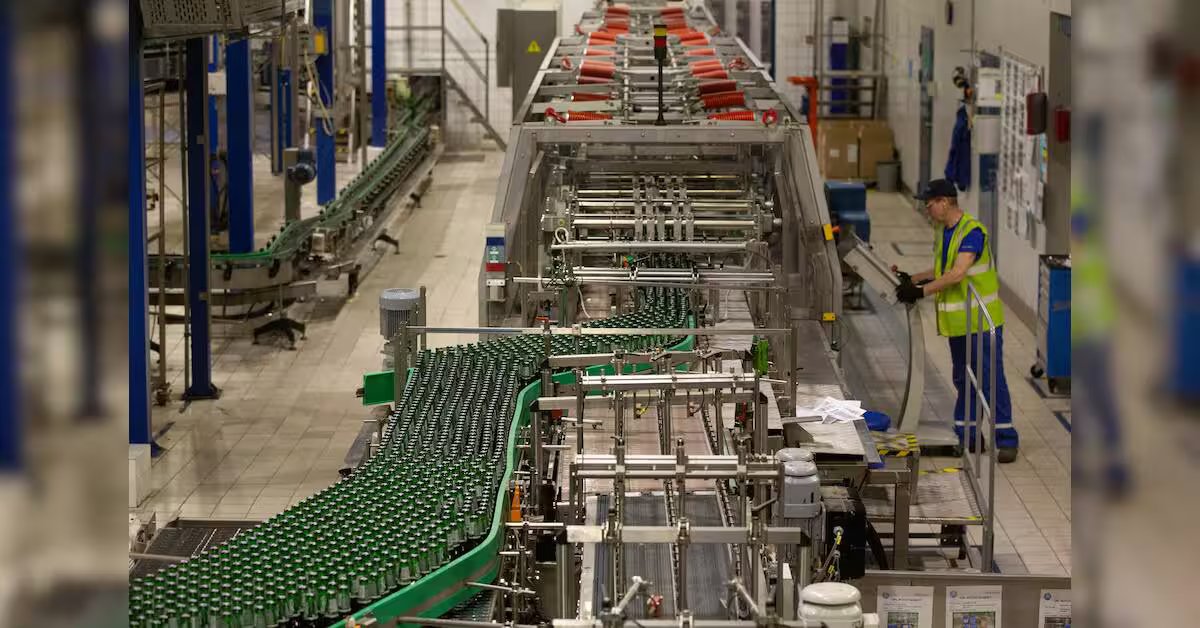
Brewer AB InBev Efes, a joint venture between Belgian brewer Anheuser-Busch InBev SA/NV and Turkey’s Anadolu Efes Biracılık ve Malt Sanayii A.Ş., said it donated 1 billion rubles to the People’s Front in 2026. The press office of AB InBev, which lost control of the unit along with its partner in 2024 when it was placed under the temporary management of little-known Russian company GK Vmeste, declined to comment.
After Putin transferred German grocery chain Metro AG’s Russian operations to local management, the company pledged 1 billion rubles to the People’s Front last month.
Support for the military doesn’t always come in cash.
Baltika, the brewer formerly controlled by Denmark’s Carlsberg A/S, now produces a non-alcoholic vitamin-enriched caffeinated drink for troops called “Dlya SVOikh,” or “For Our Own,” using the Russian acronym SVO for Special Military Operation, as Russia calls its war in Ukraine.
The label features a soldier in combat gear. The drink is produced exclusively for delivery to the front line and free distribution among the troops, according to the company’s statement.
Baltika is a rare example of foreign owners briefly regaining control of their assets to enable the sale of the Russian business to a Kremlin-approved buyer.
It’s unclear whether Russia’s new wartime business elite will gain control of more international assets that could in turn contribute to supporting the military.
The Kremlin has stepped up asset seizures since September, taking control of several foreign businesses including Nestlé’s Russian operations and, this month, local units of Japan Tobacco Inc.
Putin in October described the temporary takeovers as a deterrent against potential Western seizures of Russian assets. He left open the possibility of foreign owners regaining control of their businesses if those assets are returned.
“We’re creating conditions for ourselves so that, in the event of nationalization — or, to call it by another name, the robbery of our companies — we’ll be able to respond in kind,” he said at the Valdai forum.
The transfers are creating a scramble for assets as Russian businessmen increasingly seek control of foreign companies ahead of a potential Kremlin intervention.
Before Nestlé was put under state control, a Russian company asked Putin to impose the measure on the Swiss group’s local entities, according to Kommersant newspaper.
The outlet reported this month that a local drinks maker had asked Putin to place the Russian business of Coca-Cola HBC AG, the Swiss-based, London-listed bottling partner of The Coca-Cola Company, under temporary management as well.
Kremlin spokesman Dmitry Peskov said he was unaware of the proposal.