








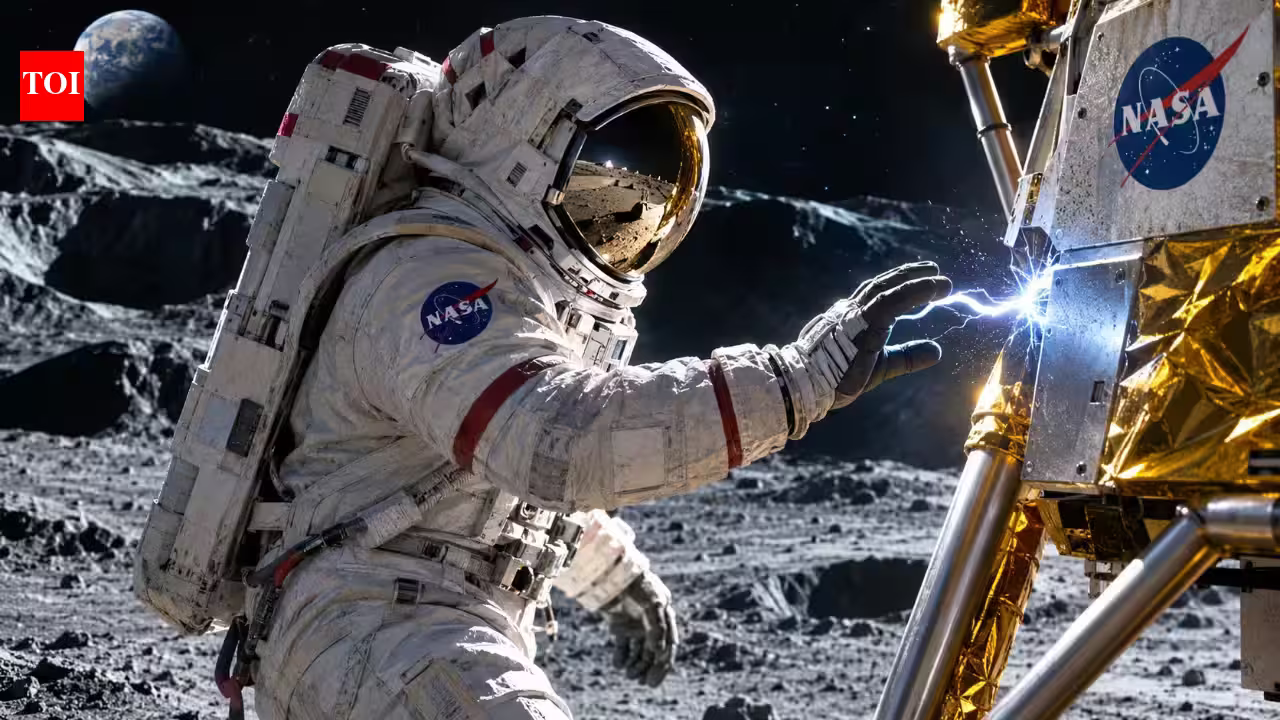
NASA is offering up to $150,000 in prize money to find a solution to a potentially dangerous problem future astronauts could encounter while exploring the Moon. As astronauts walk across the lunar surface, their spacesuits can accumulate electrical charge through contact with lunar soil and interactions with the surrounding plasma. The problem could become particularly serious when they enter permanently shadowed regions near the lunar South Pole, where electrical charge may build up significantly. When astronauts return to their spacecraft, the difference in electrical potential between their suits and the lunar lander could trigger a sudden electrical discharge, producing a spark. NASA is now inviting innovators to develop technology that can safely neutralise this charge before astronauts approach or touch their spacecraft.
Why astronauts’ spacesuits could accumulate static electricity
NASA’s Lunar Grounding Challenge, announced on October 6, 2026, identifies two processes that could cause electrical charge to accumulate on spacesuits during lunar surface activities.The first is known as tribocharging, which occurs when two materials come into contact and separate, transferring electrical charge between them. As astronauts walk across the lunar surface, repeated contact between their boots and the lunar soil, known as regolith, could generate static electricity.The second process involves plasma charging. The Moon is exposed to the solar wind and surrounding plasma, which contain electrically charged particles. Interactions between these particles and an astronaut’s spacesuit can also change its electrical potential.According to NASA, both processes could contribute to significant charge accumulation during lunar surface excursions.
Why permanently shadowed regions pose a greater risk
The problem could become particularly severe when astronauts explore permanently shadowed regions (PSRs) near the lunar South Pole.These are areas, generally located inside deep craters, that receive little or no direct sunlight. NASA explains that spacesuits entering these dark regions could develop a substantial negative electrical potential because of two factors: the lack of ambient ion flux and the absence of photoelectron emission to balance the collection of ambient electrons.In simpler terms, the spacesuit could accumulate excess negative electrical charge without the usual environmental processes helping to balance it.The danger becomes more pronounced when astronauts leave these shadowed areas and return to their spacecraft, which could have a slightly positive electrical potential in sunlit regions.
How touching a lunar lander could trigger an electrical spark
NASA warns that a significant difference in electrical potential between an astronaut and a lunar lander could produce an electrostatic discharge.The agency describes a scenario in which an astronaut returning from a permanently shadowed region carries substantial negative electrical charge. Meanwhile, the stationary lander in a sunlit area holds a slightly positive electrical potential.When the negatively charged astronaut approaches the spacecraft, the difference in electrical potential could trigger an electrical arc, essentially a sudden spark, during physical contact.NASA warns that such a discharge could have several consequences:Spacesuit damage: An electrical arc could degrade important layers of the spacesuit.Electronic failures: Sensitive electronics integrated into the spacesuit could be damaged.Electrical shocks: Astronauts could experience potentially dangerous electrical shocks.Fire-related hazards: NASA warns that an electrical discharge could threaten the oxygen-rich environment inside the spacesuit.The concern is therefore not simply the discomfort of a static shock. A sudden electrical discharge could compromise equipment and create a safety risk during a lunar mission.
NASA wants a system that can safely discharge astronauts
Through its Lunar Grounding Challenge, NASA is seeking innovative designs for an electrostatic discharge (ESD) mitigation system.The proposed technology must safely neutralise the electrical charge accumulated on an astronaut’s spacesuit before the astronaut directly interacts with the lunar lander.NASA has outlined several specific engineering requirements for the proposed solution:It must safely discharge an astronaut starting at an electrical potential of -100 kilovolts or greater to a lander at approximately +100 volts.The discharge current at the spacesuit interface must not exceed 1 milliampere, with a design target of 0.2 milliamperes or less.Any electrical arc must not come into contact with the astronaut or their spacesuit.The complete system must weigh less than 20 kilograms.It must support up to four extravehicular activities (EVAs) over 10 days.It must operate in the extreme temperatures encountered on the lunar surface.NASA also specifies that the system should minimise its volume and power requirements. If necessary, the lunar lander can provide up to 40 watts of electrical power and powered heaters to help regulate the system’s temperature.The agency’s worst-case design scenario allows for a discharge lasting up to 30 seconds.
Lunar dust could make electrical discharges more dangerous
Another complication is the presence of lunar dust, which could make controlling electrical discharges more difficult.Unlike ordinary dust on Earth, lunar regolith consists of fine particles that can become suspended and accumulate on spacesuits during surface operations.NASA warns that suspended lunar dust and heavy dust accumulation on spacesuits can significantly increase the distance over which electrical arcs occur. This means sparks could potentially jump across larger gaps than they would in a clean vacuum.The challenge specifies lunar dust particle sizes ranging from approximately 0.02 to 10 micrometres.Consequently, NASA wants a grounding system that can operate in dusty conditions without allowing a sudden electrical arc to come into contact with an astronaut’s outer pressure garment or the lander.
How NASA’s $150,000 challenge will work
NASA has organised the Lunar Grounding Challenge into two phases, inviting participants to submit concepts for a technology that could address the problem.Phase 1: Concept design submissionParticipants must submit their proposed designs and explain how their systems would safely neutralise electrical charge accumulated on astronauts’ spacesuits.NASA does not require participants to manufacture a physical prototype or conduct fabrication testing during this phase.Following the initial evaluation, up to five finalists will be selected to advance.Phase 2: Concept refinementThe selected finalists will receive consolidated written feedback from NASA’s review panel. They will then have an opportunity to strengthen their designs and address weaknesses before the final evaluation.The competition is free to enter and offers a total prize pool of up to $150,000.The challenge opened on October 5, 2026, and submissions close on January 15, 2027. Registration and competition details are available through NASA Tournament Lab, hosted on the CrowdPlat platform.
Why the challenge matters for future Moon missions
NASA’s focus on the lunar South Pole is closely connected to its plans for sustained human exploration of the Moon.The region contains permanently shadowed craters that scientists consider important locations for investigating potential water ice deposits. Exploring these environments could provide valuable information about lunar resources and help support future human activities on the Moon.However, astronauts exploring these areas will need to move between sunlit terrain and regions that remain in darkness. Managing electrical charge accumulated during these activities could therefore become an important part of ensuring their safety.Through the Lunar Grounding Challenge, NASA is attempting to address this relatively unfamiliar hazard before future astronauts encounter it during lunar surface operations.