






Nov 21: Dubai’s skyline tells the story of an economy built on ambition, investment and continuous development. From world-class commercial buildings and residential communities to advanced transport networks and major logistics facilities, construction has played an important role in transforming the emirate into an international business and investment destination.
However, the next phase of Dubai’s construction growth is about more than adding new buildings to its skyline. The focus is increasingly shifting towards infrastructure that can support a growing population, improve business connectivity, strengthen international trade and create opportunities across different industries.
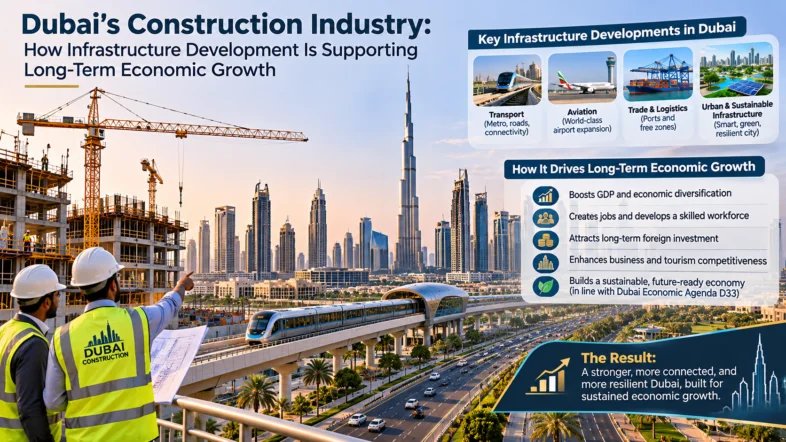
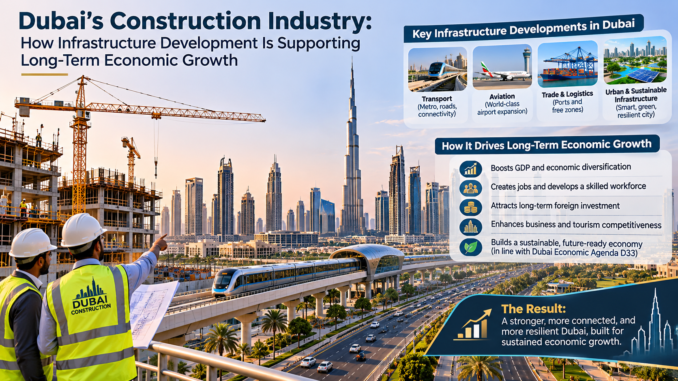
Investments in transportation, airport facilities, urban communities, industrial infrastructure and sustainable buildings are helping shape Dubai’s long-term economic future. These developments are also creating opportunities for construction companies, engineering consultancies, technology providers, material manufacturers and international investors.
With the Dubai Economic Agenda D33 and Dubai 2040 Urban Master Plan guiding its development priorities, infrastructure investment is becoming an important part of the emirate’s strategy to build a more diversified and competitive economy.
Construction Growth Is Closely Linked to Dubai’s Economic Performance
The importance of the construction industry becomes clearer when viewed against Dubai’s broader economic performance.
According to the Government of Dubai’s economic update released in October 2026, the emirate’s real GDP reached approximately AED 473 billion in the first half of 2026. Construction recorded real growth of 2.4%, with value added reaching AED 33.2 billion at constant prices. At current prices, the sector’s value added stood at AED 35.3 billion, an increase of 8.6% year on year.
This reflects the continuing demand for construction, engineering and infrastructure services across the emirate.
The sector also has a wider economic impact. A major infrastructure project creates demand for building materials, machinery, engineering expertise, transportation and specialised services. Once operational, the completed infrastructure can support new commercial activity, improve accessibility and attract further investment.
This makes construction an important link between physical development and economic diversification.
Major Infrastructure Investments Are Shaping Dubai’s Future
Dubai’s infrastructure strategy is increasingly focused on connecting different parts of the emirate and preparing for future economic and population growth. Several major developments illustrate this direction.
1. Dubai Metro Expansion Is Creating New Connectivity Opportunities
Transportation is among the most important foundations of a growing business economy. Efficient public transport reduces commuting difficulties, improves access to commercial districts and supports the development of new residential communities.
One of the significant developments announced in April 2026 is the Dubai Metro Gold Line, involving an investment of approximately AED 34 billion. The planned 42-kilometre route will have 18 stations and connect with the existing Red and Green Lines, as well as Etihad Rail.
The project is expected to strengthen public transport connectivity and support the movement of residents, employees and visitors across important economic areas.
Another important development is the Dubai Metro Blue Line, a 30-kilometre route featuring 14 stations. It is designed to connect emerging residential, educational and commercial areas, with completion planned for 2029.
Together, these projects demonstrate how transport infrastructure can influence urban development, property demand and business location decisions.
2. Al Maktoum International Airport Is Strengthening Dubai’s Global Connectivity
Airport infrastructure is another major component of Dubai’s long-term development strategy.
The expansion of Al Maktoum International Airport is expected to strengthen the emirate’s position as an international aviation, tourism and logistics hub.
The airport development programme has an allocated budget of AED 16 billion for the projects covered in the government’s June 2026 update. Work includes runway infrastructure, terminal-related development and improvements to supporting aviation facilities. The first phase remains on course to commence operations in 2032.
For the construction industry, airport development creates opportunities across civil engineering, specialised building systems, electrical infrastructure, technology integration and project management.
The wider economic benefits could extend to hospitality, cargo handling, warehousing, transportation and businesses involved in international trade.
3. Community Infrastructure Is Supporting Urban Development
Economic growth also depends on the quality of everyday infrastructure available to residents.
Dubai Municipality announced in October 2026 that it had completed more than 107 urban development projects worth AED 1.6 billion during the year. These included public beaches, parks, neighbourhood improvements, landscaping and community facilities.
The programme also created more than 100 investment opportunities across public facilities, including opportunities for small and medium-sized businesses.
These developments highlight an important change in the construction market. Infrastructure investment is not limited to large commercial projects. Smaller companies involved in landscaping, maintenance, public facilities, environmental services and specialised construction can also participate.
Dubai 2040 Urban Master Plan: Building a City for the Future
Dubai’s long-term urban development is guided by the Dubai 2040 Urban Master Plan.
The plan focuses on improving the quality of urban life while managing population growth and land use more effectively. It promotes integrated communities, improved public transport access, green spaces and the development of key urban centres.
One of its important principles is transit-oriented development, where residential and commercial growth is encouraged around public transportation networks.
This approach has significant implications for construction companies and property developers.
Instead of developing isolated residential or commercial projects, the emphasis is increasingly on creating connected communities with access to employment, education, healthcare, retail and recreational facilities.
For businesses, this means potential opportunities in residential and mixed-use development, commercial infrastructure, healthcare and educational facilities, urban landscaping, smart utilities and sustainable construction.
The plan’s emphasis on coordinated urban growth also makes infrastructure planning important for maintaining the long-term value of real estate investments.
How Dubai Economic Agenda D33 Is Supporting Construction Growth
Dubai’s construction ambitions are closely connected to the Dubai Economic Agenda D33, which aims to double the size of the emirate’s economy by 2033.
The agenda focuses on strengthening international trade, attracting foreign investment, supporting private-sector growth and developing Dubai as a leading global business destination.
Infrastructure is central to these ambitions. International businesses require efficient transport, modern commercial facilities, reliable utilities and well-connected logistics networks.
As Dubai attracts more companies across financial services, technology, manufacturing, healthcare and logistics, the demand for supporting infrastructure is expected to evolve.
This creates opportunities for construction companies beyond conventional residential development.
Industrial facilities, warehouses, business parks, commercial offices and technology-enabled buildings are becoming important parts of the broader development landscape.
For international engineering and construction firms, D33 provides a wider economic context for understanding the emirate’s long-term investment priorities.
Real Estate Development Continues to Drive Construction Demand
Real estate remains closely connected to the performance of Dubai’s construction industry.
The demand for residential apartments, villas, commercial properties, hospitality developments and mixed-use communities continues to create opportunities for developers and construction companies.
According to the Dubai Land Department’s Annual Data Review 2025, the emirate recorded 270,328 real estate transactions worth AED 917 billion during the year. Transaction value increased by 20% compared with 2024.
The report also recorded 193,100 unique investors, reflecting the depth of participation in the market.
However, the long-term performance of the property market depends on more than the number of new buildings being developed.
Buyers, tenants and investors also consider transport accessibility, surrounding infrastructure, schools, healthcare facilities and commercial amenities.
This is encouraging developers to focus on integrated projects that combine residential spaces with retail, leisure, hospitality and essential services.
For construction companies, this creates demand for architectural planning, engineering, project execution and infrastructure management.
Smart Technology Is Transforming Dubai’s Construction Industry
Technology is changing how construction projects are designed, monitored and delivered. As infrastructure projects become larger and more complex, developers are increasingly looking at digital solutions to improve efficiency, manage costs and minimise delays.
Some of the technologies gaining importance include:
Artificial Intelligence: AI-powered systems can help companies forecast project costs, monitor construction progress, identify potential delays and improve resource allocation.
Building Information Modelling (BIM): Digital building models allow architects, engineers and contractors to coordinate designs, identify potential conflicts and improve project planning.
Automation and Robotics: Automated machinery and robotic systems can improve productivity in repetitive construction activities and support greater precision.
Smart Building Management: Connected sensors and monitoring systems can help manage electricity consumption, ventilation, lighting and maintenance requirements.
Digital Project Management: Cloud-based platforms improve coordination between contractors, suppliers, developers and project management teams.
For technology providers, Dubai’s expanding construction ecosystem presents opportunities to offer software, automation, monitoring and infrastructure management solutions.
Sustainability Is Becoming a Priority in Infrastructure Development
As Dubai continues to expand, managing energy consumption, water resources and environmental impact is becoming increasingly important.
Sustainable construction is therefore moving beyond an additional feature to become an important consideration in project planning.
Developers are showing greater interest in energy-efficient buildings, environmentally responsible construction materials, water conservation systems and renewable energy integration.
This shift is creating opportunities for companies specialising in green building materials, solar energy, energy-efficient cooling and ventilation, water treatment, smart energy monitoring and environmental consultancy.
For commercial property owners and developers, energy efficiency can also help reduce long-term operating expenses.
As infrastructure requirements evolve, businesses that combine construction expertise with sustainable technologies could find new opportunities in Dubai’s development market.
What Business Opportunities Does Dubai’s Construction Growth Offer?
The expansion of infrastructure is creating opportunities across the entire construction value chain. While major developers and contractors remain important, specialised service providers and smaller businesses can also participate in the market.
| Business segment | Emerging opportunities |
|---|---|
| Construction materials | Cement, steel, aluminium, glass and prefabricated components |
| Engineering consultancy | Architecture, structural engineering and project management |
| Construction technology | AI, BIM, automation and digital monitoring |
| Logistics | Material transportation, warehousing and equipment distribution |
| Facility management | Building maintenance, security and technical services |
| Sustainable infrastructure | Renewable energy, water management and green materials |
For international companies, partnerships with local developers, engineering firms and contractors can provide opportunities to enter Dubai’s construction ecosystem.
The market also offers potential for businesses supplying specialised equipment, software and services that support infrastructure projects throughout their lifecycle.
Challenges Facing Dubai’s Construction Industry
Despite the opportunities, the construction sector must manage several operational and financial challenges.
Rising material costs, labour availability, project financing and supply chain pressures can influence project budgets and completion schedules. Large developments also require coordination between government authorities, developers, contractors and suppliers.
Another important consideration is maintaining a balance between construction activity and actual market demand.
Infrastructure development must support population growth, business requirements and long-term economic priorities rather than simply increase the supply of buildings.
Companies that invest in better project management, cost control, technology and sustainable construction practices will be better positioned to manage these challenges.
What Lies Ahead for Dubai’s Construction Industry?
Dubai’s construction industry is gradually moving towards an integrated infrastructure development model. The emphasis is shifting from individual real estate projects towards connected infrastructure that supports businesses, communities and economic activity.
The planned expansion of metro networks, development of airport facilities, investment in public infrastructure and growth of residential communities indicate the direction in which the sector is heading.
Technology and sustainability will also play a greater role in determining how future projects are designed and delivered.
For construction companies, developers, investors and international service providers, the opportunities will increasingly depend on their ability to understand changing infrastructure requirements and deliver projects that serve long-term economic needs.
The combination of urban planning, transportation connectivity, commercial development and smart infrastructure could help Dubai strengthen its position as a global destination for business and investment.
Conclusion
Dubai’s construction industry is evolving beyond traditional real estate development to become an important part of the emirate’s long-term economic strategy. Investments in transportation, aviation, residential communities, public facilities and sustainable infrastructure are helping create the foundations for future growth.
The significance of these developments lies not just in the projects themselves, but in the economic activity they can generate. Better connectivity can support businesses, modern communities can attract skilled professionals, and advanced infrastructure can strengthen Dubai’s position in international trade and investment.
As the objectives of Dubai Economic Agenda D33 and the Dubai 2040 Urban Master Plan continue to shape development priorities, construction will remain an important contributor to the emirate’s economic transformation.
For companies operating in engineering, logistics, building materials, construction technology and sustainability, Dubai’s infrastructure expansion presents opportunities across multiple business segments.
Ultimately, Dubai’s next phase of construction growth will be measured not simply by how much it builds, but by how effectively its infrastructure supports businesses, communities and the economy of the future.