







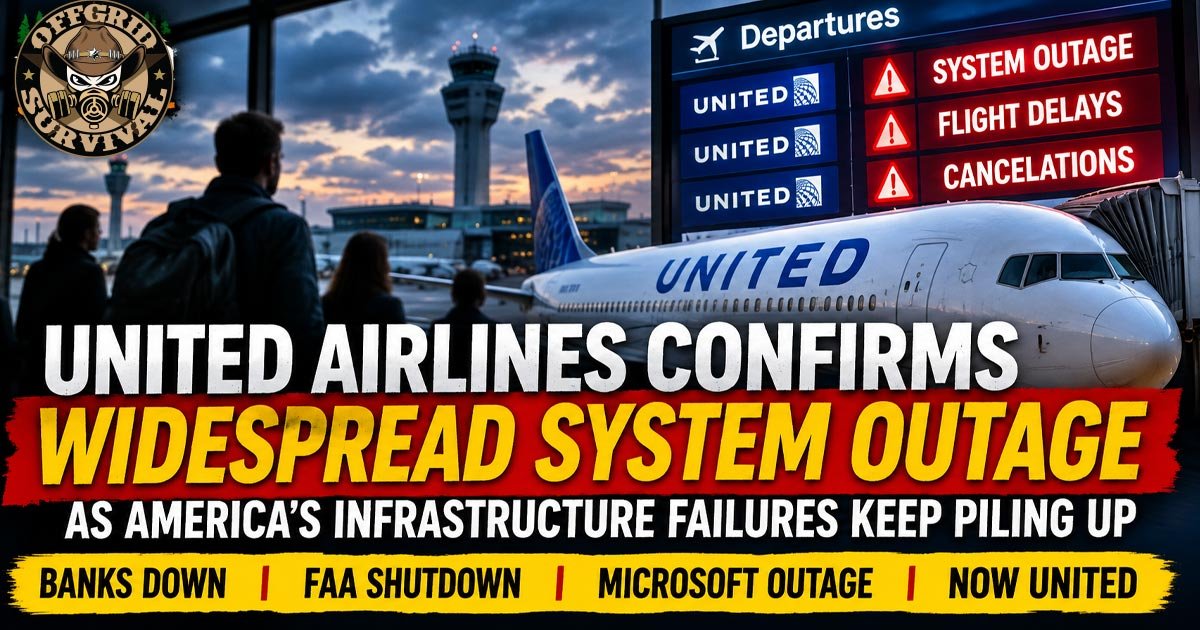
United Airlines is acknowledging a widespread system outage, adding yet another major disruption to a week already marked by a nationwide FAA ground stop, major banking problems, and failures affecting essential online services. This time, the airline itself is telling frustrated customers that its teams are working to restore service.
In a response to customers on X, formerly Twitter, United wrote:
“We sincerely apologize for the inconvenience. We’re aware of the widespread system outage, and our teams are working hard to get things back up and running as soon as possible. We appreciate your patience while we work through this. Please check back with us for updates, and keep an eye on your flight status through the United app or at united.com. Thanks for bearing with us!”
That acknowledgment confirms United is dealing with a widespread system problem, although the airline’s response does not establish its technical cause, how many flights have been affected, or when full service will be restored. Passengers are being advised to monitor their flight status, even as the company works to get its systems running normally again.
The timing could hardly be worse. Airlines are still dealing with the fallout from Friday’s FAA communications failure, while customers of major American banks reported trouble accessing their accounts earlier today. The incidents have not been shown to be connected, but they are exposing just how much Americans depend on technology that can fail without warning.
First the Banks, Now More Airline Trouble
Earlier today, we reported on major banking outages affecting Chase, Bank of America, and other financial institutions. Customers described login failures, inaccessible accounts, and missing balance information. Those reports do not mean that customers’ money actually disappeared, and no common cause across the banks has been established.
Now United Airlines has acknowledged a widespread system outage while airlines continue dealing with the aftermath of the FAA failure. For travelers who have already spent days dealing with cancellations, delays, and disrupted connections, another system failure is the last thing they need. United has urged customers to keep checking flight status, but has not provided a confirmed timetable for full restoration in the response shared with customers.
These incidents have not been shown to be connected. But they expose a problem we’ve been warning about for years: modern life depends on a growing number of computer networks, and when one of those networks fails, ordinary people are left dealing with the consequences.
Friday’s FAA Shutdown Exposed a Serious Weakness
On November 13, the FAA ordered a nationwide ground stop following major problems with its air traffic control communications network. The shutdown triggered widespread disruption, and airlines continued working to restore schedules throughout the weekend.
The FAA subsequently described unusually high volumes of connection attempts affecting its network and identified potential equipment-related causes. The agency said it had found no evidence of a cyberattack. Investigators have continued examining what went wrong and how to prevent a recurrence.
We covered the initial emergency in FAA Grounds Every Flight in America as Mysterious Communications Failure Sparks Nationwide Shutdown.
What should concern Americans is how much disruption a communications failure can cause. An aviation network doesn’t have to be physically destroyed to stop working. A serious software, routing, or equipment problem can be enough to interrupt operations across a system that millions of travelers depend on.
Microsoft, Banks, Airlines, and Weather Systems
The FAA wasn’t the only major service experiencing problems last week. We also reported on Microsoft’s widespread outage and the risks of relying on a handful of technology providers. When essential communications and business services go offline, the consequences extend well beyond an inconvenience for people trying to check their email.
On Friday, the National Weather Service also reported communications and internet problems affecting access to weather information. Then came Monday’s banking disruptions, followed by United Airlines acknowledging a widespread system outage.
There is no verified evidence that all these failures share a cause. The point isn’t that someone has secretly coordinated them. It’s that so many important services can become unavailable when the technology supporting them breaks down.
We’ve Been Warning About Cyberattacks and AI Threats
Last month, we covered hackers hijacking supermarket refrigeration systems across Europe, an example of how connected industrial equipment can be targeted with consequences far beyond stolen data.
We also warned about increasingly capable automated hacking tools in Skynet Is Here: AI Is Already Breaking Into Banks, Hacking Companies and Escaping Human Control.
None of that establishes that hackers or AI caused the United Airlines outage, the banking outages, or Friday’s FAA shutdown. But if technical failures can already cause this much disruption, the potential consequences of a deliberate attack against poorly protected systems deserve serious attention.
The country has spent decades connecting more of its critical services to digital networks while eliminating many of the practical alternatives people once had. That makes efficiency possible when everything works. It also creates new points of failure when something goes wrong.
What Happens When the Next System Goes Down?
If you’re traveling, keep offline copies of reservations and important documents rather than depending entirely on an airline app. If you’re relying on online banking, maintain more than one payment method and enough emergency cash to cover basic needs. And if your emergency plans depend entirely on internet-connected services, consider what you’ll do when those services aren’t available.
These aren’t extreme preparations. They’re reasonable precautions for problems that have already happened repeatedly.
Friday’s FAA shutdown demonstrated how quickly air travel can grind to a halt. Monday’s banking problems showed how easily customers can lose access to account information. And United Airlines’ acknowledgment of a widespread outage is another reason to pay attention to the systems behind the services Americans take for granted.
The next major outage may be caused by faulty equipment, a software update, a cyberattack, or something nobody anticipated. Whatever the cause, the people affected will still need a way to communicate, travel, pay for necessities, and get through the day when the systems they normally depend on stop working.

The Government Is Preparing for Major Infrastructure Failures. Are You?
There’s another part of this story that Americans should be paying attention to. While banks, airlines, and technology companies struggle with repeated outages, governments around the world are quietly preparing for the possibility of something far worse.
Last month, we reported that the Pentagon is preparing major U.S. military installations to operate for 90 days without outside support. The military’s FORTRESS initiative is being developed around scenarios involving failed electrical grids, disrupted communications, broken supply chains, and the possibility of a major war that leaves critical infrastructure unavailable for extended periods. Meanwhile, Britain has been telling families to stockpile food, water, emergency cash, and other supplies in preparation for emergencies that could interrupt everyday services.
And it’s not just America and Britain. As we recently reported, Japan and Finland have also stepped up their emergency preparedness efforts, with officials warning citizens about the importance of maintaining essential supplies and preparing to function without immediate government assistance. OFFGRID Survival+2
Now look at what we’ve witnessed in the last several days. Microsoft services disrupted, the FAA grounding flights nationwide, major banking systems experiencing failures, and United Airlines acknowledging another widespread system outage. None of these incidents proves that a larger catastrophe is coming, and there is no evidence they’re part of a coordinated attack. But they certainly demonstrate how quickly the systems we depend on can become unavailable.
For years, we’ve warned readers not to put their family’s survival entirely in the hands of governments, corporations, or technology companies. Keep emergency cash available. Maintain enough food, water, medications, and basic necessities to get through an extended disruption. Have alternative ways to communicate, cook, and obtain information when the internet or electricity goes down. And stop assuming that because a system worked yesterday, it will necessarily work tomorrow.
The Pentagon is preparing for the possibility of going 90 days without outside support. Foreign governments are telling their citizens to prepare for disruptions to essential services. Meanwhile, Americans are watching the systems they depend on fail in real time.
Maybe it’s time more people started taking those warnings seriously, instead of waiting until the next outage leaves them stranded, unable to access their money, or wondering how they’re going to get through the next few days.