



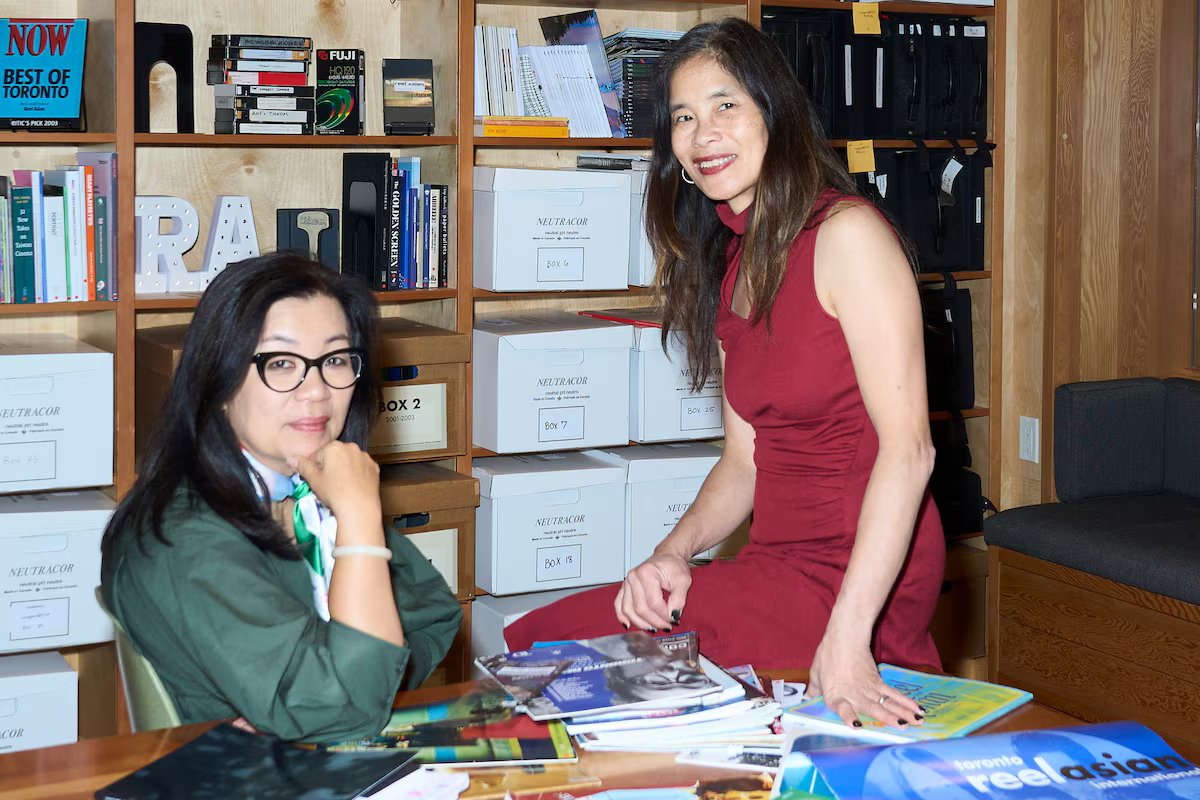





Toronto Reel Asian International Film Festival Founder Anita Lee and Executive Director Deanna Wong reflect on the event’s 30th year.May Truong/The Globe and Mail
There was something in the air when Anita Lee started the Toronto Reel Asian International Film Festival in 1997.
That same year, the Vancouver Asian Film Festival also sprang up, with programmers buoyed by a new wave of independent Asian-American films bursting onto the scene (including Rea Tajiri’s Strawberry Fields, Chris Chan Lee’s Yellow, and Quentin Lee and Justin Lin’s Shopping for Fangs).
Reel Asian film festival makes space for Canadian stories in an isolationist world
At the time, Lee never imagined that her festival would make it past a decade, let alone three. But this week, Reel Asian kicks off its 30th edition by celebrating its past at the same time that it has its eye trained on the future. In addition to its anniversary milestone, the festival is marking the departure of long-time executive director Deanna Wong, with associate director Kelly Lui succeeding her.
Ahead of this year’s fest, which runs Nov. 11-29, The Globe and Mail sat down with Wong and Lee (who is now the chief programming officer for the Toronto International Film Festival) to talk about a generational run.
Anita, when you started the festival, did you have a roadmap in mind as to where it might go?
Anita Lee: Well, did I think that the CN Tower would be turning red to celebrate Reel Asian? No, I did not. But I think that speaks to the community and the audience that have supported us over the years to come to this landmark time. My roadmap or vision, though, when I started was during when a few things converged. I had just made a short film, I had held a position at the Canadian Filmmakers Distribution Centre, which was an important experimental hub, and there were also a lot of identity politics happening at the time. I wanted to create a space where we were no longer defining what Asian diasporic stories are, but to create a space where we can support the work that was being made. This work was being created in the margins, but not being programmed in festivals.

Three decades after creating Reel Asian, Lee is now the chief programming officer for the Toronto International Film Festival.May Truong/The Globe and Mail
It’s funny thinking about 1997, because that’s when the Vancouver Asian Film Festival also started.
Lee: Yes, and Barbara Lee from Vancouver’s festival, I ran into her that same year in San Francisco for that city’s Asian-American film festival, and she and I witnessed that moment together. It was almost that Asian-American new wave movement of feature films that were travelling all over the circuit. It was groundbreaking.
Deanna, when you first joined the organization in 2005, how would you say Anita had built up the institution?
Deanna Wong: I moved to Toronto from Winnipeg around the end of ’96, and I stumbled onto the festival that first year, not knowing Anita or the community. I was just going as an Asian-Canadian person who loved movies and craved some representation on screen. I remember seeing Yellow, and being hooked immediately. I eventually joined the board, and then decided to apply for the job of executive director. I was just thrilled that there was a festival full of films like this, it was so rare. I could count on one hand the number of times I’d seen any American or Canadian movie that starred more than one or two Asian people.
Anita, what was the transition like for you to have built this up and then hand it over to others?
Lee: I ran the festival hands-on as executive director and director of programming for three years, and had never planned to do that as a career. But I wanted to set it up as a not-for-profit organization, so I’d spent that time looking for baseline operational funding, and that fourth year I moved onto the board and served as chair for 10 years. It was about growing the festival incrementally. At that time, I remember Cameron Bailey asked me, “Does success mean that Reel Asian would not need to exist in the future?” But even more than ever, we need this festival. There’s so much more that the festival supports year-round.

Wong says leaving the organization will help to make space for the next generation.May Truong/The Globe and Mail
Wong: I had left the festival for a bit, but when I came back in 2019, that was at the height of the Crazy Rich Asians phenomenon, and there was a lot of excitement about what the success of that film meant. Have we arrived in the mainstream? But we also had this peak of DEI initiatives of creating film and television projects that’s now been waning. So what has remained this whole time is the need for the community to support each other in writing and directing stories that reflect their own experiences.
Lee: Every time there’s a wave of Asian cinema from Asia, there’s a similar question that arises. When there was the time of John Woo and Hong Kong action films, there was that question of do you need places like Reel Asian. But today, Reel Asian, in terms of the programming and the audience development and the community, it’s still in advance of the industry in general. I don’t feel that the presence of Asian-Canadian filmmakers has grown in a significant way. There hasn’t been significant support for this community to develop at the rate that they should have. We joke about how there’s always support given for emerging directors, but not looking at how you bring those people through the industry. The first wave of Asian-Canadian directors are emerging, but into retirement.
We see certainly a lot more opportunity, and then success, with Asian-Canadian filmmakers working in the U.S. system.
Lee: Look at Celine Song, who has made one of the biggest American independent movies with Past Lives. Maggie Kang with KPop Demon Hunters. Domee Shi with Turning Red. There’s a gap, and what have we not been able to do in Canada that they, for example, have been not able to have those careers here? I’m thrilled they have made it in Hollywood, but there are so many other directors here who, given the opportunity, could be working in a much more significant way. For some reason that nut has not been cracked.

Archival pieces for Reel Asian displayed at the organization’s Toronto office.May Truong/The Globe and Mail
Wong: And we’re aware of that by developing our year-round programming to address that. We’ve stopped emphasizing our kind of Filmmaking 101 parts of our industry series so we can create something like our Fire Horse Award, whose $25,000 allows those filmmakers to continue doing their work in Canada. We’re not trying to create a star system necessarily, but providing the opportunity for experienced filmmakers to be recognized and keep the spotlight on them.
Deanna, why did you feel now was the right time to depart?
Wong: I feel like all organizations need to grow and have fresh blood to keep things going. Thirty is a nice round number, too. Also, it is a tough time for non-profit arts organizations and we’ve weathered a number of minor crises along with everybody else. We’re in a relatively strong position and have staff, including Kelly, who have a lot of institutional memory. I can leave and make space for the next wave, wherever the next 30 years go.
The 30th edition of the Toronto Reel Asian International Film Festival runs Nov. 11-29 in Toronto (reelasian.com).
This interview has been condensed and edited.