








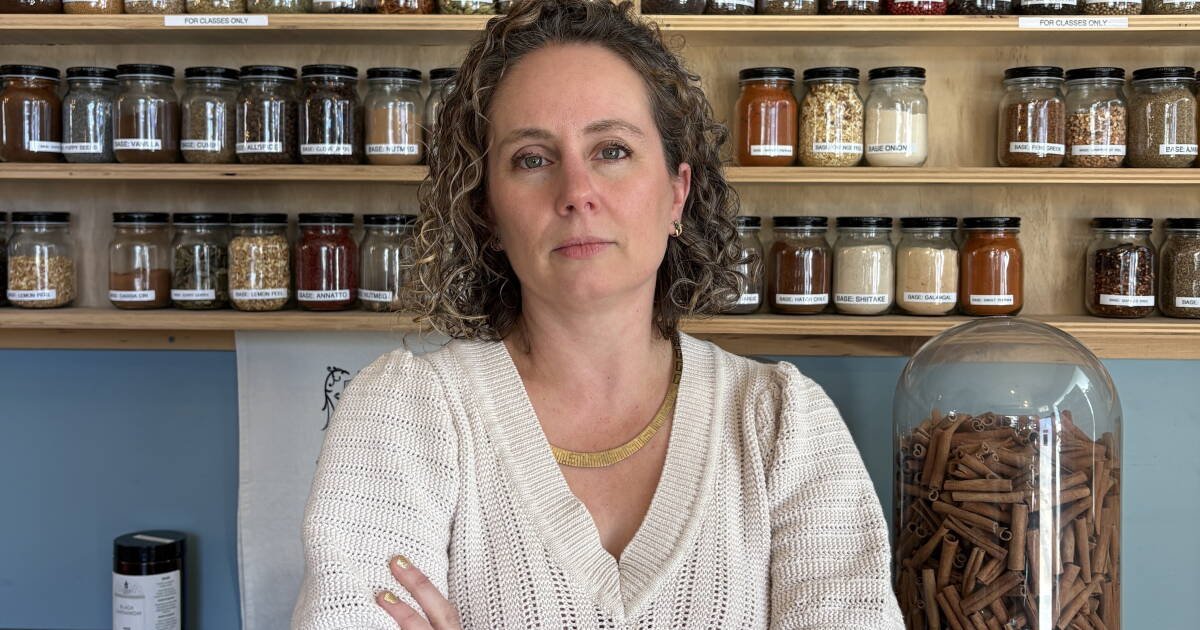
It’s been a tough year for Claire Cheney, the founder of Curio Spices, a local spice retailer in Cambridge.
“I’ve never written a letter quite like this, but I hope you’ll receive it in the spirit it’s intended,” she wrote in a recent email to Curio’s newsletter subscribers. “The truth is, Curio could use your help right now, and we all need to speak up more when we need help.”
Cheney’s business relies on spice imports from South America, Asia and Africa. So when the Trump administration announced its “Liberation Day” tariffs in April 2025, she had to reorient the entire company’s business model.
“It just turned everything into chaos,” she told GBH News.
Curio is one of 234,000 small businesses across the country hit by Trump’s tariffs, which lasted from April 2025 until February 2026.
The company paid about $14,000 in tariffs. So when the Supreme Court ruled the tariffs unlawful and mandated the administration refund businesses, Cheney applied for $10,000. However, she was only able to get $12.56 back.
“Not surprisingly,” her email continued, “it’s been a battle to maintain momentum for Curio.”

Renuka Balakrishnan / GBH News
An October 2026 report from the Center for American Progress found that firms employing fewer than 500 people bore the brunt of the tariffs — and also saw lower refunds. On average, Massachusetts small businesses paid $151,000, but got just $53,000 back.
“The big multinationals, they’re talking about refunds on their earnings calls. … There’s a big windfall for a lot of these companies,” said Ryan Mulholland, senior fellow at CAP and co-author of the report.
According to Mulholland, getting $12.56 of $10,000 is uniquely low — but the discrepancy is indicative of a broader process problem.
“The Trump administration has not made this easy,” he said.
To apply for the refunds, importers like Cheney must identify individual eligible entries, find the corresponding individual entry numbers and submit a form declaring those through a special portal. In some cases, the importer may have to submit additional information depending on the entry’s status.
Direct importation is central to Curio’s business model. That meant Cheney’s staff was responsible for the refund application from start to finish, navigating site glitches and long customer service calls.
“The refund system was disorganized and unfortunately put the onus on the business owners to figure it out,” she said.
For a 35-person company with no full-time logistical coordinator, that was a tall order.
Importer complications
Alex Whitmore, co-founder and CEO of Taza Chocolate in Somerville, was spared from chasing down the refunds by himself. That’s because Taza uses a third-party importer, who initially paid for the tariffs at the border, buying Whitmore some time to pay that amount back.
The importer was able to track down almost all of nearly $150,000 in tariffs on cocoa and sugar from Africa and Latin America — but still charged Whitmore a high interest rate on the initial tariff payments.
“Our interest rate was about 9% APR, so it wasn’t a small amount,” Whitmore said. “That money, we’ll never get back.”

Renuka Balakrishnan / GBH News
Not every experience with a third-party importer has been so smooth.
In Worcester, American Vinegar Works ferments and packages its own vinegars from domestic alcohols. But the firm imports its packaging, and from April 2025 to February 2026, the company paid over $5,000 in tariffs on glass bottles from Taiwan with an additional $1,100 on special pour-tops from Spain.
Founder Rodrigo Vargas said he has still not gotten a single dollar refunded. American Vinegar Works employs three full-time staffers. Vargas alone handles the business side.
Vargas contracted with a third-party importer for the glass bottles, which meant that firm, and not the vinegar company, is responsible for applying for the refund and sending the money back to American Vinegar Works. Vargas said he has asked the importer repeatedly for updates, but has heard nothing substantial back.
Vargas declined to share the name of the importer because American Vinegar Works still works with them — and he remains hopeful he will hear from them soon.
Trump’s tariffs were aimed at giving U.S. manufacturers like American Vinegar Works an advantage. Vargas noted the irony in that fact.
“I think we are the people … that were intended to thrive because of tariffs,” he said. “But for us, it backfired in a whole lot of ways.”

Courtesy of Rodrigo Vargas / American Vinegar Works
‘We’re paying for it twice’
Cheney and Whitmore both decided not to pursue all the refunds they are owed. For them, it came down to team bandwidth.
“We’re paying for it twice. So first we’re paying with our actual money, and then we’re paying again in the time spent paying our teammates to do the paperwork,” Cheney explained.
Vargas is determined to get the remainder of his refund — when he has the time.
“I very much want those $1,100,” he said. “But it’s hard to prioritize that over getting ready for … Black Friday.”
Small businesses make up 97% of US importers. For these firms, the cost goes beyond dollars paid at the border.
“I think the biggest negative impact of tariffs wasn’t necessarily the financial impact. It was the uncertainty,” Whitmore said. “It took up so much of our energy trying to figure out what was going to happen next and figure out how to deal with what was happening now, that we couldn’t focus on those longer-term things like putting in a new machine in the plant.”

Renuka Balakrishnan / GBH News
It’s not clear the refunds — even if paid in full — will repair the damage. The CAP report predicted smaller firms might use this refund to pay down debts incurred during the tariff period, rather than put that money toward business development as a large company might have the flexibility to do.
“For a smaller business, everything has sort of an outsized impact,” Cheney said.
