

Japan’s corporate landscape has undergone a significant transformation over the past decade, with governance reform, stronger capital efficiency, greater pressure to improve shareholder returns, and more disciplined capital allocation becoming increasingly important considerations for corporate management. Among companies listed on the TSE Prime and Standard markets, there is now greater attention to cost of capital and share price, while Japan is simultaneously seeking to deepen its relationship with international investors and global capital. With the country’s inward foreign direct investment position reaching approximately ¥58.6 trillion at the end of 2025, this appears to represent a broader change in how Japanese corporations think about growth and corporate value. From your perspective, what has fundamentally changed in the way Japanese companies approach capital, profitability, growth, and international investors? How important was the Abe administration in initiating this shift, where does the traditional corporate mindset still persist, and how do you expect Japanese corporate management to continue evolving?
I believe the major turning point came around 2015, during the Abe administration. There has certainly been a significant change since that period. Following the collapse of Japan’s bubble economy, the country experienced approximately two decades of deflation, and that environment contributed to stagnation among Japanese companies. For a long period, the corporate mindset remained relatively unchanged.
Since around 2015, however, Japanese companies have increasingly been asked to think seriously about capital efficiency. Importantly, this is not simply a question of making a profit, nor should capital efficiency be understood only through an indicator such as ROE. The more fundamental question is how management looks at the company’s overall portfolio and determines where its capital should be allocated in order to generate the greatest value and advance the business.
That is one of the important changes in Japanese corporate management. Companies are increasingly being asked not only whether they are profitable, but whether the capital available to them is being used in the most effective way. Management therefore needs to look strategically at the entire business portfolio and determine which businesses should receive capital and where those resources can create the greatest opportunity for future growth.
M&A has also increasingly become part of that thinking. It can be used as a method for optimizing the business portfolio and accelerating the development of the company. Capital efficiency, profitability, strategic portfolio management, and M&A have therefore gradually become more deeply incorporated into the mindset of Japanese corporations as corporate governance reforms have progressed.
This evolution has also affected the type of expertise companies require at the management level. There is greater demand for professionals with backgrounds in finance, investment banking, and strategic consulting. People who have developed their experience at consulting firms such as Boston Consulting Group, as well as professionals from investment banking and related financial fields, possess skills that are becoming increasingly valuable to corporate management.
This is because management decisions are no longer considered only from an operational perspective. Companies increasingly need people who can evaluate the financial implications of strategic decisions, understand capital allocation, and determine how resources can best be used to progress the business. As a result, we are seeing more management professionals with financial and strategic backgrounds.
However, the traditional mindset has not disappeared completely. Management teams that have spent many years operating according to more traditional approaches do not necessarily change simply because governance expectations or financial markets have changed around them. That creates one of the challenges for Japanese corporate transformation.
In some cases, overseas activist funds have become a catalyst for accelerating this process. Their involvement can trigger companies to reconsider their existing management structures and approaches and can contribute to the replacement or renewal of management.
Therefore, governance reform and the emphasis on capital efficiency have created the framework for change, but ultimately there is also a human element. The people responsible for management need to change, and in some companies that transformation may require a renewal of leadership before a fundamentally different approach to capital and corporate strategy can take hold.
Japan’s secondary smartphone market is undergoing its own transformation, having recorded seven consecutive years of growth and approximately 3.6 million used smartphone sales in 2025, with further expansion expected in 2026. Inflation and the rising cost of new devices clearly provide consumers with a stronger economic incentive to consider previously owned smartphones, but there is also a structural technological change taking place. Apple and Google have extended the period during which iOS and Android support existing devices, allowing smartphones to remain functional for longer and potentially changing the traditional replacement cycle. Do you see the current expansion of the used smartphone market primarily as a response to higher prices and inflation, or has the industry reached a more fundamental structural turning point in the life cycle of smartphones? How important is longer operating system support in allowing a genuine secondary market to develop?
Inflation is certainly one of the major reasons from the perspective of economic efficiency. As the cost of purchasing a new smartphone increases, consumers naturally have a greater economic incentive to continue using an existing device for longer or to consider purchasing a used smartphone instead of immediately buying a new one.
However, another important factor is what is happening on the software side. Smartphones operate primarily through platforms such as Apple’s iOS and Google’s Android, and the length of time during which those operating systems continue to support existing devices has a direct effect on the usable life of the smartphone itself.
Previously, one of the reasons consumers had to replace their smartphones was that an older device could eventually become unable to support the operating system or newer versions of the software. At that point, even if the physical device was still functioning, the inability to continue using the operating system effectively pushed the consumer into another purchasing cycle.
In other words, the life cycle of the hardware was partly determined by the life cycle of the software. Once software support ended, consumers had a reason to purchase another device.
Apple and Google have now extended the supported lifespan of iOS and Android. As a result, consumers can continue using older smartphones for longer periods. This extends the practical life cycle of the hardware itself and changes the timing of replacement.
That development is particularly important for the secondary smartphone market. If a smartphone can continue operating with supported software for a longer period, a device that has already been used by one person can still retain substantial practical value for another user.
The smartphone therefore does not necessarily lose its usefulness simply because several years have passed since it was first purchased. Its useful life can extend beyond the first owner, which creates the conditions for a larger and more sustainable secondary market.
The expansion we are seeing is therefore connected to both economic and structural factors. Inflation and higher device prices make used smartphones more attractive from the perspective of cost, while longer operating system support allows those smartphones to remain useful for longer.
The combination of these factors is extending the life cycle of smartphones and creating greater opportunities for devices to circulate from one user to another rather than being replaced simply because the software can no longer support them.
As the secondary smartphone market expands, competition is becoming considerably more sophisticated. OEMs, major mobile carriers, MVNOs, and specialist reuse companies are increasingly participating in the sector, and carriers in particular possess powerful customer relationships and distribution capabilities. At the same time, their contractual relationships with smartphone manufacturers can restrict the devices they are able to handle, whereas ReYuu operates without the same limitations. The B2B market is also becoming increasingly professionalized through standards such as those associated with RMJ, providing a more consistent framework for assessing functionality and determining value. Against this increasingly competitive backdrop, what is ReYuu’s clearest point of differentiation, and how important are your freedom to handle a wider range of devices, your experience in evaluation, and recognized industry standards in establishing the company’s position?
One of the biggest differences is our position compared with mobile carriers.
Carriers sell smartphones through contractual relationships with manufacturers, and those agreements can create restrictions regarding the smartphones they are able to handle. Their activities are therefore connected to the relationships and contracts they have with particular manufacturers.
Our position is different because we do not have the same limitations. We have greater flexibility regarding the range of smartphones we can access and handle. That is one of the fundamental differences between our business and the position of the carriers.
Another important element is the development of standards within the secondary market. In the B2B market, RMJ is already recognized, and smartphones evaluated according to those standards can be assessed more consistently.
This is important because a secondary market requires a reliable method of determining the actual condition of a device. Unlike a new smartphone coming directly from a manufacturer, every used smartphone has a different history. The market therefore needs a way to evaluate functionality and condition so that participants can understand what they are purchasing and determine an appropriate price.
The existence of recognized standards makes that process easier. A device that has been evaluated according to an established standard provides buyers with a clearer basis for judging its condition and value.
This also contributes to greater efficiency in pricing. When the condition of a device can be assessed according to standards already understood within the B2B market, participants have a more consistent basis for determining its market value.
Our ability to handle a broad range of devices, combined with our experience operating within this environment and our understanding of the standards used to evaluate those smartphones, represents an important part of our position.
The secondary market is becoming more professional, and as that happens, the ability to evaluate devices accurately and provide products that meet recognized standards becomes increasingly important. We believe our experience and flexibility allow us to respond effectively to that development.
ReYuu Japan was the first company certified under the Reuse Mobile Japan (RMJ) certification program. RMJ develops industry guidelines with Japan’s Ministry of Internal Affairs and Communications participating as an observer. By following these standards, ReYuu Japan helps ensure the quality, safety, and reliability of used smartphones.
Consumer confidence remains one of the most important obstacles to wider adoption of used smartphones in Japan. The 2025 MMRI survey referenced during our discussion indicated that only 18.3 percent of Japanese consumers surveyed would consider purchasing a used smartphone, while concerns about battery condition, functionality, and the reliability of previously owned electronics continue to influence purchasing decisions. At the same time, the entry of major mobile carriers into the secondary market could have a dual effect: increasing competition for established reuse specialists while also legitimizing the market in the eyes of consumers. How does ReYuu address concerns about device quality through RMJ standards and its own operating track record, and could the participation of major carriers ultimately help accelerate consumer confidence in the entire secondary smartphone industry?
RMJ guidelines provide common standards for evaluating the functionality and condition of used smartphones, while its certification system recognizes businesses that comply with these standards. The standards are strict, and this helps provide confidence in the devices being distributed through the secondary market.
For us, another major strength is our long track record in this industry. In a business such as this, past performance is extremely important because trust is not something that can be created immediately.
If a company is a new entrant, customers may naturally have concerns because that company has not yet demonstrated that it can consistently inspect, evaluate, process, and distribute used smartphones reliably. The longer a company operates successfully and accumulates transactions without significant problems, the stronger that trust becomes.
We have built that track record over many years. Our return rate has remained very low.
That is important because it provides a tangible indication of the reliability of the devices we distribute and of the processes used to evaluate them. For consumers or business partners who may initially be concerned about purchasing a used smartphone, a long operating history and a very low return rate help demonstrate that these devices can be handled reliably.
There is also another development taking place in the market. Major mobile carriers have begun entering the secondhand smartphone business themselves.
For us, this is in some respects a double edged development. Their participation creates additional competition, so from that perspective it can represent a threat. However, I also believe it is positive for the market as a whole.
The fact that carriers are entering the secondary smartphone business demonstrates that they recognize this as an attractive and viable market. In the past, the secondary smartphone market may not have been viewed as sufficiently attractive for these large companies to enter. Their participation therefore sends a different message about the maturity and potential of the industry.
It can also improve consumer confidence. When major carriers begin selling used smartphones themselves, consumers who may previously have been skeptical about the category can become more comfortable with the idea of purchasing a previously owned device.
In that sense, greater competition can simultaneously increase the credibility of the entire market.
We already have transactions and negotiations with carriers, so their participation also creates opportunities for relationships within the industry. As the secondary smartphone market becomes more established and more recognized companies participate, trust in the category can continue to increase.
Ultimately, the challenge is not simply convincing consumers that a particular used smartphone is inexpensive. It is demonstrating that the device has been properly evaluated, that its functionality can be trusted, and that there is an established system behind its resale. Standards, track record, and broader market participation all contribute to creating that confidence.
Beyond establishing confidence in the quality of used smartphones, another challenge is ensuring that reliable devices can actually reach a broader consumer base. ReYuu has historically operated primarily as a wholesale business rather than a conventional retailer, making partnerships an important part of its distribution model. MVNOs are particularly relevant because they may not possess the same purchasing power or direct procurement relationships with major smartphone manufacturers that large carriers have, creating an opportunity for ReYuu to connect device supply with consumer distribution. As you seek to expand the market further, how important will partnerships with MVNOs and other distributors be compared with consumer education and advertising? Do you ultimately believe that the strongest catalyst for adoption will simply be allowing more Japanese consumers to experience properly evaluated used smartphones and discover that their quality and functionality can be trusted?
For us, the first important element is partnerships because our fundamental business model is wholesale.
We recently acquired a company that has physical stores, but those locations are primarily connected to mobile device repair and maintenance. Our basic business model remains relatively asset light, and rather than developing a large direct retail network ourselves, we distribute products to consumers through partners.
MVNOs are particularly important within that structure. They are in a different position from the major carriers because they do not necessarily have the same direct procurement relationships with the major smartphone manufacturers.
For example, an MVNO may not have the ability to procure Apple products directly in the same way as a major carrier. This creates a situation in which products that are effectively new can sometimes be distributed through channels associated with the secondary market because the MVNO cannot procure them directly from the manufacturer.
This is where our position can become important. We can supply smartphones to these partners, and the MVNO can then sell those devices to consumers.
At the same time, we can wholesale smartphones that have been evaluated according to RMJ related standards. As those devices are distributed through MVNOs and other partners and reach a larger number of consumers, the market develops a greater track record.
That accumulated track record is important because it gradually builds trust. The more consumers successfully purchase and use properly evaluated secondhand smartphones, the easier it becomes for other consumers to consider doing the same.
I believe the development of this market is similar in some respects to what happened in the used automobile market.
There was also skepticism toward used automobiles. Consumers naturally wondered about their condition, reliability, and remaining useful life. However, as the market became more established and consumers gained experience purchasing properly evaluated used vehicles, those concerns gradually diminished and the market became much more widely accepted.
I believe something similar can happen with smartphones.
There may still be a perception among some Japanese consumers that they do not want to own something that has previously belonged to someone else. However, the overall reuse market is already expanding, and attitudes can change through experience.
Once a consumer actually purchases a used smartphone, uses it, and discovers that there is no significant problem with its functionality or quality, that experience changes the perception of the product.
It creates a feedback loop. More people try used smartphones, more consumers have satisfactory experiences, and that accumulated experience strengthens confidence in the market. As confidence increases, distribution can expand further.
For that reason, I believe wider adoption is ultimately a matter of time. Education and communication can certainly help consumers understand the market, but experience itself is extremely powerful. If people use these devices and discover that properly evaluated secondhand smartphones can function reliably, acceptance will continue to grow.
Our role as a wholesaler is therefore closely connected to our partners. By expanding distribution through MVNOs and other channels while maintaining standards and reliability, we can help increase the number of consumers who have that positive experience.
ReYuu’s current strategy is the result of a transformation spanning almost four decades. The company began as Nippon Telephone in 1988, initially building its business around telecommunications before management recognized that the devices moving through the industry retained significant economic and practical value even after their original users no longer needed them. That realization led the company into used mobile phone purchasing and wholesale in 2008 and subsequently required the development of capabilities in data erasure, refurbishment, repair, device inspection, information security, and accreditation, including the establishment of a refurbishment center in Osaka. By 2024, the transformation had progressed far enough to justify changing the corporate identity itself. Looking back at this journey, how did ReYuu evolve from a telecommunications company into a reuse business, why was the 2024 name change important, and how does the new identity reflect your ambition to move beyond smartphone trading toward managing the complete life cycle of IT assets, including PCs and GPU servers?
The company was founded in 1988 as Nippon Telephone, and at that time our business was centered on telecommunications related services.
Because we had been operating within telecommunications for many years, we gradually developed a deeper understanding of the value contained in the devices themselves. Through that experience, we realized that a telecommunications device does not necessarily lose all of its value simply because its original owner has finished using it.
Even if someone uses a smartphone for several years, the practical value of that device does not automatically become zero. The same principle can be seen in the PC market. A device may no longer be needed by the first owner, but it can still retain substantial value for another person.
The important question is whether the device can be properly prepared for that next user.
If we inspect it correctly, securely erase the personal information contained on it, and repair it where necessary, that device can continue providing value. It can move from one user to another rather than simply reaching the end of its useful life when the first owner replaces it.
That realization was the basis for our decision to enter the used mobile phone business.
In 2008, we began purchasing and selling used mobile phones, initially focusing primarily on wholesale. That was the beginning of the reuse business, but the capabilities required to operate responsibly in this market developed progressively rather than all at once.
Personal information was one of the important issues we had to address. Smartphones and other telecommunications devices contain substantial amounts of personal data, so preparing a device for reuse requires more than simply inspecting its physical appearance and reselling it.
We therefore developed processes for data treatment and established a refurbishment center in Osaka. The purpose was to create the capabilities required to process these devices properly, including securely removing personal information.
From there, we continued building the business step by step. We expanded our capabilities in refurbishment, inspection, information security, and the systems required to confirm the condition and reliability of devices.
This accumulated expertise became an important part of the company.
In 2024, we changed the corporate name to ReYuu Japan Inc.. There was considerable discussion within the company about that decision because it was not simply a matter of replacing the old name with something new.
The new identity was intended to express what the company had become and where we wanted it to go.
The name “ReYuu” embodies three ideas: expanding the circle of reuse, giving customers a reason to choose us, and combining “Re” (again and again) with “Yuu” (to connect). It expresses the idea of connecting the remaining value of an item with its next user and keeping that value in circulation.
That is important because our future is not limited to smartphones.
We are now looking at PCs and GPU servers as well, and our objective is to become a company capable of taking responsibility for the entire life cycle of IT assets.
We do not want to remain simply a trading company that purchases one device and sells it to another party. We want to manage a broader portion of the supply chain and provide the functions required throughout the life of those assets.
That includes refurbishment, maintenance, repair, warranty, rental, and other services.
By combining these capabilities, we want to strengthen the company as an integrated business. The transformation from Nippon Telephone to ReYuu therefore reflects a much larger strategic transition from telecommunications and device trading toward a business centered on circulation and the complete life cycle of IT assets.
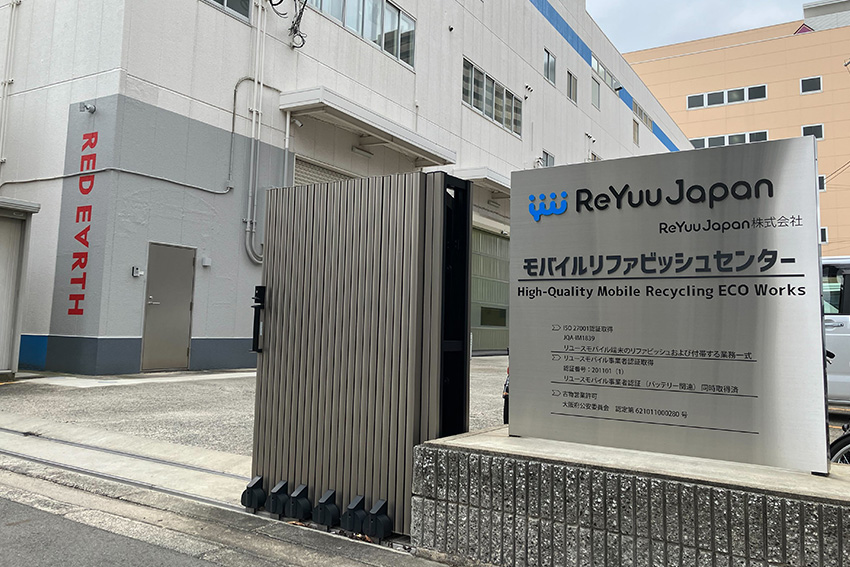
ReYuu Japan’s Mobile Refurbishment Center is certified under ISO/IEC 27001, the international standard for information security management. The facility manages secure data erasure, device inspection, and refurbishment through integrated processes, supporting the quality and reliability trusted by major corporate partners.
The ability to manage that life cycle also helps explain why major corporations such as SoftBank, Amazon, and Rakuten have chosen to work with ReYuu despite having numerous potential partners. For organizations of this scale, the decision is not simply about obtaining the best price for a used device. Smartphones can contain substantial amounts of personal and corporate information, making secure data erasure, reliable evaluation, appropriate redistribution, and quality assurance essential. You also pointed out that properly erasing data creates an additional cost, which can create problems when less rigorous operators attempt to avoid that expense and devices are redistributed internationally with information still remaining on them. What specifically has allowed ReYuu to establish credibility with major companies, and why is secure data treatment such an important differentiator in the secondary electronics market?
The companies you mentioned have different requirements, so the reasons for working with us are not necessarily identical in every case. However, credibility is extremely important, particularly from the perspective of companies such as major carriers.
For a company such as SoftBank, one of the critical questions is who can be trusted with functions such as data erasure and device evaluation.
When a company transfers smartphones to another party, it needs confidence that the information contained on those devices will be handled correctly. It needs to know that the data will actually be erased and that the devices will subsequently be evaluated and redistributed appropriately.
That trust is extremely important.
One of the reasons major carriers have chosen to partner with us is the reliability we have established in ensuring that personal data is adequately erased before a smartphone is resold.
At the same time, we evaluate the quality of the device and make sure that it is distributed appropriately within the market. Therefore, it is not only one individual process. It is the reliability of the overall sequence from receiving the device through preparing it for its next use.
Secure data erasure is particularly important because smartphones can contain a considerable amount of personal information.
There have been cases in the broader international market where smartphones have been redistributed while data from the previous user remained on the device. For example, a smartphone originating in one market can be sold somewhere else in the world while still retaining information that should have been removed.
That can create a major problem.
One reason this can happen is that properly erasing data costs money. It is an additional process and therefore creates an additional cost for the company handling the device.
However, from our perspective, that process cannot be omitted simply to reduce expenses. If the secondary market is going to operate responsibly, the information belonging to the previous owner must be securely removed before the device reaches the next user.
Our experience in performing these processes consistently is therefore part of the credibility we have established.
Major companies need to know that when they entrust devices to us, the work will be performed correctly. They need confidence in the data treatment, the evaluation of the device, its quality, and the way it is subsequently redistributed.
That combination of capabilities and the track record behind them is one of the reasons we have been able to develop relationships with major corporate partners.
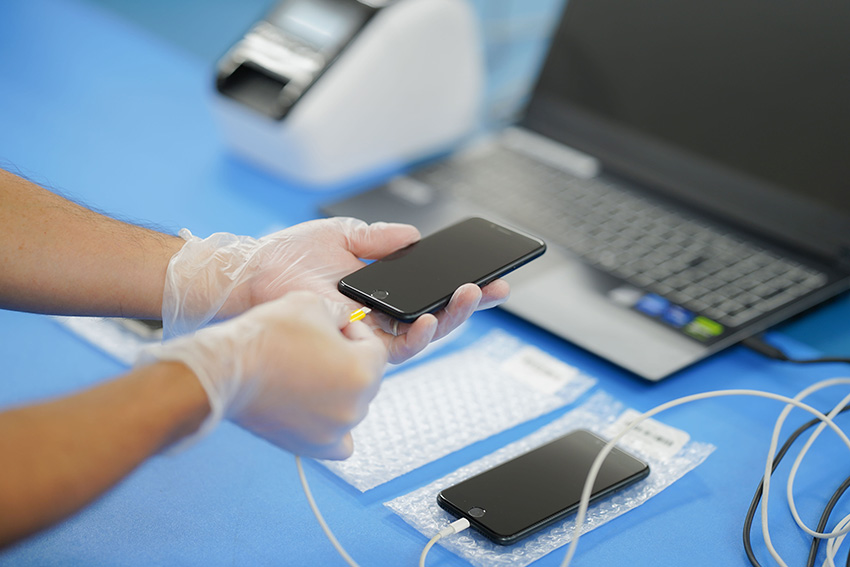
At the Mobile Refurbishment Center, used smartphones undergo data erasure, functionality testing, condition assessment, and cleaning. Combining specialized equipment with years of operational expertise, ReYuu Japan maintains rigorous quality control and information security standards to deliver reliable refurbished devices.
ReYuu is now extending that accumulated expertise into a much broader range of activities through both acquisitions and internal development. Repair and refurbishment are particularly important because longer smartphone life cycles increase the probability of display damage and battery deterioration, making the ability to repair those components internally strategically valuable when purchasing devices upstream. At the same time, the acquisition of NEXT Security introduces advanced cybersecurity capabilities that you believe could eventually have applications in smartphones, while your interest in physical AI addresses another emerging problem: robots and machinery may already function in logistics facilities, but incorporating AI requires machine learning environments in which data can be accumulated and developed. How do these apparently different areas fit together strategically, and how do repair, security, physical AI, maintenance, rental, and other services support your goal of reducing ReYuu’s dependence on smartphone trading revenue and creating a more balanced business?
If we begin with refurbishment, one of our biggest differentiating capabilities is that we can perform important repairs internally.
In particular, we have the ability to repair damaged displays and deal with deteriorated batteries. These are extremely important capabilities in the secondary smartphone market.
Whether a company has those repair capabilities can determine how proactively it can operate further upstream when purchasing devices.
This becomes even more relevant as smartphone manufacturers extend the useful life of their products. As we discussed earlier, operating systems are being supported for longer periods, which allows consumers to continue using smartphones for more years.
However, the longer someone uses a smartphone, the greater the possibility that physical components will deteriorate. The display can become damaged, and the battery will naturally lose performance over time.
Therefore, longer device life cycles also create a greater need for repair.
If we have the ability to repair a damaged display or replace a deteriorated battery internally, we can handle devices that another company without those capabilities might find more difficult to process. Repair therefore supports the reuse business directly and strengthens our ability to participate further upstream in the purchasing process.
Security is another area that we believe has important potential.
As electronic devices continue to be used for longer periods and circulate through different users and organizations, the need for appropriate security becomes increasingly important.
NEXT Security, which we acquired, has expertise in a very specific area of advanced security. Its capabilities include security designed for applications requiring a high level of protection, including government-related and large corporate environments.
We believe that some of this expertise could eventually be applied to smartphones and other devices.
That does not necessarily mean taking exactly the same security systems used for the most demanding government applications and placing them directly onto a smartphone. The opportunity could instead involve adapting elements of that technology into software or more specific security applications for devices.
Encryption provides one example of the type of requirement that exists. Government employees and other users handling sensitive information may need particular levels of encryption and information protection on their devices.
Therefore, we see potential for security capabilities to become increasingly relevant to the broader IT device life cycle.
Physical AI is another area we are examining.
Robotics and machinery are already being introduced into logistics facilities in Japan. The machines themselves can operate, and their basic functionality has been demonstrated.
However, when you want to incorporate AI into those machines, there is another requirement. AI needs machine learning, and machine learning requires an environment in which data can be accumulated and used for training.
At present, there are relatively few companies providing the environment or machinery specifically required for this type of machine learning.
Because the market is still developing and is not yet a major established business, companies may not necessarily see an immediate reason to invest heavily in creating that infrastructure.
We see an opportunity to make an early attempt.
Our objective is to establish an environment where the necessary machine learning data can be accumulated so that it can ultimately be used appropriately in physical AI applications.
These initiatives may appear different when considered individually, but they are connected to our broader objective of expanding beyond a business that depends primarily on trading smartphones.
At present, a very large proportion of our revenue comes from smartphone related trading. In the future, I would like trading revenue to represent less than half of the business.
To achieve that, we need to increase the contribution from services.
Maintenance is one area we want to strengthen. Rental is another. Repair is also important because it requires technical capabilities and can provide attractive profitability.
The objective is therefore not simply to replace smartphone trading with one new business. We want to create a more balanced structure by combining trading with repair, refurbishment, maintenance, rental, security, and other services.
Smartphone reuse remains an important foundation, but the company should increasingly generate value from the capabilities and services surrounding the complete life cycle of IT devices.

ReYuu Japan is preparing a proof of concept (POC) using PaXini’s physical AI robots at a Japanese logistics facility operated by JoyLogistics, JD Logistics’ international brand. The project will evaluate object recognition, handling, movement, and sorting, with the goal of developing a commercial robot rental service for corporate customers.
As ReYuu works to build a complete IT asset life cycle business, acquisitions appear to be one important way of adding capabilities quickly, but you have also made clear that M&A will not be the answer for every area of expansion. Recycling represents a particularly important next step because completing the supply chain ultimately means taking responsibility not only for devices that can be reused, repaired, or refurbished, but also for equipment that has reached the point where reuse is no longer possible. You have described this as a process that begins with dismantling devices and recovering components that still have value, followed by a second stage in which equipment that can no longer be reused is processed to recover precious metals and other materials. At the same time, areas such as GPU related activities are expected to be developed organically. How do you intend to balance M&A with internal development, why do you describe acquisitions as a way of buying time, and how important will recycling and resource recovery be in completing ReYuu’s supply chain?
We have already identified the next stage of our strategy, and one of the most important areas for us is recycling.
If our objective is to take responsibility for the complete life cycle of IT assets, we eventually have to address what happens when a device can no longer be reused in its existing form.
Until that point, there are several ways to extend the value of a device. It can be resold to another user, repaired if there is damage, refurbished, maintained, or used through other service models. However, eventually every device reaches a stage where continuing to reuse the complete product is no longer practical.
That is where recycling becomes important.
The first stage is dismantling. Even if the complete device can no longer be reused, individual components may still have value. We can disassemble the equipment and identify parts that can be recovered and used again.
That allows us to extend the value contained within the device even after the complete product itself has reached the end of its reusable life.
There is then a second stage. When components can no longer be reused, the remaining materials can be processed further in order to recover valuable metals and other resources.
If we are able to establish both of these capabilities, the cycle becomes much more complete. We are no longer involved only when a smartphone or another IT device can be purchased and sold again. We can continue participating through the point where the equipment is dismantled and its remaining materials are recovered.
In Japan, this area is connected with industrial waste treatment, and it requires specialized capabilities.
For that reason, M&A can be particularly useful. Rather than attempting to develop every capability internally from the beginning, we can acquire companies that already possess the expertise, licenses, infrastructure, or operational capabilities required in these fields.
That is what I mean when I say that M&A allows us to buy time.
Building specialized capabilities organically can take many years. If an appropriate company already possesses the knowledge and infrastructure we require, an acquisition can accelerate the process of completing our supply chain.
We are therefore actively looking at opportunities that can help us expand into recycling and related areas.
However, our growth strategy will not depend exclusively on acquisitions.
There are other areas that we intend to develop organically. As I mentioned earlier, GPU related activities and some of our newer initiatives will be developed through our own efforts.
Therefore, we will operate on both axes.
M&A can help us accelerate expansion into areas where established expertise and infrastructure are particularly important, while organic development can be used to create capabilities internally in businesses where we believe that is the more appropriate approach.
The ultimate objective is to connect these activities.
We began with telecommunications, moved into smartphone reuse, developed refurbishment and data related capabilities, and are now expanding into repair, maintenance, security, rental, and other services. Recycling is another necessary part of that progression because it allows us to address what happens at the final stage of the device life cycle.
If we can recover reusable components first and then retrieve valuable metals and materials from what remains, we can create a much more complete circular model for IT assets.
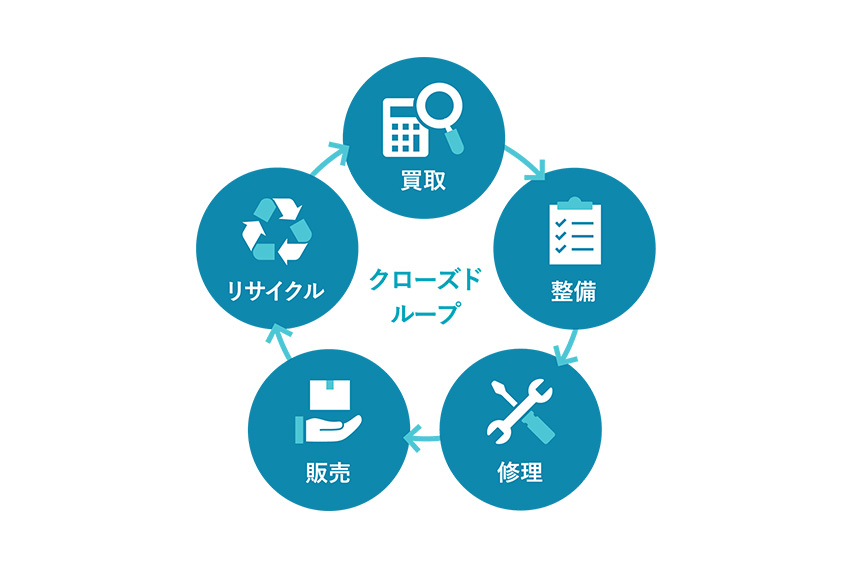
Through strategic M&A, ReYuu Japan is strengthening its capabilities in device procurement, repair, refurbishment, and sales. The company aims to build an integrated supply chain extending from device acquisition to eventual recycling, creating a closed-loop business model that maximizes value throughout the entire IT asset lifecycle.
ReYuu’s international business already accounts for a meaningful portion of revenue, with the interview referencing approximately 23 percent coming from overseas activities in the fiscal year ended October 2025, and locations such as Hong Kong and Dubai playing important roles in the company’s network. Your approach to international expansion is distinctive because you do not necessarily view success as establishing directly operated offices in as many countries as possible. Instead, the strategy begins by understanding the global flow of used devices, identifying where demand is concentrated, and determining which markets can provide the highest value. Hong Kong functions as an important hub for secondary goods across Asia, while Dubai connects markets in the Middle East, Africa, and Europe, and you also identified Texas, Florida, and particularly Dallas as important points within the American market. As you consider the next phase of international expansion, how do you identify the hubs that matter most, why have Hong Kong and Dubai been effective for ReYuu, and will the preferred model continue to be entering new markets through partnerships before establishing your own local presence once sufficient scale has been achieved?
To understand our international strategy, it is first necessary to understand how the global used market operates.
The secondary market does not function simply as a collection of individual national markets. There are particular locations that operate as hubs through which products, information, demand, and pricing are connected across larger regions.
In Asia, Hong Kong is one of those hubs.
This is not limited only to used mobile phones. Hong Kong functions as a hub for various categories of secondary products and devices, and from there the market connects with demand across the broader Asian region.
Dubai plays a similar role in another part of the world.
From Dubai, the secondary market connects with the Middle East, Africa, and Europe. This makes it strategically important because it provides access to demand across several regions rather than only within one domestic market.
In the Americas, Texas and Florida are important locations. Dallas in particular is recognized as an important hub in the used market, and there is also a company called PCS operating within that ecosystem.
The important point is that our success internationally has not come simply from establishing an office somewhere overseas.
Opening an office by itself does not create a successful secondary market business.
What matters is understanding where the demand exists, where devices are moving, and where a particular product can obtain the highest value.
We therefore need to collect information continuously.
If we have a particular smartphone or IT device, we need to understand which market currently has demand for that product and where the best value can be obtained. The ability to capture that information and connect supply with the appropriate market is fundamental to the business.
Our international strategy is therefore based on strengthening the network around these global hubs rather than assuming that we need directly operated locations everywhere.
That is why Hong Kong and Dubai have worked for us. Their value comes from the role they already play within the international secondary market.
Hong Kong connects us with Asia, while Dubai connects us with the Middle East, Africa, and Europe.
We already have another area that we are considering as a future focus, although I cannot disclose the specific target at this stage.
In terms of how we would enter another market, our basic approach would begin with a partner.
Partnership allows us to understand the local market, develop transactions, and establish a network without immediately creating a complete local organization ourselves.
If the market then develops and we obtain a sufficiently large market share, there may be a point where establishing our own local presence becomes appropriate.
Therefore, the sequence is important.
We do not necessarily begin by establishing our own base. We first develop the business through partnerships, understand the demand, and determine whether the scale of the opportunity justifies a direct presence.
In some of the areas we are considering, it may eventually become necessary to establish our own operation, but that would come after developing the market rather than before.
We are currently exploring potential expansion through our own network as well as with support from Japanese government related organizations involved in overseas market development.
By combining those channels, we are trying to determine the most effective method for entering new regions and identifying the appropriate partners.
The objective is therefore not simply geographic expansion for its own sake. We want to position ourselves where we can access the most important flows of demand in the international secondary market and create the strongest network around those hubs.
Looking ahead, there are two closely connected challenges surrounding how the market understands ReYuu today and what you want the company to become by 2030. On the capital markets side, the interview referenced strong business growth alongside a decline in the share price over the previous six months, highlighting a potential disconnect between operating progress and market valuation. You have also pointed to the characteristics of Japan’s microcap market, where individual investors remain highly influential, the company has been working to address legacy inventory issues, and institutional investors are not yet playing the role you would ultimately like them to play in price formation. At the same time, your longer term vision is to transform ReYuu from a company associated primarily with smartphone trading into an integrated IT device life cycle company with a completed supply chain, a greater contribution from services, stronger recycling capabilities, and less dependence on trading revenue. What do you believe investors still need to understand about the company today, and if we return in 2030, what would ReYuu need to have achieved for you to say that this transformation has been successfully completed?
This is a difficult question because there are several factors involved in how the market currently values the company.
One of the issues is the structure of the Japanese microcap market itself. This market is influenced significantly by individual investors.
Ultimately, we need to create a situation in which the company is sufficiently recognized and valued by institutional investors as well. If institutional investors participate more actively, they can play a greater role in price formation.
When a market is dominated primarily by retail investors, there can sometimes be a mismatch in pricing. That is one factor we need to consider when looking at the relationship between the company’s performance and its share price.
There have also been company specific factors that we have had to address.
Although the company has recorded losses in recent fiscal years, we have recently achieved quarterly operating profitability and are working toward a sustainable turnaround. We have also been working to resolve legacy inventory issues and improve our operational processes.
Those historical issues can affect how individual investors perceive the company, and that perception can subsequently be reflected in the share price.
For us, therefore, it is important to continue establishing a track record and building trust through results.
The market needs to understand the changes taking place within the company, but ultimately credibility comes from what we actually achieve. We need to demonstrate progress through our performance and through the transformation of the business.
Looking toward 2030, the first objective is to complete the supply chain.
By that point, I do not want ReYuu to depend primarily on trading revenue. The company should have a much better balance between trading and services.
As I mentioned earlier, the objective is for trading eventually to represent less than half of the business, with a greater contribution coming from areas such as repair, maintenance, rental, refurbishment, and other services.
At that stage, I also do not want ReYuu to be recognized simply as a company that buys and sells smartphones.
I want the company to be recognized for enhancing and managing the entire life cycle of IT devices.
That requires us to strengthen our processing capabilities and, in particular, our recycling capabilities. M&A can play an important role in acquiring some of those capabilities because recycling and industrial waste treatment require specialized expertise and infrastructure.
The regulatory environment is also relevant to this vision.
Europe already has stringent regulations concerning electronic waste and relatively high levels of collection. Japan, by comparison, currently has a lower level of electronic waste collection.
However, Japan is a country with limited natural resources.
For that reason, I believe there will be increasing pressure in the future to recover more of the resources that already exist within products circulating inside Japan.
Electronic devices contain precious metals and other valuable resources. Rather than allowing those materials to be lost, there is a strong rationale for collecting electronic waste, processing it, and recovering those resources for further use.
Over the coming years, regardless of the exact mechanism through which this develops, I believe Japan could move toward stronger regulations and collection requirements, potentially approaching the levels already seen in Europe.
If that happens, it would create a significant tailwind for our business.
However, our strategy does not depend on that regulatory change. We are already moving in this direction because we believe completing the IT asset life cycle is the appropriate strategy for the company.
Stronger electronic waste regulation would therefore support a strategy that is already in place rather than fundamentally changing our direction.
By 2030, I would like the supply chain to be complete. I would like ReYuu to have a more balanced revenue structure, with substantially greater weight coming from services rather than relying primarily on trading.
I would also like us to have significantly strengthened our recycling and processing capabilities so that we can participate not only when a device is resold or repaired, but throughout its entire remaining life cycle, including the recovery of components and materials when reuse is no longer possible.
At that point, I want the market to recognize that ReYuu is no longer simply a smartphone trading company.
The objective is to be recognized as an integrated IT device life cycle company, capable of extending the value of IT assets, supporting them through repair, refurbishment, maintenance, and other services, and ultimately recovering their remaining resources when they reach the end of their usable life.
If we have completed that transition by 2030, then we will have achieved the transformation we are working toward today.
For more information, visit their website at: https://www.reyuu-japan.com/english/







Leave a Reply