








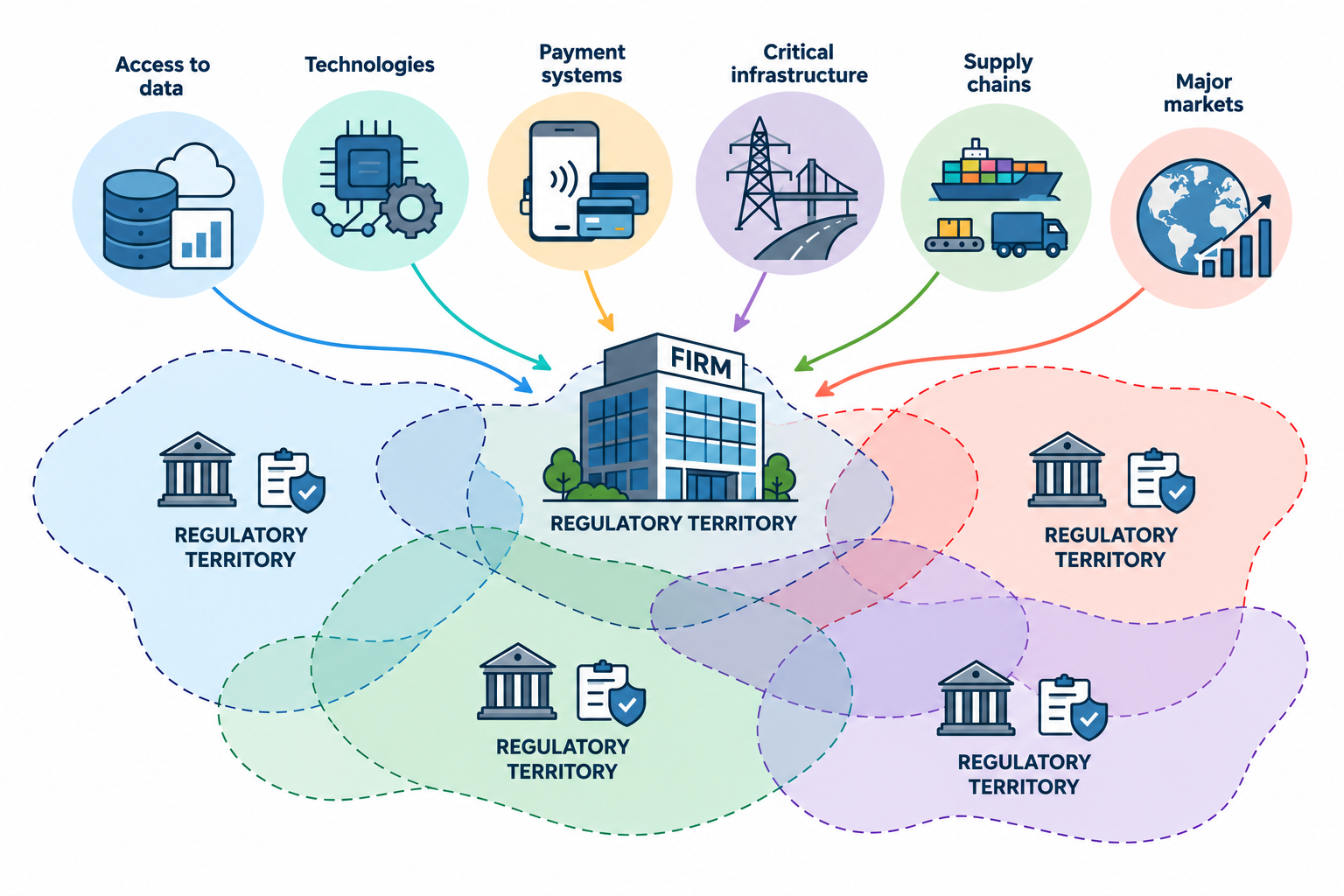
The Swiss banking experience reveals a shift from regulatory jurisdictional territory to a territory of dependencies. Given this broader shift in the geography of power, how can Europe protect and strengthen its competitiveness?
Borders have weakened, but state power has not
It was expected that globalisation would weaken governments as capital, information and production are moving increasingly freely across borders. Instead, interconnectedness has created new sources of regulatory power. A company may have no entity in the United States (U.S.) yet depend on dollar clearing, no establishment in Europe yet serve European consumers, or no production facilities in China yet rely on Chinese critical minerals or technologies. These dependencies are reshaping the geography of regulatory power and firms’ exposure to foreign governments.
Swiss banks and the discovery of regulatory territory
Profs Emmanuelle Reuter (U. Neuchâtel), Florian Überbacher (U. Linz) and Andreas Georg Scherer (U. Zürich) articulated the concept of regulatory territory – dependencies that can reshape the boundaries of regulatory authority. They show how firms’ understanding of these changing and sometimes overlapping boundaries shapes their compliance responses. You can read the original article here and find a discussion of key findings here: SciPod podcast.
This case study of 93 Swiss private banks offers valuable broader insights into the reorganisation of global power. The authors investigated U.S. enforcement against Swiss banks accused of helping wealthy U.S. clients evade taxes.
Following the territoriality principle, Swiss banks generally assumed that activities conducted on Swiss soil were primarily governed by Swiss rules. The U.S. DOJ’s prosecution of UBS in 2009 and Wegelin in 2012 challenged this assumption. Beyond the substantial penalties, these cases signalled that activities conducted through Swiss entities could fall within the reach of U.S. authorities owing to connections to U.S. clients and, crucially, to the U.S. dollar and financial system.
This reveals how economic dependencies can reshape the boundaries of regulatory authority. Banks’ responses, in turn, strongly depended on how they interpreted their exposure to foreign regulatory authorities and on whether they perceived themselves as falling within U.S. regulatory territory or not.
The new geography of power
Farrell and Newman’s (2019) notion of weaponised interdependence captures this transformation. Global economic networks contain hubs or nodes, such as international payment systems, technology platforms and information infrastructure that create strategic interdependencies and can be exploited by powerful states to exercise influence beyond borders. Prof Reuter and her colleagues complemented this perspective by showing that such strategic dependencies can become an important lever for enforcing compliance with foreign regulatory demands, as organisations recognise the growing scope of their strategic dependencies.
Together, these perspectives reveal a shift from a rules-based international order to a territory of dependencies, where states can influence foreign organisations through their reliance on financial networks, technologies, infrastructure, supply chains and markets. In this emerging geography, regulatory power travels beyond national borders not merely because a law reaches conduct abroad (Potts, 2024), but also because powerful economies control strategic dependencies (see Figure 1).
In the U.S., under FATCA, foreign financial institutions may be required to report relevant U.S. accounts; non- compliance can trigger the withholding of certain U.S.-source payments. Thus, dependence on access to U.S. financial markets and infrastructure creates incentives for foreign institutions to comply with U.S. requirements.
Similarly, export controls, for instance of U.S. semiconductors, can reach foreign-produced goods through their dependence on U.S. technologies. Regulatory exposure therefore depends not only on where products are manufactured, but also on how strategic dependencies can become instruments of geopolitical and regulatory leverage. In turn, China’s export controls and anti-foreign- sanctions legislation can affect foreign companies that depend on Chinese markets, technologies and critical materials (Rachman, 2020; TheEconomist, 2026).
In the EU, the GDPR can apply to companies established outside the EU when they target individuals within it or monitor their behaviours. Through the Brussels effect (Bradford, 2012), European standards can also influence corporate practices and legislation internationally. Comparable mechanisms appear in carbon and supply chain regulations.
While some laws explicitly apply extraterritorially, others create powerful incentives for foreign companies to comply because access to critical networks or markets is at stake.
Thus, a European company may simultaneously depend on U.S. financial and/or data infrastructure, Chinese critical inputs, and access to European markets. According to Farrell and Newman, power thus increasingly resides in controlling information (panopticon effect) and/or access to critical nodes (chokepoint effect) on which organisations elsewhere depend.
Policy conclusions
While Europe possesses considerable market-based power, its competitiveness increasingly depends on access to infrastructure and technologies controlled by others – particularly digital infrastructure, semiconductors, financial systems, energy, and critical raw materials. The challenge is to reduce asymmetric dependencies while preserving the benefits of global interconnectedness.
Several key policy priorities emerge:
- Stress-test firms against regulatory chokepoints: Identify firms’ exposure to foreign-controlled hubs or nodes in economic networks and conflicting regulatory requirements.
- Efficiency can create geopolitical vulnerability: Evaluate dependencies not only economically, but also politically and regulatorily.
- Build resilience and substitutability: Diversify suppliers, technologies and infrastructure rather than pursuing total independence.
- Connect regulatory and industrial policies: Strengthen Europe’s capabilities and position in strategic networks to reduce vulnerability to foreign regulatory leverage.
- Network centrality does not automatically translate into state power: Ensure appropriate legal and political conditions to exploit the leverage.
- Defend rules against weaponized interdependence: Promote predictable trade rules and cooperation against economic coercion.
The European Commission’s competitiveness and economic security agenda increasingly integrates reducing strategic dependencies into its policy orientation. Moving beyond simply protecting itself, the EU could act as a stabilizer of global interdependency by reducing the incentives for chokepoint competition internationally (cf. Farrell et al., 2026). It could, for instance, advocate agreements limiting economic coercion, create plurilateral supply- chain resilience arrangements, support neutral technical standards and crisis mechanisms among major trade powers.