








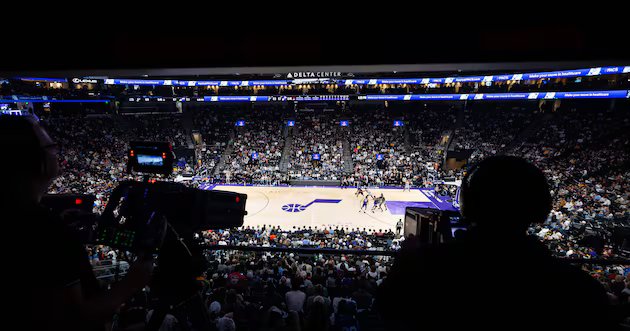
When the Utah Jazz decided to move away from the traditional regional sports network model in 2023, the goal wasn’t necessarily to make more money. It was to make games easier for fans to watch.
The organization wanted to give fans more options, whether that meant watching games for free through over-the-air television or paying for a direct-to-consumer streaming subscription to watch on the go.
Three seasons later, that decision has developed into something bigger than the Jazz’s original vision.
Smith Entertainment Group now has two professional sports teams, the Jazz and Utah Mammoth, with its SEG+ streaming service bringing both teams under one subscription. The expanded business has created more opportunities for Ryan Smith’s company to grow its audience, attract subscribers and generate revenue through advertising and sponsorships.
And SEG is starting to see some of those results.
Caroline Karlson, SEG’s director of streaming, alongside chief marketing officer Elaina Pappas, noted that the holding company feels encouraged by this growth as it continues to build out its DTC business.
“At the center of it was providing a really good experience to our fans and putting a fan-first mentality on this,” Pappas said of the organization’s original decision to move away from its previous RSN model. “Giving as little impediment as we can to our fans to watch our games.”
The strategy has remained relatively consistent, but the business behind it has changed.

From Jazz+ to a bigger SEG streaming business
When SEG Media launched the first incarnation of its streamer model with Jazz+ in 2023, the company was taking a different approach to how fans could watch games.
Rather than relying exclusively on a traditional RSN, the production company introduced a DTC option while also making games available through KJZZ, allowing Utahns to watch without paying for an additional streaming subscription.
The vision was to give “as little impediment” as possible for fans to watch games.
That approach has since expanded with the addition of the Mammoth.
The organization now offers Mammoth+ alongside Jazz+, with SEG+ providing a combined option for fans interested in following both teams for $174.99 annually.
That has made comparing the platform’s current performance with its original launch numbers a little more complicated.
SEG doesn’t evaluate performance against the first year when only Jazz+ existed. Moving forward, the focus is on operating as a unified platform under SEG+ featuring both teams.
Jazz+ remains a relatively affordable option compared with other NBA teams’ DTC offerings. At $124.99 for an annual subscription, it sits near the middle of the league’s pricing range. Although several teams offer cheaper annual packages, the Jazz’s service is still well below some of the league’s most expensive DTCs.
When looking at SEG+’s year-over-year growth across its streaming business, Karlson said subscriptions have increased 45% over the same period last year, while viewership is up 31%.

The organization is also seeing strong engagement from people who tune in.
Karlson mentioned viewers spend just under 100 minutes watching games on the platforms. Those figures reflect the broader streaming business across both teams rather than Jazz+ alone.
“I think that’s really, really long compared to other times that I’ve seen,” said Karlson.
Much of that viewership comes through integrations with the teams’ mobile apps and web platforms, suggesting fans are using the services beyond their TVs.
Karlson said the organization is also seeing strong engagement through the live chat and reaction features that allow viewers to interact with one another while streaming games.
“Fans are excited, fans are tuning in, the watch time is extremely long, which is great to see,” Karlson said.
Flexible ways to subscribe
SEG offers fans different ways to watch its teams, including annual, monthly and single-game subscriptions.
Karlson said annual subscriptions remain the most popular option because they provide the best value for fans who plan to follow a team throughout the season.
Monthly subscriptions bring in a “few thousand” customers, although Karlson described those users as more likely to move in and out of the service depending on the time of year.
“Did we always keep our fan first? Did we always keep the ethos of making sure it’s easy to find our games, watch our games and engage with our brand, both from a DTC option and an over-the-air option? That’s always going to be our guiding principle — making sure that these games are affordable and accessible to view. That’s what’s really important to me.”
— SEG chief marketing officer Elaina Pappas
Single-game subscriptions also continue to attract customers, even though they are generally the least bang-for-your-buck option for fans who regularly watch games.
Karlson mentioned SEG has sold approximately 1,500 single-game subscriptions so far this year, with both seasons still in their early stages. The organization typically sells a few thousand over the course of a year.
The type of subscription fans purchase also changes as the season progresses.
“In October and November, we sell more annual subscriptions than any other time of the year, just because people are excited to tune in at the beginning of the season,” said Karlson. “When we start to get into December, January and February, that’s when monthly subscriptions start to spike, because there’s not quite enough season left to justify getting an annual (subscription) in a lot of people’s minds.
“An annual would still last you 365 days, so you’d get half of one season and half of the next season, but I don’t think consumers typically think that way — they just think about the season at hand,” Karlson continued. “And then single games pick up if we are in playoff contention, or if there’s something exciting going on — a really big matchup or a big player coming to town.”
She also noted approximately 80% of subscribers stick around and renew after the season.
The majority of SEG’s streaming audience remains in Utah, with approximately 77% of subscribers located in the Beehive State.
Both teams’ audiences are seeing growth nationally, though not through SEG Media.
That reflects the geographic limitations of the platforms, which are designed to serve fans within the Jazz’s and Mammoth’s local broadcast territories rather than competing directly with national out-of-market services such as NBA League Pass.
However, the platforms do see some pops in cities like Boise — there are “a lot of fans” there.
Can SEG get back to its previous media revenue?
One of the biggest questions surrounding the Jazz’s decision to leave the traditional RSN model was whether the organization could eventually generate comparable revenue through its new approach.
ESPN previously reported in 2023 that the Jazz were making approximately $20 million per season through their AT&T SportsNet agreement.
When the organization made the transition, it was moving away from a traditional TV rights arrangement and toward a model that relies on a combination of streaming subscriptions, over-the-air broadcasts, advertising and sponsorships.
SEG believes it is getting closer to replacing that revenue.
Pappas said SEG’s current media business is nearing that $20 million figure, although she acknowledged there is still room for growth.
“I would say it’s in the ballpark,” Pappas said. “First and foremost, this was a fan-first decision, not a revenue-first decision. … The more eyeballs we have, the more people we have streaming, the more lucrative this is to sell and monetize, and that’s something that’s critically important to us. That will continue to be a focus moving forward as far as getting back to where we were and continuing to have upside from there.”
Subscriptions are only one piece of that revenue strategy.
SEG has partnered with Kiswe to operate its DTC model, with minimum guarantees included in the agreement. Pappas said the majority of the organization’s revenue is coming through other avenues, particularly advertising sales.
The organization also owns its advertising inventory on the KJZZ side of the business, giving it more control over the sponsorship opportunities it can offer.
Karlson said digital ads and virtual signage have also become important parts of the business model for both the NBA and NHL platforms.
That gives SEG more opportunities to generate revenue beyond what fans pay for subscriptions.
The Mammoth’s TV arrangement also provides another area the organization could eventually revisit. Pappas mentioned SEG inherited a deal with Scripps when it acquired the Arizona team and will look at reconsidering that arrangement when it comes up for renewal.
Making the experience more than just watching games
Another part of SEG’s strategy has been finding ways to make its services stand out beyond simply offering live broadcasts.
The organization has introduced several viewing features designed to give fans more control over how they consume games.
For the Jazz, fans can choose between the standard TV broadcast and different views, English and Spanish radio audio feeds, and ArenaCast.
ArenaCast provides a split-screen view with four windows, so fans can watch the regular game feed right alongside extra wide-angle angles of the court. Plus, it pulls in real-time social posts so fans can follow the online chatter while watching.
The Mammoth platform offers advanced tracking technology that displays player and puck information, making it easier for fans to follow the action.
Karlson said the tracking feature has been particularly popular with hockey viewers, while Jazz Nation has responded positively to the ability to pick who they’re listening to on different audio feeds.
SEG also added a multiview feature, so you can watch two games simultaneously when the Jazz, Mammoth or SLC Stars have overlapping schedules.
The organization recently added DVR functionality and a start-from-the-beginning option after receiving feedback from fans who wanted to avoid having live broadcasts spoil the score when watching games on delay.
Karlson said the goal is to continue making the experience easier to use, rather than constantly adding features that could complicate the platform.
“We’re always looking at what the most frictionless way to view is,” Karlson said.
Why the Mammoth changed the equation
The addition of the Mammoth has given SEG something it didn’t have when Jazz+ first launched: the opportunity to connect two different audiences through the same streaming business.
The organization believes there is enough overlap between basketball and hockey fans to make the combined subscription worthwhile.
Pappas said that broader reach is part of what makes the combined platform important to SEG’s long-term strategy.
The organization also wants to create more connections between its sports properties and other parts of its business, including the Delta Center.
SEG launched a loyalty program that allows fans to earn points through different activities, including watching games.
Those points can eventually be used toward merchandise, tickets, food and beverages, retail purchases, and even fan experiences, such as meet-and-greets or shooting on the court after games.
Pappas said the goal is to create more synergy between the Jazz, Mammoth and Delta Center, giving fans more reasons to remain connected to the organization.
The over-the-air television component remains just as important.
Jazz games are available on KJZZ Channel 14, while Mammoth games are available on Utah 16 The Spot. Fans can also access the broadcasts through participating cable and satellite providers or with an antenna.
That local access becomes even more important when the teams aren’t featured nationally. The Jazz were originally scheduled to have Tuesday’s game against the LA Clippers broadcast nationally on NBC, but the Deseret News was told the game was ultimately removed from the national schedule.
Pappas said the partnership with KJZZ and Sinclair helps SEG reach fans who might not want to purchase a streaming subscription or who prefer watching games through traditional television.
That combination of free broadcasts and paid streaming remains central to the organization’s approach.
What’s next for the business?
Even with the recent growth, SEG isn’t treating its current model as a finished product.
Pappas said the organization recognizes that the sports media landscape will continue to change, particularly as the NBA and NHL explore their own DTC opportunities.
The challenge will be continuing to attract new subscribers while keeping existing fans engaged enough to renew.
“Fan acquisition, fan engagement and retention are instrumental to our future success, because we want to continue to listen to fan sentiment (and) be able to react to that to make improvements on our end,” said Pappas.
She noted the organization took a “big bet” when it moved away from the RSN model in 2023. She expects the business will eventually have to make more decisions as the industry evolves.
Whatever comes next, Pappas said the focus will remain on making games accessible and easy to find.
Three years from now, she hopes SEG can look back and know it maintained that fan-first approach, regardless of how the media landscape changes.
“Did we always keep our fan first? Did we always keep the ethos of making sure it’s easy to find our games, watch our games and engage with our brand, both from a DTC option and an over-the-air option? That’s always going to be our guiding principle — making sure that these games are affordable and accessible to view,” said Pappas. “That’s what’s really important to me.”
Karlson shared a similar outlook, saying the organization wants to continue understanding what fans need while anticipating what they might want next.
The next challenge is turning that audience into an even more valuable part of the organization’s broader sports and entertainment business.
