








Over a year after Gov. Josh Stein signed an executive order to implement artificial intelligence across the North Carolina state government, the state Artificial Intelligence Leadership Council is still working to make sure AI is implemented effectively and ethically.
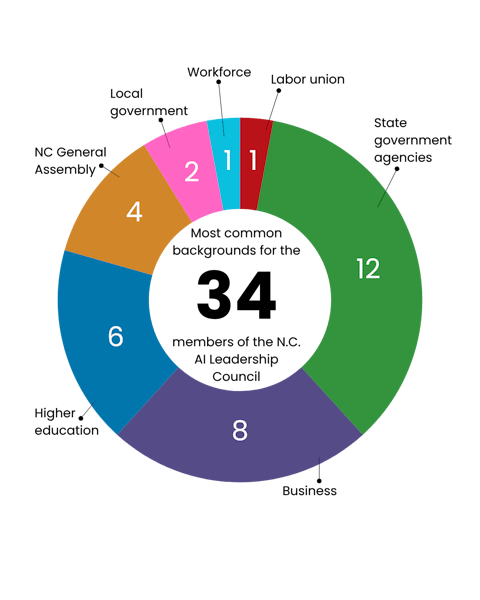
Thirty-four people serve on the council, including representatives from the state government, higher education and the private sector. Rep. Jake Johnson is a member of the council and serves in the N.C. House of Representatives, where he represents Henderson, McDowell, Polk and Rutherford counties. Johnson is co-chair of the oversight committee on information technology, and said he has enjoyed working with the council on improving AI legislation.
“That is the most beneficial part of the council for me, to make sure that if I am writing a law and I run that by the council, what’s so beneficial is to have people from different sectors, whether it’s in academia or whether it’s in the department itself,” Johnson said.
The executive order from Gov. Stein said the purpose of the council was to advise the Governor and state agencies in AI strategy. According to the North Carolina Department of Information Technology’s website, the council’s three commitments are to protect North Carolina residents from the dangers of AI, prepare residents for AI in school and work, and transform state government with AI to better serve citizens.
As of Nov. 4, 2026, the council has made 25 recommendations to the governor’s office and state agencies, including launching a statewide AI literacy initiative and enacting policies to counteract unemployment caused by AI. Most of these recommendations are targeted to be implemented in 2027 and 2028.
Johnson said the legislative side of the council uses the AI Regulatory Reform Act, a bill that was introduced to the State House in April 2025. He said the bill is intended to be a living document, keeping it open for amendments when new developments or concerns with AI arise.
“This is not something where we put a set of guidelines in place and say, ‘OK, everybody play ball,’” Johnson said. “This is something that every year we are going to have to come back and say, ‘Are these rules and guidelines still applicable to the market and to where the technology has evolved from last year?’”
Johnson foresees energy being the next big question the council faces. Duke Energy estimates North Carolina electricity demand to rise between 16% and 60% by 2040, with a majority of the demand coming from data centers and other large users. Johnson said he supports self-generation, producing electricity near where it is being used instead of fully relying on the power grid.
One of the concerns people have regarding AI is the construction of data centers. An Aug. 2026 survey from the Elon Poll found that 53% of respondents would oppose having a data center built in their community, and only 20% said they would support its construction. Despite this, only one of the council’s 25 published recommendations focuses on the environmental impacts of AI.
The council’s recommendations include encouraging public schools to adopt AI policies and guidelines, connect state agencies with external AI partnership programs, and developing a statewide plan to keep critical AI systems operating during emergencies. The recommendation about environmental impacts suggests using third-party sources to monitor and report on how data centers impact land, water, energy and public health concerns.
Johnson said when he worked with the council on recommendations, he suggested making the recommendations intentionally broad to protect citizens without harming AI developers in the state.
“We would rather take it a little slow because we can always go back and adjust,” Johnson said. “But if we go in and overregulate and try to over-prescribe these laws guarding AI, then we may actually backfire and stifle innovation in North Carolina.”
Sophie Loeb is a policy analyst with the Center for Progressive Reform, a left-leaning nonprofit research and advocacy agency. Loeb said that while the council is looking at the social impacts of AI, environmental impacts are not given as much focus.
“A lot of times these conversations are happening about the technology itself or the infrastructure, and not talking to both worlds,” Loeb said.
Loeb said she wants to see more people on the council who can represent people’s concerns with AI.
Sushma Masemore, deputy secretary for environment at the N.C. Department of Environmental Quality, is the only member of the council explicitly representing the environmental sector. Two members of the council represent labor concerns, Jennie Bowen with the Rivers East Workforce Development Board and Hannah Drummond with the North Carolina American Federation of Labor and Congress of Industrial Organizations. None of these council members were available for an interview.
Stan Ahalt, dean of the School of Data and Information Science at the University of North Carolina at Chapel Hill, serves on the council and represents education. Ahalt said that when UNC-Chapel Hill worked to integrate AI into the school, they focused on how it can benefit the student experience instead of just being efficient. Ahalt said he tried to bring that mindset to the AI Leadership Council.
“I was on the technology and infrastructure committee, and we met to talk about the things that we might need in the state of North Carolina in order to utilize AI in constructive ways,” Ahalt said.
Ahalt said that he and other representatives from UNC-Chapel Hill — Tommy Sowers and Angel Hsu — brought up to the council that the state should be very deliberate about where data centers are constructed, to make sure they are doing minimal harm to citizens.
Ahalt said that the council has not yet discussed new policy, but members of the council are conscious that this technology must be integrated responsibly and fairly.