







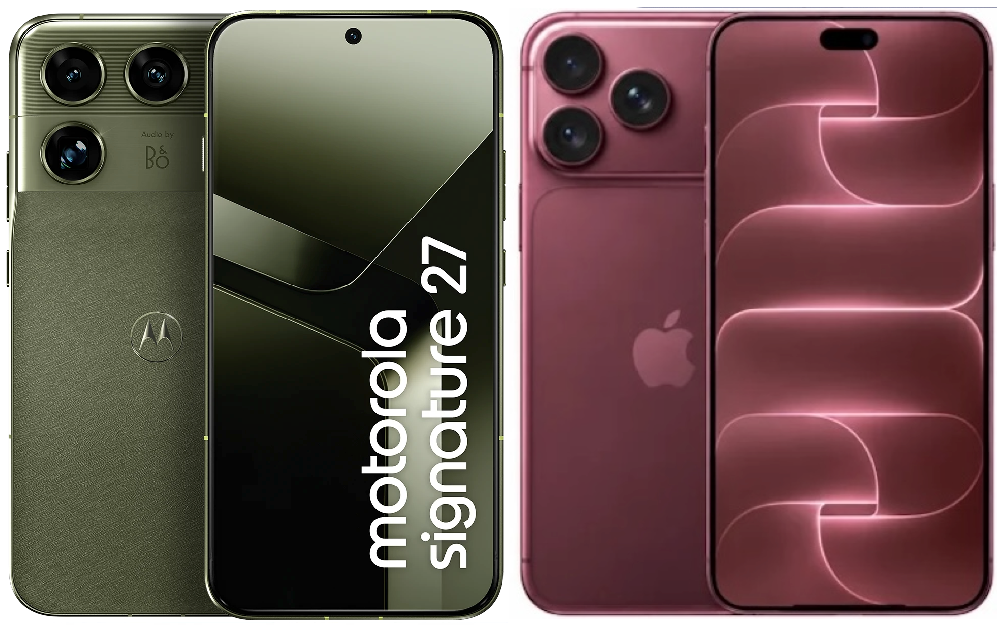
The Motorola Signature 27 challenges the iPhone 18 Pro Max with an unusual combination: a substantially larger battery inside a thinner, lighter body. It also offers high-power charging and a 200MP periscope camera, but those specifications come at a premium. Comparing the 512GB models, Motorola’s flagship costs approximately $100 more.
Apple counters with a slightly larger display, a variable-aperture main camera and a lower starting price for buyers who do not need 512GB of storage. The choice ultimately extends beyond hardware, with software, ecosystem compatibility and regional specifications all playing important roles.
Design: Motorola Packs More Battery into Less Weight
Despite its larger listed battery capacity, the Motorola Signature 27 is the more compact device.
It measures 162.01 × 77.04 × 7.99mm and weighs 227g. The iPhone 18 Pro Max measures 163.4 × 78.0 × 8.75mm and weighs 249g, making Motorola’s phone 22g lighter and 0.76mm thinner.
| Specification | Motorola Signature 27 | iPhone 18 Pro Max |
|---|---|---|
| Dimensions | 162.01 × 77.04 × 7.99mm | 163.4 × 78.0 × 8.75mm |
| Weight | 227g | 249g |
| Construction | Aluminum frame, contoured edges | Aluminum unibody |
| Front protection | Gorilla Glass Ceramic 3 | Ceramic Shield 2 with anti-reflective coating |
| Listed protection ratings | IP68 and IP69 | IP68 |
Motorola combines its aluminum frame with a camera panel featuring ceramic and brushed aluminum. Buyers can choose between Pantone Coal Smoke with a Tactical Weave back and Pantone Capulet Olive with a brushed textile finish.
The company also says the phone passed 14 MIL-STD-810H procedures across 16 categories. That remains a manufacturer-reported durability claim rather than a guarantee against damage.
Apple retains the aluminum unibody approach associated with the previous Pro Max generation. Its listed finishes are Black, Silver, Glacier and Burgundy.
Battery: A Clear Capacity Advantage, but Endurance Remains Unproven
The Signature 27’s headline specification is its advertised 7,000mAh silicon-carbon battery, with a rated capacity of 6,790mAh.
The supplied report attributes the iPhone’s battery figures to an iFixit teardown: 5,567mAh for the US eSIM-only version and 5,391mAh for the version with a physical SIM tray.
Using Motorola’s advertised 7,000mAh figure, the difference works out to approximately 26% over the eSIM-only iPhone and 30% over the physical-SIM model. Using Motorola’s rated capacity would produce a smaller percentage gap, so the basis of the comparison matters.
Capacity alone also does not establish how much longer either phone will last. Apple claims up to 45 hours of video playback, but that figure cannot be used as a direct comparison without equivalent testing of Motorola’s phone.
The most defensible conclusion is that Motorola offers considerably more listed battery capacity. Whether that translates into a similarly large endurance advantage remains a question for controlled testing.
Motorola emphasizes rapid charging
The Signature 27 supports 90W wired and 50W wireless charging. Motorola claims that 12 minutes of wired charging can provide enough power for a day, although that promise depends on its testing conditions and usage assumptions. Compatible chargers are sold separately.
The supplied material does not include equivalent iPhone charging specifications. Motorola’s charging hardware is therefore a significant selling point, but a precise charging-speed comparison cannot be established from the information provided.
Cameras: Variable Aperture Meets High-Resolution Zoom
The two phones take notably different approaches to photography.
Apple focuses on adjustable optics and manual controls
The iPhone 18 Pro Max is listed with three 48MP rear cameras. Its main camera features a six-blade variable-aperture mechanism offering four settings: f/1.48, f/1.8, f/2.8 and f/4.
Apple’s Pro controls also provide manual adjustment of aperture, shutter speed and white balance, supported by a histogram in the camera app.
The remaining rear cameras are:
-
A 48MP periscope telephoto camera with 4× optical zoom and a separate 8× “optical-quality” mode.
-
A 48MP ultrawide camera with a 120-degree field of view.
Digital zoom extends to 40×. On the front, Apple uses an 18MP Center Stage camera with a square sensor.
Motorola combines LOFIC imaging with a 200MP telephoto camera
Motorola’s main camera uses a 50MP Sony LYTIA L910 sensor behind an f/1.6 lens. It incorporates LOFIC technology, which the company says helps retain detail in bright and dark areas within the same image.
A 200MP periscope telephoto camera provides 3× optical zoom. Motorola also advertises Super Zoom Pro at up to 100×, although generative AI sharpening contributes at higher magnifications. That maximum should not be confused with native optical zoom.
The camera system also includes a 50MP ultrawide with a 122-degree field of view, a 50MP front camera and a dedicated EVS Action Sensor intended to assist with fast-moving subjects in low light.
On paper, Apple offers more direct control over the main camera’s aperture and a longer native optical telephoto reach. Motorola emphasizes telephoto resolution, highlight handling and additional action-capture hardware. Neither approach establishes an overall image-quality winner without comparable photographs and video.
Displays: Similar Sizes, Different Brightness Claims
Apple’s flagship has a 6.9-inch LTPO OLED display with a resolution of 2,868 × 1,320 pixels and a listed density of 460ppi. Its adaptive refresh rate ranges from 1Hz to 120Hz.
The quoted brightness figures are 1,000 nits for typical use, 1,600 nits for HDR content and up to 3,000 nits outdoors. Dolby Vision is supported, while a smaller Dynamic Island can reportedly display up to three Live Activities simultaneously.
Motorola uses a slightly smaller 6.8-inch tandem OLED panel. The supplied article cites display databases listing a resolution of 2,780 × 1,264 pixels and an Android Headlines report specifying a refresh rate of up to 120Hz. Both Dolby Vision and HDR10+ are supported.
Motorola’s most striking claim is peak brightness of up to 12,000 nits. However, that figure comes from specific laboratory conditions and is not directly comparable with Apple’s quoted outdoor brightness.
It would therefore be misleading to describe Motorola’s screen as four times brighter in ordinary use. Independent measurements under matching conditions are needed to establish practical visibility and sustained brightness.
Performance: Two 2nm Platforms, No Established Winner
Both phones are described as using processors manufactured on a 2nm process, but their architectures and performance claims differ.
Apple’s A20 Pro features a six-core CPU, including two “super cores” that the company says are 20% faster than those in the previous generation. It also includes a seven-core GPU and a dual Neural Engine with 32 cores for AI-related workloads. The phone is listed with 12GB of RAM.
Motorola uses the Snapdragon 8 Elite Extreme Gen 6, with prime CPU cores reaching up to 5.01GHz. Qualcomm’s quoted improvements over the Snapdragon 8 Elite Gen 5 are 13% for CPU performance and 44% for graphics.
These percentages describe gains against different predecessors, not a direct contest between the two phones. They cannot establish which device is faster.
Retail-unit benchmarks, sustained gaming tests and thermal measurements would be more useful than headline specifications when assessing their relative performance.
Software: The Ecosystem Could Decide the Purchase
The iPhone 18 Pro Max ships with iOS 27 and Siri AI, according to the supplied specifications. Listed additions include Siri Mode in the camera app, plus Spatial Reframing, Extend and Clean Up tools in Photos.
For existing Apple users, continuity may matter more than any individual feature. An Apple Watch, Mac, AirPods, purchased apps and established messaging habits can all influence whether switching platforms feels worthwhile.
Motorola’s Signature 27 runs Android 17 with Gemini Intelligence and Motorola Qira. Qira is described as helping users find and recall information across apps, with a Motorola or Lenovo account and at least 12GB of RAM required.
Motorola also lists audio by Bang & Olufsen and promises seven operating-system upgrades alongside up to seven years of security updates.
The original material additionally attributes GrapheneOS support to Android Headlines. That claim should be verified separately before it becomes a purchasing consideration.
Pricing: Motorola Costs More at the Same Storage Capacity
Motorola offers one US configuration: 12GB of RAM and 512GB of storage for $1,599.99.
Apple provides a wider storage range and a lower entry price.
| Storage | iPhone 18 Pro Max | Motorola Signature 27 |
|---|---|---|
| 256GB | $1,299 | Not offered in the US |
| 512GB | $1,499 | $1,599.99 |
| 1TB | $1,899 | Not offered in the US |
| 2TB | $2,499 | Not offered in the US |
At matching 512GB capacities, Motorola costs $100.99 more. Buyers satisfied with 256GB can enter Apple’s range for approximately $301 less than Motorola’s only US option.
The supplied pricing also puts the Signature 27 at a starting price of £1,299 in the UK.
Motorola’s US sales channels are listed as Motorola.com, Amazon and Best Buy, with no confirmed carrier-store availability in the original report. Apple offers its phone through its own retail network and carrier partners.
Verdict: Different Strengths at Different Prices
The Motorola Signature 27 makes its strongest case through hardware packaging. It combines a larger listed battery with a lighter, thinner body, high-power charging and an ambitious camera system. Its seven-upgrade software commitment also strengthens its long-term proposition.
The iPhone 18 Pro Max offers a lower starting price, a less expensive 512GB configuration, a slightly larger and higher-resolution display, and variable-aperture camera hardware. For buyers already invested in Apple products, ecosystem compatibility adds another practical advantage.
Motorola is the more compelling option for buyers prioritizing battery capacity, weight and charging specifications. Apple makes the stronger case for those seeking a lower purchase price or continuity with existing Apple devices.
Actual battery endurance, camera quality and sustained performance remain the comparisons that specifications alone cannot settle.