








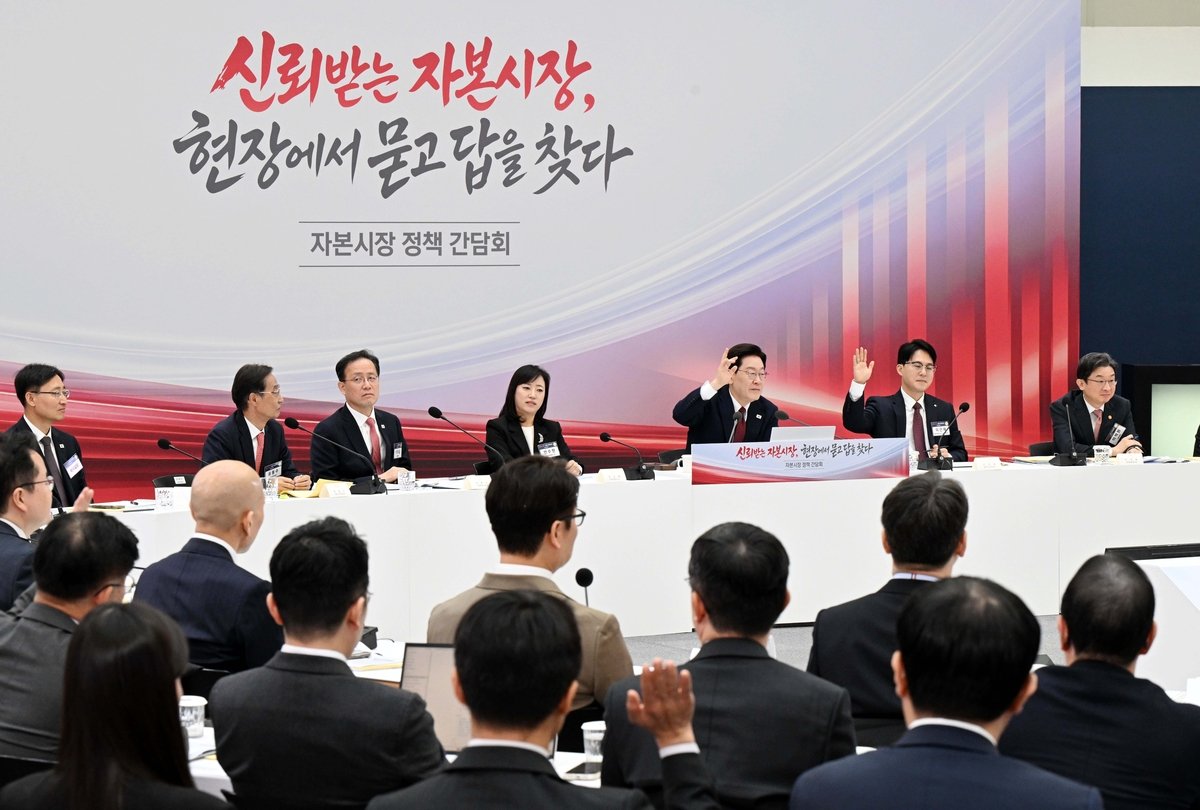

“The truth is, even if I take criticism for it, I lean toward growing the pie — that is, toward the view that all shareholders benefit only when mergers and acquisitions become more active and the market as a whole is normalized.”
That was President Lee Jae-myung’s position at a capital markets policy roundtable held at the Korea Exchange on the 13th. With minority shareholder protection and the revival of mergers and acquisitions pulling in opposite directions over the introduction of a mandatory tender offer requirement, Lee put his weight behind expanding the overall market. He stressed in particular that “it would be good to place a little more emphasis on the need to activate hostile mergers and acquisitions and break this abnormal structure once and for all.” The intent is to improve the chronic undervaluation of Korean stocks by making contests for corporate control more active.
A mandatory tender offer requirement guarantees that when someone acquires control of a company, ordinary shareholders — not just the largest shareholder — get a chance to sell their shares. Until now, even when a controlling shareholder sold a stake at a premium for control, minority shareholders often had no opportunity to sell at the same price. A bill to amend the Capital Markets Act addressing this passed the National Assembly’s Legislation and Judiciary Committee in September, but action on the plenary floor was put on hold. At the center of the controversy is a provision that would require an acquirer to secure 50% plus one share of all stock while allowing it to buy the controlling shareholder’s stake first.
Lee Cautious on Full Buyouts, Opens Door to Compromise

Lee said that “in opinion polls, ‘buy 100%’ got the most support, because it is the ideal,” but countered: “Yet from the standpoint of officials who have to implement it, if you require buying 100%, attempts themselves are likely to decline — and wouldn’t that shrink the opportunities for the market as a whole?” His concern is that even if minority shareholder rights are protected to the maximum, a chilling of control transactions could ultimately fail to serve investors’ interests.
That does not mean Lee instructed lawmakers to pass the original 50%-plus-one-share version as written. “In the end it is a matter of making a decision,” he said. “The interests of minority shareholders and controlling shareholders collide, and whether to energize the M&A market, or to emphasize fairness and require a 100% acquisition, or to go with 50% plus one — that is a question of policy judgment.” In an on-the-spot vote held at the session that day, relatively strong support went to a pro rata approach that would keep the 50%-plus-one-share threshold while giving controlling and minority shareholders the same proportional chance to sell. That leaves open the possibility that the legislative process will produce a compromise prioritizing M&A activity while shoring up shareholder protection.
U.K. and EU Require Full Buyouts, Japan Allows Partial Offers
Overseas cases show that the design choices are not simple. Britain requires that in cases such as acquiring 30% or more of voting rights, other shareholders be given the chance to sell all of their holdings. The European Union likewise takes as its principle that anyone acquiring control must give all shareholders a chance to sell their entire holdings at a fair price. Both approaches guarantee equity among shareholders as a matter of law.
Japan, by contrast, has allowed partial tender offers while overhauling its rules to strengthen transparency in control acquisitions and protect minority shareholders. Since May of this year, the key ownership threshold that triggers a tender offer obligation was lowered from more than one-third to more than 30%, and regulation was extended to on-exchange trades. Where a post-acquisition stake reaches two-thirds or more, the acquirer must in principle buy all shares tendered. The structure recognizes the flexibility of partial offers while tightening shareholder protection at the stage where control grows.
If a mandatory tender offer requirement is introduced in Korea, considerable change is expected in the M&A market. First, ordinary shareholders would get more chances to share in the control premium that has been concentrated in the hands of the largest shareholder. New investment demand could flow into companies whose share prices are low relative to corporate value and whose control may be up for sale. Management would also face greater pressure, knowing that failure to raise corporate value could expose it to a challenge for control by an outside acquirer. That is the backdrop to Lee’s emphasis on hostile M&A as a central mechanism for normalizing the market.

Still, as the volume subject to a tender offer rises, so can the capital and financing costs required for an acquisition. Mid-sized companies and domestic private equity funds with limited financial firepower could find it harder to bid for control. On the other hand, some argue that including minority shareholders in the tender offer would lower the control premium concentrated in the largest shareholder’s hands, limiting the actual increase in acquisition costs. Whether the rules energize or chill the M&A market may depend on the required purchase ratio, how prices are set and conditions in the acquisition financing market.
Empirical research abroad also shows that simple conclusions are hard to draw. Kim Woo-chan, a professor at Korea University, argued at the roundtable on the 13th, citing a study covering 41 countries, that there is no evidence M&A activity shrank after mandatory tender offer rules were adopted and that tender offers to ordinary shareholders and hostile acquisitions in fact increased. Financial regulators and the private equity industry, by contrast, presented research findings and practical cases pointing to a market contraction driven by heavier acquisition burdens. Because assessments of the rules’ effects diverge, observers say the design must be finely calibrated to the characteristics of the domestic market.
Compromise Emerges: Buying Half of the Remaining Shares
Amid this debate, a new compromise has been floated. The Yeouido Investor Rights Research Institute, affiliated with the law firm Hannuri, proposed in a report on the 15th titled “Review of and Alternatives to the Capital Markets Act Amendment for Introducing a Mandatory Tender Offer System” that an acquirer be allowed to buy the controlling shareholder’s stake first but be required to make an additional tender offer for at least 50% of the remaining shares. If a controlling shareholder sells a 40% stake, the acquirer would have to launch an additional tender offer for 30% — half of the remaining 60%. The institute says this would widen minority shareholders’ chance to sell compared with the existing bill from the National Assembly’s National Policy Committee while reducing the acquisition burden that a full 100% buyout would impose.
The point, in the end, is that simply setting a tender offer ratio is not enough. What matters is how far the rules can lower the barrier to entry in the M&A market while fixing a structure in which the control premium flows only to particular large shareholders. Even if the 50%-plus-one-share approach is retained, giving the controlling shareholder priority in selling and applying a pro rata allocation deliver very different benefits to minority shareholders. With the emergence of a compromise calling for an additional purchase of half the remaining shares, lawmakers now have more alternatives to choose from.

Lee Puts Emphasis on M&A Activity; Legislative Balance Is Key
Lee stressed that “rather than crafting a highly reasonable and ideal plan, it would be good to focus on the need to activate hostile mergers and acquisitions and break the abnormal structure” — a reference to undervalued share prices. The remark reveals the president’s policy priorities in viewing the mandatory tender offer debate. It can be read as a direction that puts growth first while designing the rules so that the gains also reach minority shareholders.
Growing the overall market and protecting minority shareholders do not necessarily conflict. If contests for control become more active, corporate value rises and ordinary shareholders share in the gains, both goals can be achieved together. Conversely, if deal structures favoring only large shareholders persist under the banner of energizing M&A, the effects of capital market reform will inevitably be limited.
Attention now turns to how the direction Lee laid out will take shape in the legislative process. The market impact will differ depending on whether lawmakers keep the 50%-plus-one-share framework and add a pro rata allocation, or raise the tender offer volume to strengthen minority shareholder protection. The task is to energize transactions in corporate control while letting ordinary shareholders share in the benefits. Whether the National Assembly can produce a legislative solution that grows the market pie Lee emphasized while also delivering protection for minority shareholders remains to be seen.
