









Among major smartphones currently on the market, Apple’s iPhone 17 has been found to have the highest specific absorption rate (SAR) of electromagnetic radiation. Conversely, Samsung Electronics’ Galaxy A17 recorded the lowest figure among the products tested.
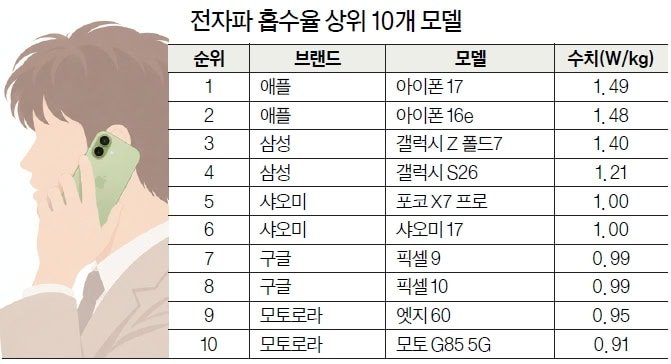
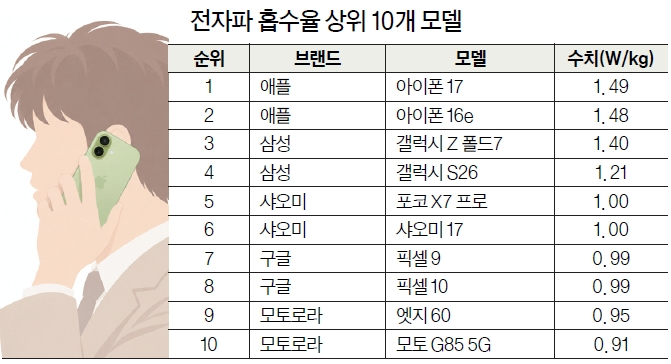
Recently, data analysis outlet Visual Capitalist compared the electromagnetic radiation absorption rates of 104 popular smartphones currently on sale, based on measurements taken by the German Federal Office for Radiation Protection (BfS) according to European standards. The results showed that the Apple iPhone 17 recorded the highest reading at 1.49W/kg based on the head region.
The specific absorption rate (SAR) is an index representing the rate at which radio frequency energy generated by a smartphone is absorbed into human tissue, measured in W/kg, which indicates the amount of power absorbed per 1 kilogram of body tissue.
Following the iPhone 17, the survey revealed that the iPhone 16e had the second highest absorption rate at 1.48W/kg. Models that were not part of the same generation or flagship lineup were excluded from the rankings.
Samsung Electronics’ Galaxy Z Fold 7 ranked third with 1.40W/kg, while the Galaxy S26 recorded 1.21W/kg. In contrast, the Galaxy A17 was the lowest among the surveyed products at 0.37W/kg.
As such, figures varied by model even within products from the same manufacturer, and no clear correlation was found between price or release timing and the electromagnetic radiation absorption rate.
The Google Pixel 9 and Pixel 10 both tied with head absorption rates of 0.99W/kg, while Xiaomi’s Poco X7 Pro and Xiaomi 17 each recorded an identical 1.00W/kg.
Motorola products fell within a similar range, spanning from 0.84W/kg for the Razr 60 to 0.95W/kg for the Edge 60.
However, experts explained that a high electromagnetic radiation absorption rate does not necessarily mean an increased risk to health. In general, smartphone radiation is known to be somewhere between that of a TV and a microwave oven.
SAR is the maximum energy absorption rate measured in a standardized laboratory environment and does not represent the total amount of radiation a user is exposed to in daily life. The radio wave transmission intensity of a smartphone varies depending on communication signal strength and network environments.
Furthermore, unlike ionizing radiation such as X-rays, the radio frequency electromagnetic waves generated by smartphones do not possess enough energy to directly ionize atoms or damage DNA in the same manner.
The U.S. Food and Drug Administration (FDA) maintains the position that cumulative scientific evidence gathered to date has not confirmed a link between mobile phone radio frequency radiation exposure and health problems.
Nevertheless, if users wish to reduce their exposure to electromagnetic radiation, methods such as using speakerphone or earphones to keep the smartphone away from the head can be helpful.
Experts also emphasized that these survey results compare the maximum laboratory electromagnetic radiation absorption rates of each smartphone and do not imply that a specific product is inherently safer or more dangerous to health than another.