








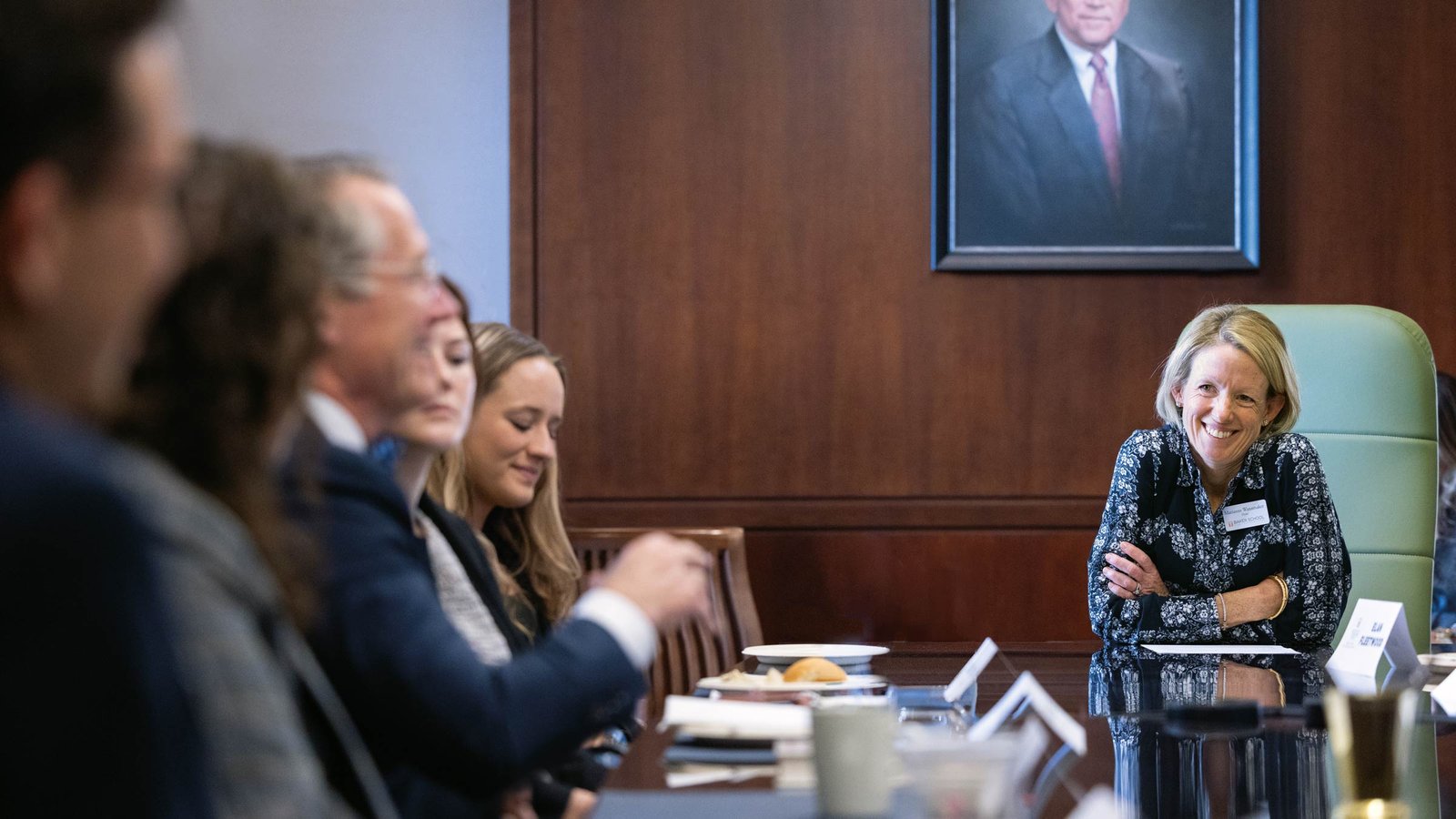
When Marianne Wanamaker stepped in to instruct a class
on public leadership at the University of Tennessee’s
Baker School, she had two goals: Teach the next generation
of public servants the history of recent leadership
crises and emphasize the trade-offs that leaders
faced in real time.
“The idea here was, hey, these kids are 22 years old.
They’re going to go out and be ready to work at a public
employer, and there are a whole series of stories
that their bosses know that they don’t know, at least
not in the same way that their bosses know them,”
Wanamaker said. “If you try to look at all of what is
happening right now without that context, how would
you ever make sense of it?”
To study each of those stories—Hurricane Katrina,
9/11, COVID, the financial crisis—the class took the
perspective of the people making the choices. “We
framed it as, What are the trade-offs that someone
in that position is facing?” Wanamaker said. “And
therefore, why might someone think this was the right
answer, even if in retrospect, we understand that it
wasn’t? It’s about understanding that every time you
make a decision in public life, you’re choosing one
value over another one.”
The class reflected themes that have animated
Wanamaker’s career: a love of history, a commitment
to public service, and a belief that listening to others
is essential for citizens and leaders alike. Wanamaker was drawn to economics because of her fascination with people’s
stories. “I want to know where you started, what caused
you to take the education path that you took, how did you end
up where you are?”
Wanamaker’s own journey started in Tennessee, where
she grew up hearing stories from great-aunts and great-uncles
who had, like millions of other Americans, followed the
railways to points north and west before returning home. She
later published several papers on the Great Migration. After
earning tenure as a professor of economics at the University
of Tennessee and serving on the White House Council of Economic
Advisers, she became executive director of the Howard
H. Baker Jr. Center for Public Policy, leading its transformation
into Tennessee’s first school of public policy that graduates
students with master’s and bachelor’s degrees. The Baker
School of Public Policy and Public Affairs is now in its fourth
year of operations.
“This place had zero students three years ago, and we’re
going to have 600 in the fall,” Wanamaker said. “The way you
get to changing the nature of the public service workforce is
you just graduate students, and in 10 years you will be able to
see your impact.”
This interview has been edited for length and clarity.
What were the big questions that inspired you
to specialize as an economic historian?
I started my career being really interested in choices people
made about how many children to have. I studied all of that
in a historical context. One of the big mysteries of economic
history is the demographic transition. Why was it that we went
from having basically as many babies as we could to a very,
very small subset of that number? Why did it happen in different
places at different times for different demographic groups
in the U.S.?
I think what’s interesting about it is it’s only partially economic.
It’s also cultural—it’s about what are the elites doing and how
do people model that or follow that. And so that kind of transmission
of ideas alongside the economic causes—that’s what
Joel Mokyr won the Nobel prize for, was trying to understand the
dissemination of ideas and how that intersects with the dissemination
of economic change itself. Fertility is no different.
The saying goes that those who do not know
history are condemned to repeat it. Do you look
around you and feel like we are making some
of the same mistakes?
Yesterday, I was thinking about how when you study demographic
history, you start with Malthus and the idea that the
amount of life-sustaining material in the environment is the
thing that determines the birth rate.
“If you want a different demographic outcome, you can’t have everything be expensive and you really can’t have housing be expensive.”
And so in years where there’s more food, there are more babies. I mean, it’s true for deer and it’s true for humans.
And this is the thing you’re trying to refute in economic theories
about demography, that it’s not just about how much
food there is. But if you think about what is happening right
now, why are people not having babies? One of the reasons
people aren’t having babies is it’s super expensive to get a
house. It’s super expensive to get day care. All the pieces are
really expensive, and food is back on the menu of things that
are in scarcity.
So I’ve been thinking the last 24 hours, Malthus is back.
And if you want a different demographic outcome, you can’t
have everything be expensive and you really can’t have housing
be expensive. People just aren’t going to have babies in
that environment.
So anyway, that’s my hot take on an old idea.
What are some of the important economic
consequences of the decline in fertility that you
see as deserving more of our attention?
The one that is really interesting to me is the public finance
implications. So here’s an example. In Southern states, our
fertility rates are pretty low. Our death rates are pretty high.
But what we do have in the South are some higher education
institutions that we’re super attached to. This is not
just in the South, but thinking about the state that I’m in and
the states that border us, there are a lot of flagship universities.
Mississippi has two, Alabama has two, South Carolina
has two. And you start thinking about a decline in population
and how do you support those schools? And then you
think about the regional state schools. The regional schools
are really important from an economic development perspective,
yet there’s no way that all of those higher ed institutions
can maintain the scale that they have been at. And so
it’s going to require some sort of interesting public finance
outcome, which almost certainly means we have less money
for other stuff.
Another place we may see a consequence of the
demographic transition is the trajectory of U.S.
economic growth. What do you see as the drivers
of growth in the American economy right now?
Well, I’ve certainly changed my perspective on this as the
country has sort of changed its strategy. Not meaning that we
actually have been cognizant of our changing strategy, but
quietly behind the scenes, we have changed our strategy as a
country from “We are going to lead on labor force” to “We’re
going to lead on technology.”
“If you don’t have more people, the only other way to grow is through innovation. And I think you see that playing out right now with the intense focus on technology.”
I think it would be healthy for all of us to take a step back
and acknowledge this quiet choice that we’ve made. If I were in
charge, task number one is write down the equation: Economic
growth equals the sum of the growth in workforce plus the growth in labor productivity. That’s it. And then you can say, because
we have decided to really restrict immigration and workforce,
that means that in order for this economy to keep growing, the
technology that drives labor productivity has to shine.
We didn’t have to make this choice, but it’s a choice that
we made. I think most Americans don’t realize that there was
a fork in the road and we took one path—the low immigration
path—and not the other. And I think the whole conversation is
healthier once you can do that.
In 2024, 84 percent of population growth in this country
was due to immigration. That tends to get people’s attention.
They’re like, wait, what?
If you don’t have more people, the only other way to grow is
through innovation. And I think you see that playing out right
now with the intense focus on technology—which the government
didn’t lead. This is really a private sector process.
People don’t trust technology all the time, they don’t trust
data centers, they don’t trust AI. And yet in the absence of population
growth, these things are the key to economic growth.
There’s no way around it. And so I think the policy world is
trying to figure out how to manage that. We put all of our eggs
in the technology and innovation basket, and the American
people are really skeptical about the technology and innovation
basket. And so what do we do next?
Let me put that question back to you:
What do we do next? How should leaders be
communicating about technology in order to
build trust and foster economic growth?
On the technology side, I think a sort of silver lining in all of
this is that no one trusts technology. People on the left, people
on the right, people in the middle. So it’s actually a very
nonpolarizing topic, and it’s hard to name a lot of nonpolarizing
topics right now. Now, it’s polarizing in the sense that you
have pro-technology and anti-technology people, but they
don’t cleanly line up with political parties.
I’ll also say that when it comes to data centers in particular,
their location, the side effects, the environment, the tax, the
effects on the energy system, these are hyper-local questions.
And it’s good for us as Americans to have hyper-local questions
that get sorted out in our city councils and our county
commissions and don’t get resolved in Washington. Immigration
isn’t a thing that you could sort out in the city council in
Knoxville, but data centers are.
As the drivers of economic growth shift,
how do you see the opportunity for economic mobility
for the younger generation?
I think there are lots of reasons to be optimistic. We’re in a period
of very disruptive change. Disruption can reset what otherwise
would be a default to higher levels of inequality and
less mobility.
It doesn’t have to turn out that way, but it could. The optimistic
side of me sees a leveling of the playing field in the
sense that there are things that AI can do where previously, it
would’ve taken a particular path to develop that skill and that
particular path might have been more accessible to higher
socioeconomic status individuals. I do think this technology
has a chance to democratize a lot of things.
One thing I think that’s concerning when you look at the
early data on AI is that men are way more likely to adopt AI
in their daily life than women. And they’re also more likely
to build the skillset. So I think that’s something we have to
watch. Will that change over time or is that destined to be
a gender gap that we’re going to live with forever? I would
view that to be a very negative thing if that’s the way that
that played out.
On the flip side, what do you see as some of the
obstacles to inclusion in the economy today?
What I see is we still have a lot of attention in this country on
higher education. I work in higher education and it’s great to
have attention on your industry, but from my perspective, our
attention on higher education is way out of line with our attention
on what happens before kids get to school.
In my own state, we spend a ton of resources and a ton of
time thinking about what happens as soon as a kid turns 18
and graduates from high school. What community college are
they going to? What training program are they in? What’s their
workforce pathway?
How much time do we spend thinking about what happened
to the kid the year before they show up in the kindergarten
room? Zero. And yet I think you could argue that what
happens to them when they’re 4 is just as important as what
happens to them when they’re 19, or certainly it’s not zero and
100 percent. It’s way harder to catch up than to never allow the
gap to emerge.
I’ll also say that I find it a little bit puzzling that when we
talk about pre-K, we talk about it as though it’s just solving this human capital problem. But pre-K also solves day care,
which is on people’s top-five list of affordability problems in
this country.
There have been a lot of headlines about the tough
economic environment that new college graduates are
facing. What is your message to the undergraduates at
the Baker School in light of these anxieties?
I think it’s actually a two-part issue. One is the headlines about
the labor market that they’re walking into. Two is how many
times this generation has been told that they are in deficit as
a generation.
So what I tell them is, Look, I can’t do anything about housing
prices. I can’t change that. I can tell you that, Are unemployment
rates for college-age kids coming out of college
higher than they have been? Yes. Are they high? No. You still
have a 95 percent chance of employment. So first of all, let’s
make sure we understand what the numbers actually say.
And then the other thing that I spend a lot of time talking
to them about is this deficit framing of their generation, that
there’s something wrong with them. And I remind them
that we have a country that is desperate for an ability to
talk across difference, to find inclusion, to solve problems
together. And those are all the characteristics that this generation
does have.
“We have a country that is desperate for an ability to talk across difference, to find inclusion, to solve problems together. And those are all the characteristics that this generation does have.”
They’re really good problem solvers. They’re very interested
in inclusion. I think it’s because of COVID. The group that I am
with every single day, they love a good gathering where Republicans
and Democrats are in the same room. They love that.
Then on the economic side of the equation, they are in
a position to take advantage of the technological change in
a way that those of us who are 20 years their senior cannot.
Can I rewrite an email with AI? Sure. Can it be part of what
I offer the labor market? Absolutely not. Can it be that for
them? Yes. And there’s increasing evidence that employers
are looking for that.
This isn’t the first time a younger generation
has been told by their elders that they don’t have what
it takes. Do you think there’s something different about
the message that young folks today are hearing?
I mean, I don’t think it’s different from what they were told, but
I think the context is wildly different. At the moment people
don’t believe in the capacity of the country to do the things
that we have to do to succeed. And so it’s not that I think the
country is telling this generation that it’s their fault, but they
certainly aren’t recognizing that they’re the answer.
Fundamentally what we’re not able to do as a country
anymore is communicate. And what is the younger generation
good at? They do know how to communicate. They may
not communicate the way we do, but I enjoy watching high schoolers, college-aged kids on Instagram or on LinkedIn.
When someone posts something that they’ve done, they will
get 400 messages of how proud their classmates are of them.
That would not have happened when I was that age even if
Instagram was available. Just the level of support and collaboration
in life is different for this group in a way that I think
is super helpful.
How does the Baker School prepare students
to be effective public problem solvers and
meet the challenges at the moment?
Well, we start with their first class when they come to the Baker
School, which is an introduction to citizenship. The idea is to
get them prepared to think about their role as citizens as well
as the role of government. What is it supposed to be doing?
What is our role in it? And then they take an introduction to
public policy, which is how do we get stuff done? What are we
trying to accomplish? And an important part of how you get
stuff done and how you become a public problem solver is
that you listen to other perspectives.
“An important part of how you get stuff done and how you become a public problem solver is that you listen to other perspectives.”
I think the beauty of what we’ve built at UT at the Baker
School is that we have very intentionally recruited students
from all over the political spectrum. So you’re in class from
the beginning with people who by definition you’re not going
to agree with about everything. And then our faculty are in
the business of helping people see, okay, you don’t agree with
this person about this, but you still have to solve the problem.
How might you get to a solution that everyone can live with?
That used to be called compromise. It’s a dirty word these
days, so we don’t use it. But public problem-solving is just as
good a phrase.
But it starts with recognizing the strengths of this generation.
That tension of, “Hey, we both want to solve this problem, but
we don’t see eye to eye on it”—they enjoy living in that tension.
Tennessee recently passed a law to improve
civic education at the K-12 level. What are the
essential components of civics learning and
how does civic knowledge strengthen our
communities and our country?
I think the core of civic knowledge is understanding that the
system was built for disagreement. If you understand that,
then everything else is possible. If you don’t understand
that, then it’s not possible. And the way you understand
that is to study the founding. Understanding the diversity
of views that were in the room, the way that the actual
outcome, the U.S. Constitution, is itself a compromise and
it reflects the disagreement of those founders. If those great
humans can disagree and still find common ground, that is
the calling for all of us.
Winning is not the calling. The compromise is the calling.