









Wall Street always wants a Santa rally, but inflation numbers threaten to turn the Federal Reserve into the least welcome guest at the Christmas party. BMO Economics’ Sal Guatieri sees price pressures broadening beyond energy, while Robert Kavcic warns that another round of monetary tightening could become the ultimate test of an equity market enjoying extraordinary earnings growth. Meanwhile, Carl Campus finds France heading toward a politically explosive election year with its bond market already demanding a considerable fiscal risk premium. There is an uncomfortable thread connecting all three arguments: the economy may be strong enough to withstand higher interest rates, but the financial markets increasingly depend on that strength continuing without another inflation shock. BMO’s message is not that the expansion is finished. It is that the price of keeping it alive may be rising.
• BMO sees a troubling change in the inflation picture that could force the Fed into a more aggressive tightening cycle than investors anticipated only weeks ago.
• US earnings remain exceptionally strong, but the widening performance gap between stocks and bonds is raising questions about how much longer both markets can sustain their current trajectories.
• France’s fiscal problems are becoming inseparable from its election outlook, potentially creating another source of volatility for European rates and currencies.
• BMO’s latest economic forecasts and Priscilla Thiagamoorthy’s global recap reveal an unusually mixed backdrop heading into a pivotal week for monetary policy.
There is something almost comical about the market’s determination to manufacture a year-end rally while the inflation data keep arriving with all the subtlety of a marching band. Investors have spent much of November trying to look through the selloff in technology shares, reassess the AI investment story and convince themselves that resilient corporate earnings will eventually overpower another increase in Treasury yields.
Perhaps they will. But the bond market has become a considerably less accommodating passenger, and the Federal Reserve is unlikely to be persuaded by the seasonal calendar.
BMO Economics’ November 13 Viewpoint brings together three arguments that deserve to be considered as parts of the same macroeconomic problem. Sal Guatieri examines the broadening inflation shock and its implications for Fed policy. Robert Kavcic questions how long equities can outrun a bond market suffering another round of tightening. Carl Campus turns to France, where political uncertainty and fiscal deterioration are creating a potentially dangerous feedback loop.
The common denominator is the cost of capital. It is rising at precisely the moment when equity investors, governments and highly indebted households would prefer it to be falling.
Guatieri’s inflation analysis starts with a number that should concern anyone relying on a relatively painless conclusion to the current tightening cycle.
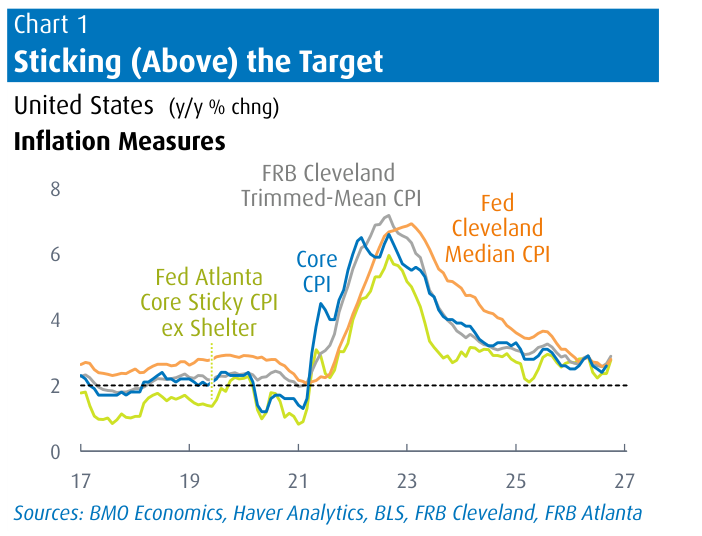
US core consumer prices increased 0.3% in October for the third consecutive month, lifting the three-month annualized rate to 3.7%, its fastest pace since April 2024.
The problem is not simply that headline inflation remains elevated. Several alternative core measures, including trimmed-mean CPI, median CPI and sticky-price inflation excluding shelter, are also showing renewed pressure.
That suggests inflation is becoming more broadly embedded rather than remaining confined to a few volatile components.
Guatieri identifies three important sources of pressure.
The first is the AI infrastructure boom, which is now creating shortages in certain computing components. Consumer prices for computers and peripherals have risen at an extraordinary 25% annualized rate over the past three months. That is a reminder that the AI investment boom may be profoundly beneficial for productivity over time while simultaneously creating inflationary bottlenecks in the nearer term.
The second is the energy shock. Higher fuel costs have pushed airfares sharply higher and are increasingly feeding into other goods and services. Core services excluding rents are running at a 5.5% three-month annualized pace, while core goods inflation has reached 2.1%.
The third is housing, where owners’ equivalent rent continues rising at 3.4%. Elevated house prices and mortgage rates are preventing many prospective buyers from entering the ownership market, maintaining pressure on rental demand even as housing transactions deteriorate.
That combination makes the inflation problem particularly awkward. The Fed is confronting price pressures originating in supply constraints, energy costs and housing-market dysfunction, rather than simply excessive discretionary consumer spending. Strong productivity growth continues restraining unit labour costs, but it is not yet delivering sufficient disinflation to offset the other pressures.
Guatieri believes October’s 0.3% increase in core producer prices could be followed by another 0.3% reading for core PCE on November 25, potentially lifting the annual rate to 3.2%, the highest since early 2024.
The monetary-policy implications are increasingly difficult to ignore.
BMO still favours two 25-basis-point Fed increases in December and March, but Guatieri sees the balance of risks shifting toward a faster, more substantial tightening cycle. Governor Waller has raised the possibility of discussing a 50-basis-point increase, while New York Fed President Williams appears more inclined toward incremental quarter-point adjustments.
The futures market already prices approximately 27 basis points of tightening for December and a cumulative 82 basis points over the following year.
That is quite a shift for investors who entered autumn assuming the Fed might soon be approaching the end of its work.
For my part, the more important question is whether the Fed can still afford to proceed at every other meeting. Once inflation broadens across categories, the risk is that policymakers become more concerned about falling behind the curve than about the collateral damage from another hike.
And that brings us directly to Kavcic’s argument.
Robert Kavcic’s Move Fast and Break Things offers a useful counterweight to the enthusiasm surrounding corporate earnings.
With approximately 90% of S&P 500 companies having reported third-quarter results, earnings growth is running at 34% year over year, while more than 83% of companies have exceeded analysts’ estimates. Seven of ten major sectors are reporting double-digit profit growth, suggesting the expansion isn’t confined entirely to technology.
Those are exceptionally strong numbers, and they help explain why equities have continued absorbing the latest inflation and interest-rate shocks with surprising resilience.
But there are qualifications. Kavcic highlights the effects of circular financing relationships, mark-to-market gains on equity holdings, and the enormous capital expenditure commitments that have not yet fully hit corporate income statements through depreciation.
That last point is important. The AI investment boom is supporting current economic activity and reported profits, but much of the associated cost will be recognized over future accounting periods.
BMO estimates that real investment in software, computing equipment and data centres contributed nearly one percentage point to US real GDP growth over the past year, before adjusting for net imports. This is an enormous growth impulse, but it could eventually become vulnerable if financing costs keep rising.
Meanwhile, the ten-year Treasury yield had climbed to approximately 5.15% by early Friday, leaving bonds struggling while equities held onto a year-to-date gain just above 10%.
BMO’s long-run return comparison illustrates how thoroughly the traditional relationship between stocks and bonds has changed.
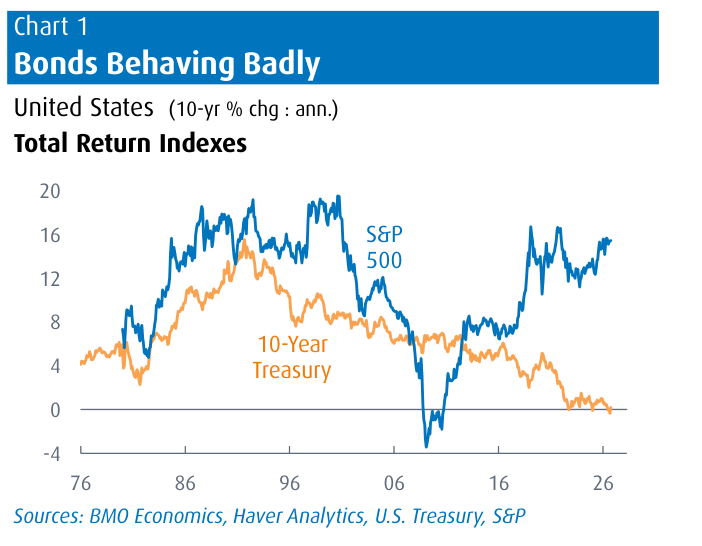
Equities have outperformed ten-year Treasuries by approximately ten percentage points annually over the past five years and fifteen points over the past decade. Bond returns have offered considerably less compensation for holding duration, particularly as inflation and fiscal concerns have pushed yields higher.
That performance divergence has become a headache for the conventional 60/40 portfolio.
BMO estimates the combined stock-bond allocation has delivered slightly more than 5% this year, potentially its weakest performance since 2018 outside the extraordinary joint selloff of 2022.
Kavcic expects further near-term upward pressure on yields as the Fed continues tightening, followed by some curve flattening as the cycle matures. Traditional bond diversification may eventually regain its usefulness, but he suspects the turning point will come when tighter monetary policy begins to damage economic activity more visibly.
The housing market is already offering an example.
US existing home sales fell in October to their lowest level since the aftermath of the 2010 financial crisis, while thirty-year mortgage rates rose above 7.5%, about 150 basis points higher than in the spring. Expensive borrowing, high prices, and mortgage lock-in are suppressing transactions even as the broader economy remains resilient.
This is where the difference between a strong economy and a strong market becomes important. Corporate earnings can continue expanding while higher discount rates reduce the valuation investors are willing to pay for those profits. Housing can remain severely depressed while AI investment supports aggregate GDP growth. Financial conditions do not tighten evenly across the economy.
Kavcic is essentially asking how much further equities can advance before the bond market’s increasingly restrictive message begins to matter.
I think that is the right question heading into December. A positioning-driven Santa rally can develop even while interest rates rise, particularly following a substantial liquidation. But sustaining the advance into 2027 becomes more difficult if higher yields begin eroding earnings expectations or forcing another round of multiple compression.
The market can ignore the bond vigilantes for a while. It rarely ignores the cost of money indefinitely.
Carl Campus brings the analysis across the Atlantic, where France is discovering that fiscal credibility becomes an expensive commodity when investors begin questioning whether the next government can deliver it.
French ten-year government bond yields briefly breached 5%, up from 3.56% at the beginning of 2026, while the spread over German Bunds widened to 175 basis points in October.
The magnitude of that repricing is striking, particularly when compared with other European sovereign markets.
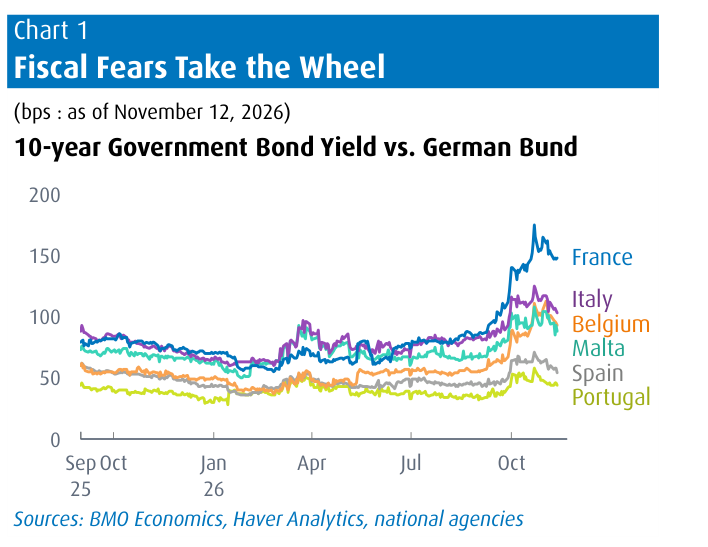
France’s problem is that fiscal consolidation is becoming increasingly difficult to reconcile with the political calendar. Government revenue already amounts to about 52.2% of GDP and spending to 57.3%, leaving little room to improve the budget without difficult choices over taxation, public services, and entitlements.
The European Union’s requirement to reduce the deficit toward 3% of GDP by 2029 remains a formidable challenge. Prime Minister Sébastien Lecornu’s consolidation proposals have struggled to gain sufficient political support, and failing to secure a budget before December could spark another confrontation over constitutional powers and the government’s survival.
Campus sees the presidential election, beginning April 18, 2027, as the next major test. Marine Le Pen leads the field in the polling discussed by BMO, with centrist candidates including Édouard Philippe, Gabriel Attal and Raphaël Glucksmann seeking to provide an alternative. Financial markets view Jean-Luc Mélenchon’s more radical fiscal proposals as especially uncomfortable, while the possibility of another National Assembly election raises the prospect of continued political fragmentation.
The specific electoral outcome matters less to the immediate bond-market argument than uncertainty about the next government’s willingness and ability to restore fiscal discipline.
A particularly unpleasant feedback mechanism is at work. Higher yields raise the government’s borrowing costs, complicating deficit reduction and potentially weakening economic growth. Investors then demand a higher premium for holding French debt, pushing financing costs even higher.
That is how a political problem can gradually become a fiscal and financial-market problem.
And with European interest rates already under pressure from inflation and global bond-market repricing, France has considerably less room to absorb another confidence shock.
For currency traders, this distinction matters. An isolated bout of French political uncertainty may have a limited impact on EUR/USD, particularly if the European Central Bank can preserve confidence in the wider financial system. But a broader sovereign-spread problem that begins to influence expectations for ECB policy could become a much more serious headwind for the euro.
Campus is therefore identifying a risk that could develop well beyond the French government bond market, particularly if the 2027 election fails to produce a credible path toward fiscal stabilization.
BMO senior economist Priscilla Thiagamoorthy pulls the week’s international developments together in her Recap, separating the indicators pointing toward stronger growth and price stability from those suggesting the global economy is becoming more difficult to manage.
I’ve retained her complete original recap rather than breaking it into smaller panels, preserving every regional heading, figure and good-news/bad-news comparison.
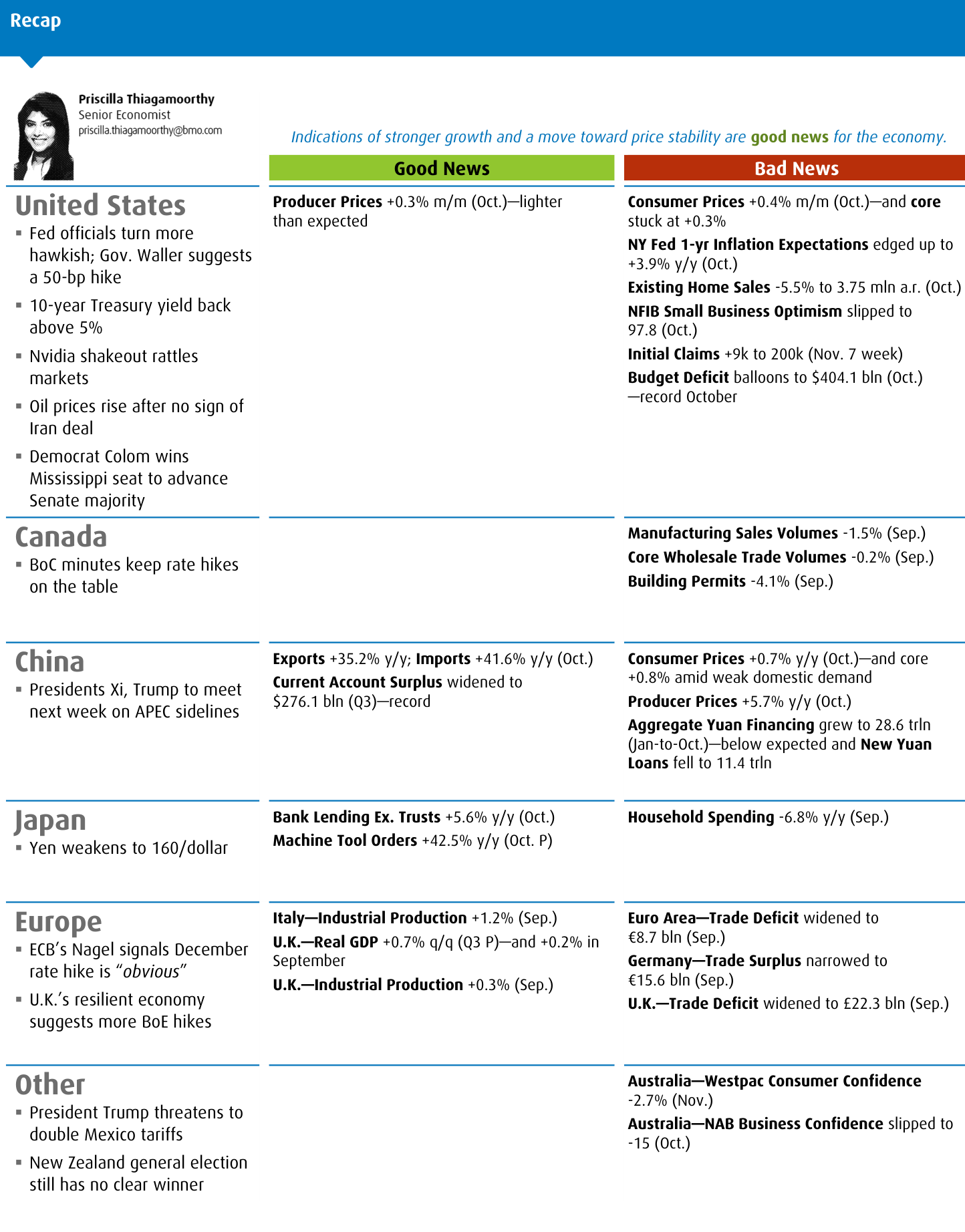
The regional divergence is revealing. American inflation and borrowing costs continue rising even as the economy remains relatively resilient. Canada’s interest-sensitive sectors are still struggling, with manufacturing sales volumes, wholesale trade and building permits all declining. China’s external sector is exceptionally strong, with exports up 35.2% and imports 41.6% year over year, yet domestic demand and lending remain disappointing.
Japan presents another contradiction: bank lending and machine-tool orders are growing strongly while household spending has fallen 6.8%. Meanwhile, European economic performance remains mixed, with modest industrial improvements overshadowed by trade imbalances and increasingly hawkish central-bank commentary.
That is not the backdrop of a synchronized global recovery. It is an environment in which different parts of the economy are being pushed in opposite directions by inflation, policy tightening and the uneven benefits of the investment boom.
BMO’s accompanying forecast table reinforces how restrictive financial conditions could remain during 2027.
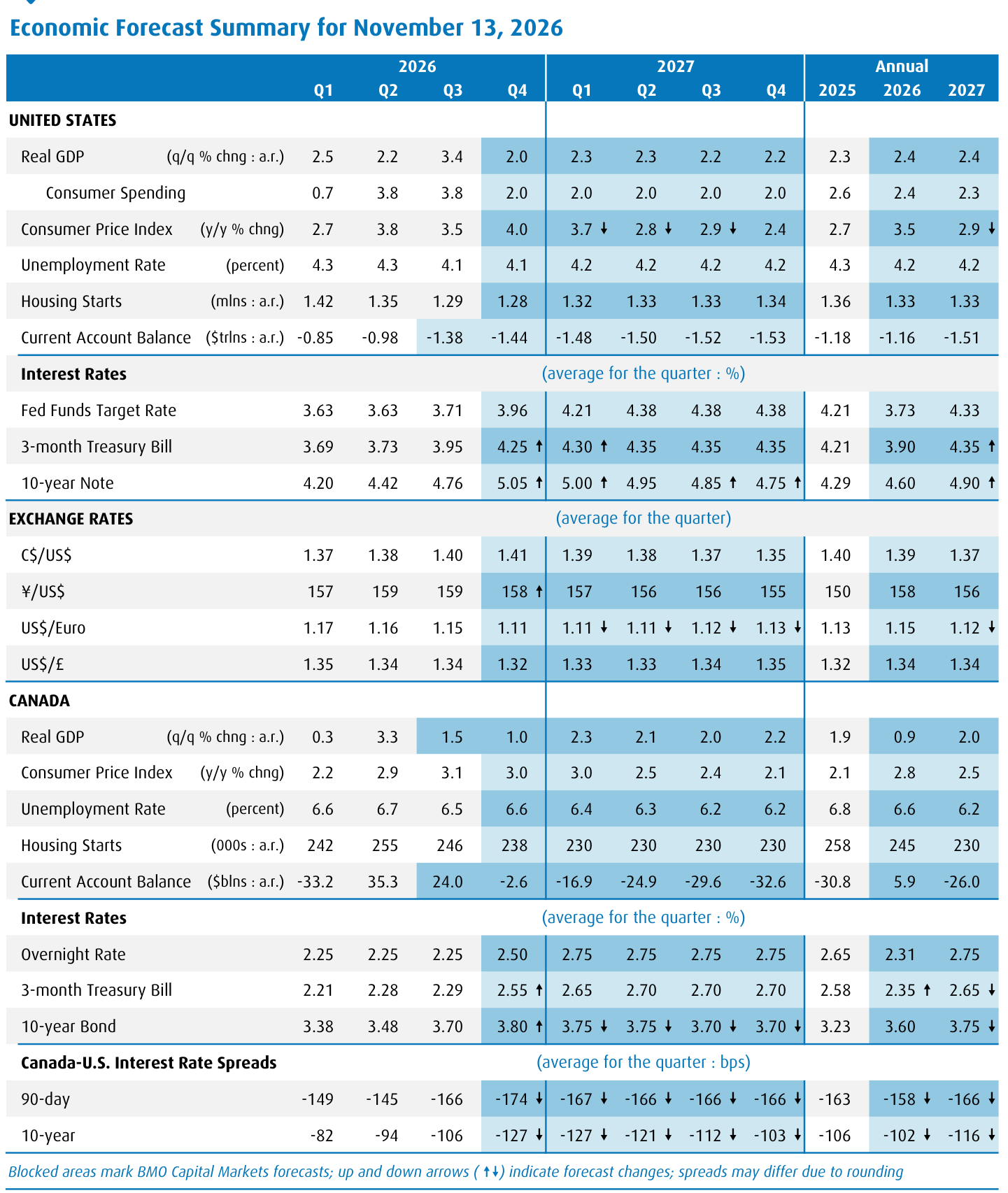
BMO forecasts US GDP growth of 2.4% in both 2026 and 2027, with average annual inflation easing from 3.5% to 2.9%. Yet the bank expects the Fed funds target to average 4.33% next year, while ten-year Treasury yields average approximately 4.90%.
That is hardly an environment in which investors can assume the Fed will quickly rescue risk assets from another bout of volatility.
For the coming week, BMO’s Scott Anderson and Priscilla Thiagamoorthy highlight October retail sales, industrial production, housing starts and the minutes of the October 27–28 FOMC meeting. Their forecasts suggest retail sales growth slowing to 0.2%, industrial production increasing 0.2%, and housing starts edging higher without materially changing the weakness in the residential construction market.
The FOMC minutes may prove particularly important because investors will be looking for evidence of how many policymakers were already concerned about the inflation outlook before the latest CPI surprise.
What I find most compelling about BMO’s weekly assessment is how neatly these three arguments connect. Guatieri sees inflation becoming more entrenched, Kavcic sees a bond market struggling under the weight of additional tightening, and Campus sees fiscal credibility deteriorating in one of Europe’s largest economies. Each issue has its own immediate catalyst, but all three ultimately revolve around the price of money and the growing difficulty of financing economic activity at higher interest rates.
I remain relatively comfortable buying selected equities where the recent correction has created attractive valuations and the underlying earnings outlook remains intact. But I am considerably less relaxed about carrying large leveraged index positions into a period when the Fed may be forced to accelerate tightening. The equity market has demonstrated remarkable resilience, particularly with third-quarter earnings growing at 34%, yet that resilience is being tested against rising discount rates and an increasingly restrictive monetary-policy backdrop.
There is also a distinction worth making between the AI investment boom supporting economic growth and the investment returns that shareholders will ultimately receive. BMO’s observation that technology-related investment contributed nearly a full percentage point to US GDP growth over the past year is extraordinary, but the financing requirements and depreciation expenses associated with that spending have yet to work fully through corporate accounts. A strong earnings quarter does not automatically settle the question of whether every dollar of AI investment is generating an adequate return.
The bond market is where I would concentrate much of my attention. A ten-year Treasury yield above 5% places a meaningful hurdle in front of long-duration growth equities, particularly when the Fed is discussing the possibility of larger rate increases. If yields continue rising because inflation is broadening, the equity market may eventually need either substantially stronger earnings or lower valuation multiples to absorb the adjustment.
And France is a reminder that the consequences of tighter money are not confined to corporate balance sheets. Governments accustomed to comparatively inexpensive financing can find their fiscal assumptions deteriorating quickly when investors demand a larger term or credit premium. That creates additional uncertainty for European assets and potentially the euro, particularly if political fragmentation prevents credible budget consolidation.
For the immediate trading window, I would not dismiss the possibility of a Santa rally. Positioning has been reduced, earnings remain strong and year-end seasonal flows can support equities even when the macroeconomic backdrop looks uncomfortable. But a positioning-driven advance can lose momentum quickly once the marginal buyers have finished rebuilding exposure, especially if another inflation surprise pushes Treasury yields higher.
The December Fed meeting now matters more than the seasonal calendar. BMO’s baseline of two quarter-point hikes remains relatively measured, but the possibility of consecutive increases or even a larger initial move makes this a difficult environment for assuming that the recent equity correction has permanently removed the downside risk.
The uncomfortable message from BMO is that the economy may remain strong enough to justify further tightening, even as several interest-sensitive parts of the financial system are already showing signs of strain.
That is a rather different problem from the conventional recession scare, where weakening activity eventually encourages the Fed to provide relief. Here, the central bank may see sufficiently resilient demand and employment to keep tightening despite deteriorating housing activity, weaker bond returns and increasingly expensive government borrowing.
I would therefore continue separating the longer-term investment opportunity from the immediate leveraged trading decision. Buying quality companies at improved valuations can be perfectly reasonable even if index volatility remains elevated. Carrying too much leverage while inflation expectations and the front end of the Treasury curve are still repricing is a more demanding proposition.
BMO’s three economists have identified different pressure points, but the larger lesson is familiar to anyone who has spent years trading through monetary cycles: markets often remain remarkably resilient until the cost of money finally becomes restrictive enough to change behaviour.
Santa may still deliver the rally. But if inflation keeps running hot, the Fed could arrive with the bill before investors have finished opening their presents.
And with Treasury yields already moving higher, I would make sure there is enough room in the trading book to handle an unwelcome surprise.