







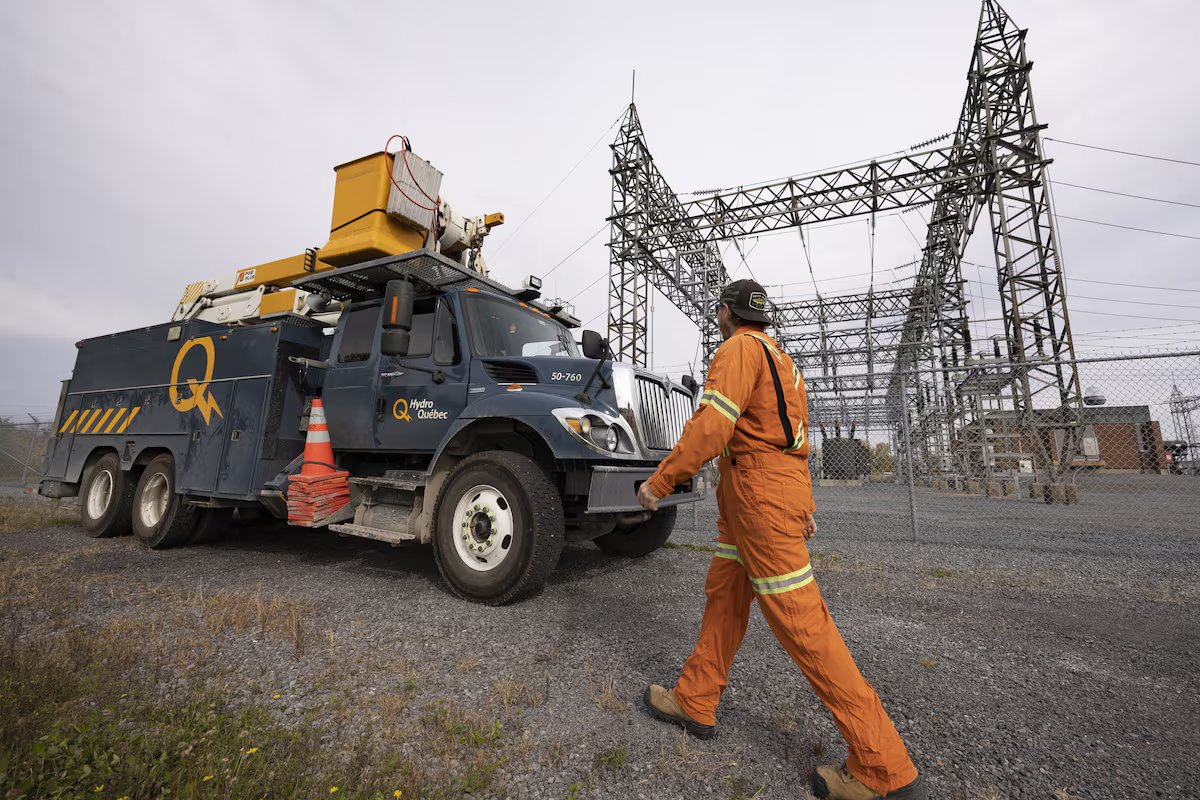

A hydro worker inspects a substation in Delson, Que. Electricity demand is expected to grow by 15 per cent between now and 2030, according to Wood Mackenzie’s annual Energy Transition Outlook.Christinne Muschi/Christinne Muschi/The Globe and
Global conflicts and supply-chain pressures are pushing some countries to shift away from a dependency on fossil fuels and helping to reduce their carbon emissions more than with climate-specific policies alone, a new report finds.
Research group Wood Mackenzie’s annual Energy Transition Outlook found trade conflict and the U.S.-Iran war have led some major economies to become less reliant on global energy markets, focusing more on domestically produced energy, including nuclear and other low-carbon sources.
“The world now confronts an energy landscape of unprecedented complexity, where emissions trajectories continue deteriorating, climate targets drift further from reach, and market volatility has reached extraordinary levels,” said Prakash Sharma, Wood Mackenzie vice-president and head of scenarios and technologies and one of the report’s lead authors.
“We believe the government thinking has moved in parallel with these market pressures.”
Mr. Sharma said climate policy and net-zero objectives require stronger policy supports and incentives, and “the current global order, we believe, is not designed to support that alternative.”
Canada is one of almost 200 countries that have committed to net zero carbon emissions by 2050 as signatories to the 2015 Paris Agreement, which seeks to limit a global average temperature rise to between 1.5 and 2 degrees above preindustrial levels.
Wood Mackenzie’s independent assessment, which outlines five distinct energy transition scenarios across 105 energy markets to 2060, found the energy security scenario – one which focuses on domestic renewable sources – would result in a projected warming of 2.5 degrees by 2100, lower than their base-case scenario of 2.6 degrees.
Ottawa won’t lift Arctic oil and gas moratorium without Inuvialuit input, Carney says
The security scenario accounts for a boost in investment in nuclear and geothermal energy sources over technologies such as hydrogen and carbon capture, which it said rely on stronger climate policies and incentives.
The scenario that accounts for countries choosing to focus on economic expansion, such as major investments in data centres for artificial intelligence and robotics, is projected to lead to warming of 3 degrees since fossil fuel usage continues longer, delaying investment in renewable sources.
The report states electricity demand is expected to grow by 15 per cent between now and 2030, with data centres accounting for about one-third of that increase.
Prime Minister Mark Carney has been shifting Canada’s policies away from a climate-focused approach to one prioritizing investment in major projects, including fossil fuels, with new oil and natural gas pipelines to the West Coast announced recently.
However, the 2026 federal budget tabled Nov. 5 outlined billions in new money for Canada’s electricity system, including $40-billion over 10 years starting in 2027-28 for infrastructure expansion.
It also extended tax credits for clean electricity investment through 2040, with an expected cost of $2.4-billion from 2027-28 to 2030-31 and $36.1-billion from 2031-32 to 2041-42.
Budget proposes incentives to encourage buildout of electrical grid
Lindsey Entwistle, Wood Mackenzie’s principal analyst of scenarios and technologies and another of the report’s lead authors, said electrification is “clearly the solution to many of the challenges of energy security, decarbonization, and economic growth.”
The Canadian Climate Institute’s annual early emissions report found the country was well short of its carbon-emissions-reduction goals for 2030, and also turned to clean electrification as a solution.
Sachi Gibson, mitigation research director at the environmental think tank, said technology such as electric vehicles and heat pumps has driven power demand in Canada, although the transition has not been as rapid as in other countries.
“Folks are electrifying for many reasons, not just climate concerns,” Ms. Gibson said.
“There’s multiple drivers at play. It can be climate policy, it can be energy security concerns, it could also be affordability.”
Wood Mackenzie said data centres and AI are expected to double global power demand by 2060, with the U.S., China and India accounting for more than half of that growth.
“There’s an immediate scramble for electricity supply and real fears around high energy prices,” Ms. Entwistle said.
The federal budget also included a commitment to support data centre developers to build 500 megawatts of processing power for Canadian AI companies, though it did not put a dollar figure behind the program.