









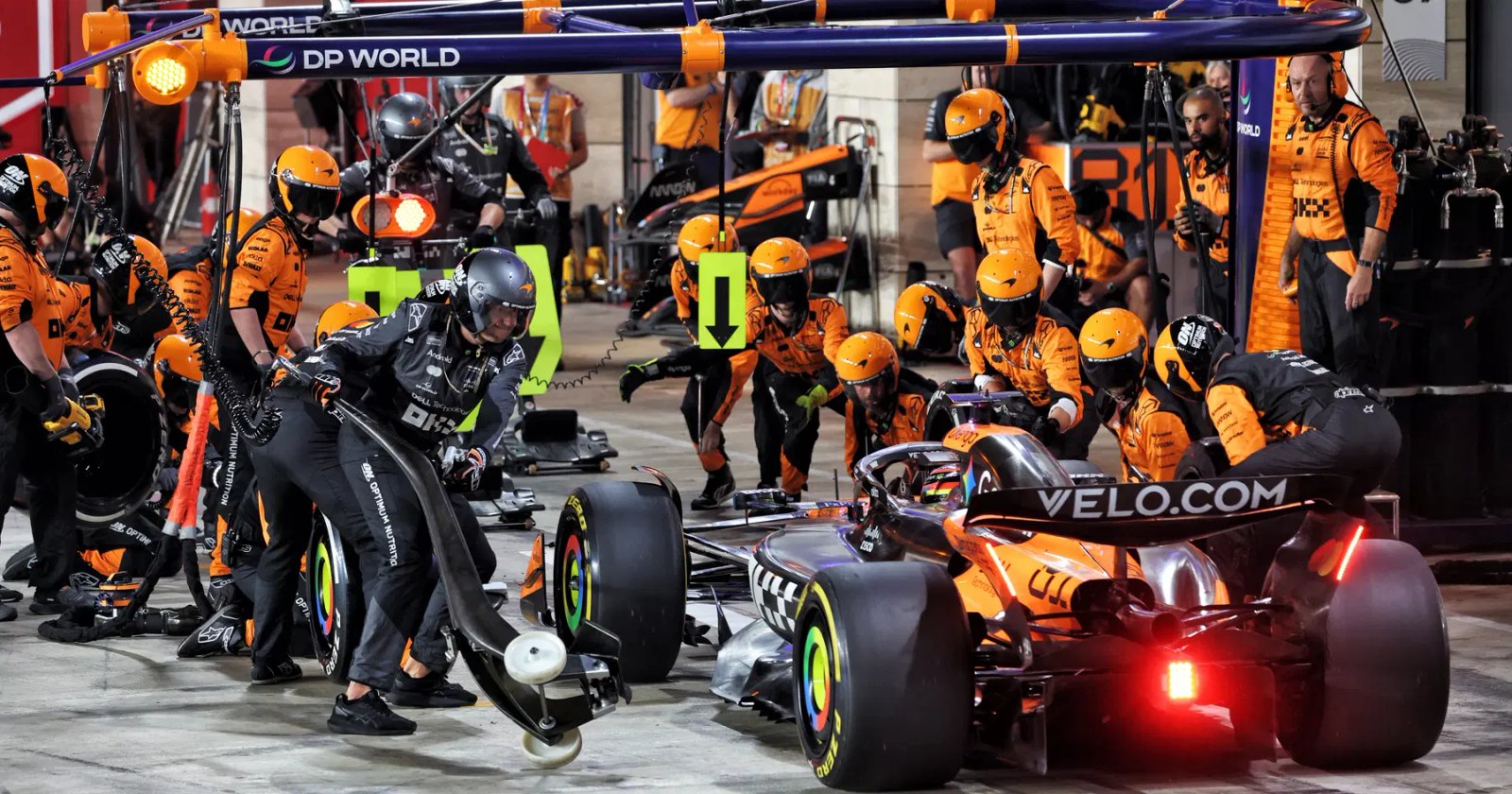
Formula 1 will once again impose a strict tyre stint limit at the Qatar Grand Prix, with Pirelli confirming that drivers face a maximum of 27 laps per set at Lusail International Circuit this season.
The rule echoes the measure first introduced in 2023, when the FIA capped tyre life at 18 laps per set after Friday practice revealed internal separation between the sidewall’s topping compound and carcass cords.
That separation was traced back to repeated high-speed contact between tyre sidewalls and Lusail’s 50-millimetre pyramid kerbs, with Pirelli and the FIA warning at the time that continued running risked sudden, dangerous deflation. The restriction forced every driver into at least three pit stops to cover the 57-lap distance.
Three years on, the same underlying issue, localised front-tyre wear driven by Lusail’s relentless medium- and high-speed corners, has prompted Pirelli to bring back a stint limit, albeit a less severe one.
Asked whether a limitation would again be in place, Pirelli’s Simone Berra confirmed the figure to select media, including RacingNews365.
“The same limitation in terms of rules, but the number of laps will be 27, not 25. We increased by two laps. We have seen from our indoor testing that this is, let’s say, acceptable without any particular risk.
“But we know the issue in Qatar is that we have very high localised wear, especially on the front, with 100% wear easily reached after 25, 26 laps on average.
“This is generating higher stress on the tyre because you don’t have the thread compound protecting the structure and then you have high loads, high lateral loads there, and high temperature, high carcass temperature.
“So, these are the factors that are influencing more the integrity resistance of the tyre.”
No sprint makes Pirelli life easier
Berra explained that the limit is designed, as before, to force teams into two pit stops rather than risk running tyres beyond the point where the structure is exposed.
“We are going to keep the same laps limitation just to induce the two stops and avoid any risk of running on the under-thread for multiple laps and generating integrity issues,” added Berra.
“We know that if you reach 100% wear on the front, then you don’t really induce a big degradation. The teams, they can easily manage the front axle in the long runs, they don’t stop if they don’t see quite a significant drop in performance.
“So, that’s the situation, and we will count the number of laps for each session. It will be a little bit easier because it’s no more a sprint event this year, while it was last year.
“So, even the lap count will be easier for us and we will review the lap count and release the remaining laps per set at the end of Saturday running.”