






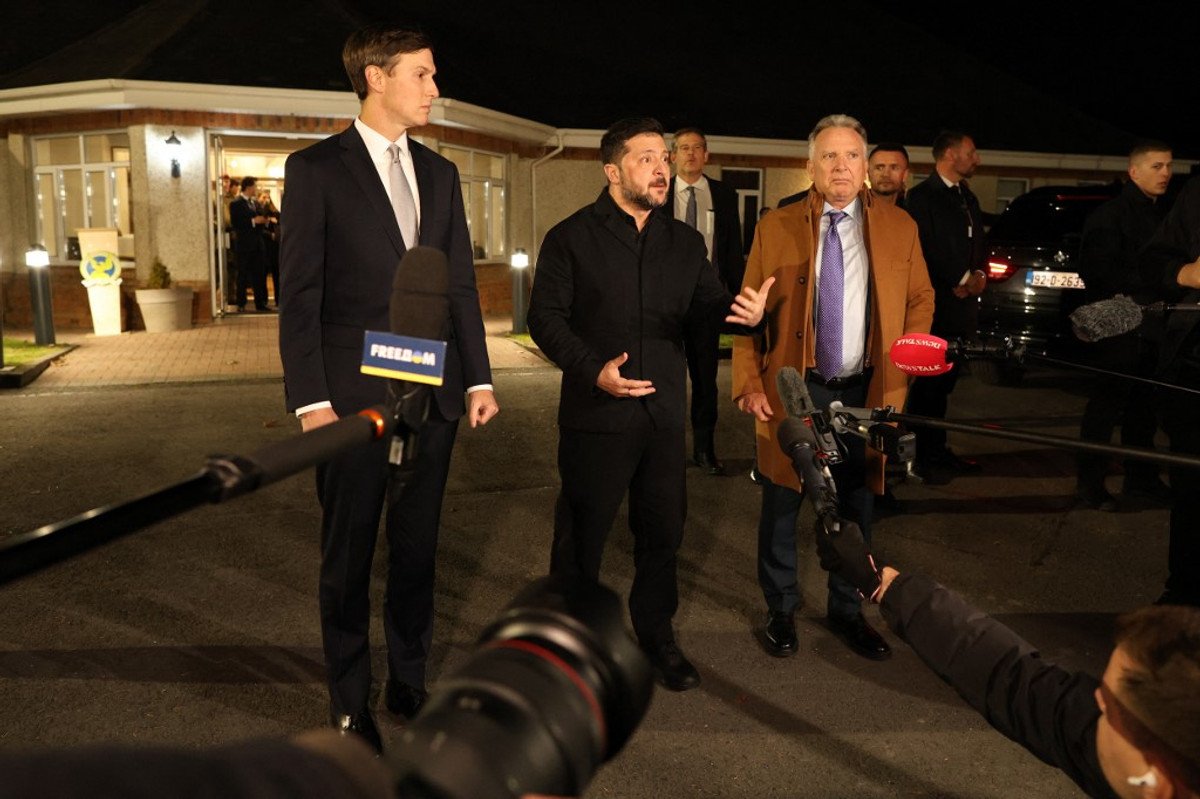
European representatives will join the next round of US-mediated peace negotiations between Ukraine and Russia, President Volodymyr Zelensky and US envoys Jared Kushner and Steve Witkoff announced Thursday, Nov. 12, following talks with Russian President Vladimir Putin in Moscow.
The announcement coincided with an agreement on what could become the largest prisoner-of-war exchange since Russia launched its full-scale invasion of Ukraine in February 2022.
JOIN US ON TELEGRAM
Follow our coverage of the war on the @Kyivpost_official.
Speaking alongside the American envoys at a military airbase outside Dublin, Zelensky welcomed both developments as concrete progress after two days of negotiations in Abu Dhabi and subsequent US talks with Putin.
“Each meeting has to give results and bring us closer to peace,” Zelensky said.
The Ukrainian leader said the prisoner exchange could bring more than a thousand Ukrainians home, describing it as a significant humanitarian achievement.
“Our soldiers will come home,” Zelensky said. “This is a real result.”
The agreements emerged from intensive US shuttle diplomacy, with Kushner and Witkoff traveling from Abu Dhabi to Moscow before briefing Zelensky in Ireland, where he was attending a summit of European leaders.
Moscow signals openness to European participation
Zelensky described securing Europe’s direct involvement as a significant diplomatic development, particularly after European representatives were excluded from the main negotiations with Russia in Abu Dhabi on Nov. 10-11.

Other Topics of Interest
No date or venue has been announced for the next round of trilateral talks yet, although Witkoff confirmed it will include European partners.
“All the sides accepted that Europe will get [a seat at the] negotiation table,” Zelensky said, stressing that European governments would participate directly rather than remain limited to separate consultations.
“They will have their voice,” he added.
Kushner said Washington had spent months working with European partners, stressing that their participation was essential to reaching a lasting peace agreement.
“We cannot conclude this deal without the Europeans being at the table,” Kushner said.
According to Kushner, the American delegation raised the issue directly with Putin, who indicated a willingness to accept European involvement.
“He’s going to give it a try,” Kushner said.
Witkoff separately told Russian state television that European representatives would attend the next round of negotiations. The Kremlin, however, had not formally confirmed the arrangement.
Zelensky emphasized that European involvement was essential not only to ending the war but also to Ukraine’s post-war security, economic recovery and future membership in the European Union.
Zelensky pushes for an ‘all-for-all’ prisoner exchange
The agreement on a major prisoner exchange is among the clearest results of the latest diplomatic efforts.
Kushner confirmed that the arrangement had been finalized following discussions involving Ukrainian and Russian negotiators in the United Arab Emirates and subsequent consultations in Moscow.
“We were able to finalize the prisoner-of-war exchange, which is a very important thing,” Kushner said.
Zelensky reiterated Ukraine’s longstanding position that all prisoners of war should be returned, questioning why a comprehensive exchange remained impossible.
“I don’t know what the problem is to exchange all prisoners of war. Let all people come home,” Zelensky said.
Ukrainian and Russian negotiators had previously discussed exchanging between 1,000 and 1,500 prisoners from each side during the Abu Dhabi meetings. The final number and timetable have not been announced.
Putin refuses territorial compromise, rejects foreign troops
Despite the diplomatic progress, Putin reiterated Moscow’s demands concerning Ukrainian territory and post-war security arrangements.
During a televised exchange with the US delegation in Moscow, Putin rejected proposals for demilitarized or “grey” zones separating Ukrainian and Russian positions.
“For us, there is only one line of demarcation: the state border. Because then it will be clear and obvious: here are we, and here are you,” Putin said.
Russia continues to claim Ukraine’s Donetsk, Luhansk, Kherson and Zaporizhzhia regions despite not fully controlling them. Moscow illegally declared their annexation in 2022, eight years after its illegal annexation of Crimea.
Zelensky has repeatedly ruled out territorial concessions, including proposals requiring Ukraine to surrender areas of Donbas it continues to control.
Putin also reiterated his opposition to foreign peacekeeping forces in Ukraine, warning that Moscow would consider such troops legitimate military targets.
He described their deployment as a continuation of the war, challenging European proposals for an international force intended to help deter future Russian aggression.
The disagreements underscore the distance between the two sides on territorial control and enforceable post-war security guarantees.
Next talks to address ceasefires and de-escalation
Zelensky said another round of negotiations was planned, with delegations expected to develop proposals covering ceasefires and other measures to reduce hostilities.
“We decided that we work on an agenda about any kind of de-escalation, some kind of ceasefires,” Zelensky said.
Witkoff confirmed that another meeting had been scheduled, although its precise location and timing were not disclosed.
“We’ve got another meeting on the schedule, and we’re going to work very, very hard to get to that goal,” he said.
Kushner described the preceding three days of diplomacy as intensive, involving extensive meetings in Abu Dhabi before detailed discussions with Putin and senior Russian officials in Moscow.
He said direct negotiations could help narrow differences between Russia and European governments despite their sharply conflicting public positions.
The US delegation also discussed Ukraine’s economic reconstruction and long-term security guarantees.
Kushner praised Ukraine’s wartime innovation and ability to defend itself, saying those capabilities could help drive the country’s post-war recovery.
“The plans that we’re working on are really incredible,” he said.
He emphasized the importance of security arrangements capable of preventing another Russian invasion, although no specific guarantees were announced.
Europe rejects Moscow’s proposed security overhaul
The developments came as European leaders gathered in Dublin to discuss Ukraine and the continent’s broader security.
Moscow has sought to expand negotiations beyond ending the war into a reconsideration of Europe’s security framework, including NATO’s presence in Eastern Europe.
European leaders have resisted that approach, arguing that Russia must first end its aggression against Ukraine.
European Council President António Costa said there was “no need to reinvent the wheel” concerning Europe’s security arrangements, accusing Moscow of undermining the existing framework through its invasion.
In a French-backed declaration, 39 countries insisted that “any matter affecting European security should be decided with the Europeans.”
French President Emmanuel Macron called for a “clear and united vision” among European governments on the objectives of the negotiations.
Asked about proposals for a broader security arrangement between Russia and Europe, Zelensky said the outcome of the war in Ukraine must come first.
“A lot depends on when and how the war will end in Ukraine,” he said.
His comments reflected Kyiv’s position that any future European security framework must account for the terms of a settlement and Ukraine’s ability to defend itself.