








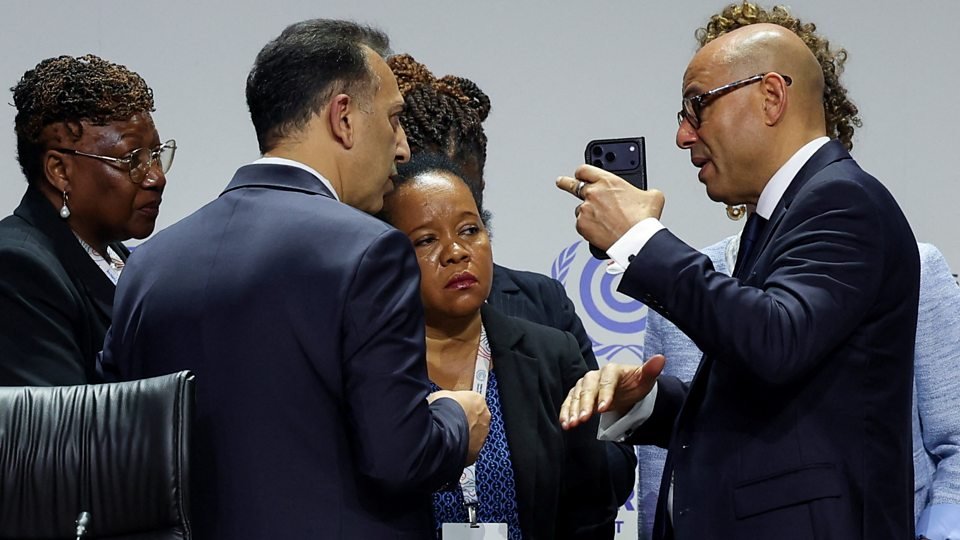
COP31 talks failed to produce an overarching climate agreement on Sunday after the European Union and other countries rejected a proposal that omitted explicit references to fossil fuels, leaving the Antalya conference without the political declaration its leaders had sought.
Murat Kurum, the Turkish environment minister presiding over the conference, acknowledged that the proposed text lacked consensus and had not been adopted, according to Euronews’ report from the closing session. The outcome followed negotiations that extended beyond the summit’s scheduled Friday finish.
Ireland’s climate and energy minister, Darragh O’Brien, said the European Union would not endorse a cover decision without a reference to fossil fuels. Australia’s climate minister, Chris Bowen, who led the negotiations, expressed disappointment at the failure to agree on that decision.
United Nations Secretary-General António Guterres also expressed disappointment, saying governments had failed to meet expectations for the overarching outcome. The objections concerned the proposal before the conference; they did not amount to a negotiated replacement for it.
The Associated Press reported that the meeting had made progress on smaller issues despite the failure of the cover decision. That leaves a narrower outcome than the abandonment of the entire climate process: the main political agreement failed, while smaller issues had seen progress.
A dispute that sharpened during the final days
The argument over fossil fuels had become visible before the final session. In a November 20 dispatch, U.N. News described a Thursday draft that had removed explicit references to moving away from those energy sources, emphasizing clean energy and electrification instead.
The same account described a Wednesday ministerial exchange convened by Kurum to try to resolve differences. Some participants considered the discussion constructive, while ministers from vulnerable countries said it had produced little progress.
Adaptation finance was another unfinished part of the proposed compromise. U.N. News reported that the Thursday text reaffirmed a goal of tripling funding by 2035 but left important details, including how to calculate the increase, for further discussion.
Outside the negotiating rooms, activists used missing-cat posters to criticize the draft. Their fictional pet, Ambition, stood for demands for a fossil-fuel transition and climate justice. U.N. News reported that the campaign had begun at COP29 and returned in Antalya as environmental groups pressed governments to strengthen the proposed agreement.
Türkiye’s electrification proposal was already central to the conference. As The FINANCIAL reported earlier in the talks, the voluntary initiative sought to raise electricity’s share of global final energy consumption to 35 percent by 2035. That initiative and the disputed conference-wide cover decision were separate instruments.
The earlier pledge envisaged investment in grids, storage and flexibility, while leaving participating countries authority over their own electrification plans.
The emissions gap behind the negotiations
The U.N. Environment Programme’s 2026 Emissions Gap Report sets out the scale of the task facing governments. Its assessment says global warming is set to exceed 1.5 degrees Celsius above preindustrial levels and examines a pathway designed to keep that overshoot as limited as possible.
In that scenario, temperatures peak around 1.7 to 1.8 degrees near the middle of the century and return to or below 1.5 degrees by 2100, with roughly a 50 percent chance. Those figures describe a modeled pathway, rather than a guarantee about future temperatures.
Following it would require global greenhouse-gas emissions to fall 18 percent by 2030, 45 percent by 2035 and 69 percent by 2040, compared with 2025 levels. Increasing carbon-dioxide removal would also be needed later in the century.
By contrast, UNEP estimates that full implementation of national climate pledges would reduce emissions by 5 to 8 percent by 2030 and 11 to 15 percent by 2035, on the same baseline. It puts the resulting warming trajectory at about 2.6 degrees this century.
The report’s sectoral benchmarks also address renewable energy, energy intensity, the share of fossil fuels in energy supply and methane emissions beyond 2030.
Adaptation finance remains far below estimated needs
Separate UNEP findings address the cost of preparing for impacts already occurring. At the launch of its 2026 Adaptation Gap Report, Executive Director Inger Andersen said international public adaptation finance from developed to developing countries increased by $1 billion between 2023 and 2024.
She said that growth was slowing when it needed to accelerate. The report estimates adaptation-finance needs at about $305 billion annually by 2035, excluding private-sector needs, which could almost double the total.
Andersen said even the earlier call to at least triple adaptation finance by 2035 would cover only 20 to 29 percent of developing countries’ needs after adjusting for inflation. The estimate measures the gap between projected requirements and funding, rather than announcing money governments have committed or paid.
She also cited pressure on the Fund for responding to Loss and Damage. Its initial funding-round envelope was $342 million, while developing countries submitted requests totaling about eight times that amount. Those applications were requests for support, not approved disbursements.
Andersen also described growing private adaptation investment, while cautioning that it largely serves investors’ own needs and does not replace public support for vulnerable communities.
The Paris framework continues beyond Antalya
The Paris Agreement remains the underlying treaty for the negotiations. Adopted in December 2015 and in force since November 2016, it sets a goal of holding warming well below 2 degrees above preindustrial levels while pursuing efforts to limit it to 1.5 degrees.
Its implementation works through successive national climate plans, known as nationally determined contributions. The U.N. climate secretariat describes a five-year cycle in which each new contribution is meant to show greater ambition than its predecessor.
Those plans cover both emissions reductions and resilience to climate impacts. The agreement also establishes a framework for financial assistance, technology development and transfer, and support for countries that lack the capacity to carry out the necessary work.
Countries are also invited to prepare voluntary long-term low-emissions development strategies.
Reporting and review form another part of that structure. Under the enhanced transparency framework, countries report on climate action and on support provided or received, with international procedures for reviewing their submissions. These arrangements arise from the Paris framework rather than from Sunday’s unsuccessful proposal.
A continuing assessment of collective progress
The global stocktake examines implementation of the Paris Agreement across countries collectively. According to the U.N. climate secretariat, it assesses progress toward the treaty’s purpose and long-term goals, considering climate action alongside the support needed to deliver it.
The first stocktake concluded at COP28 in Dubai in 2023, and the process is repeated every five years. It is intended to identify where progress is being made, where gaps remain and which responses governments can pursue together.
Preparations for the second assessment were already under way before the Antalya closing session. A call for submissions for its information-collection and preparation stage was issued on July 20, 2026. The secretariat’s stocktake page also listed an Antalya ministerial event for November 18.
The secretariat also records preparatory discussions held in Bonn earlier in 2026. The United Arab Emirates dialogue took place on June 10 and 11, followed by the annual global stocktake dialogue on June 16. Those meetings preceded the Antalya summit.
FAQ
Did COP31 adopt the proposed overarching agreement?
No. Kurum said the text lacked consensus and was not adopted. The failure concerned the cover decision; AP reported that the meeting had made progress on smaller issues.
Did that failure cancel the Paris Agreement?
No. Paris remains the treaty framework for national climate plans, financial and technical support, transparency reporting and the periodic assessment of collective progress.