






The UN’s climate change conference collapsed in Antalya, Turkey, on Sunday, with no final agreement after countries failed to reach consensus on phasing out fossil fuels and addressing demands for greater climate financing from developed nations.
The breakdown of COP31 is the first major failure to reach agreement at UN climate talks since the Copenhagen summit in 2009.
After more than two weeks of negotiations — making it the longest COP on record — Turkey’s conference president, Murat Kurum, closed the plenary, saying parties were unable to agree on outcomes.
The failure by nearly 200 parties to agree on this year’s climate change deal after days of political negotiations comes at a time when the world is experiencing increasing natural disasters.
A recent UN report called on the countries to go beyond existing pledges and deliver accelerated action to reduce emissions, or the planet could suffer from warmer temperatures.
Speaking for the EU, which represents 27 countries, Irish minister Darragh O’Brien pinned their rejection mainly on one fact: the lack of any mention of phasing out fossil fuels.
“The EU and its member states object to this cover decision … because these decisions go nowhere near the level of action or ambition that is required for us to tackle climate change.
“It is unconscionable that we would have a climate act that makes no reference to fossil fuels, no reference to transitioning away from fossil fuels either, and it is for those reasons that the EU strongly objects to this text,” O’Brien said.
The initial draft decision made a call for accelerated action to phase out fossil fuels, striking at the heart of South Africa’s main source of energy security, but the final draft did not include the wording. Business Day understands that the UAE was among the nations that pushed against the inclusion of fossil fuels.
The EU and its member states object to this cover decision … because these decisions go nowhere near the level of action or ambition that is required for us to tackle climate change.
— Darragh O’Brien, Irish minister
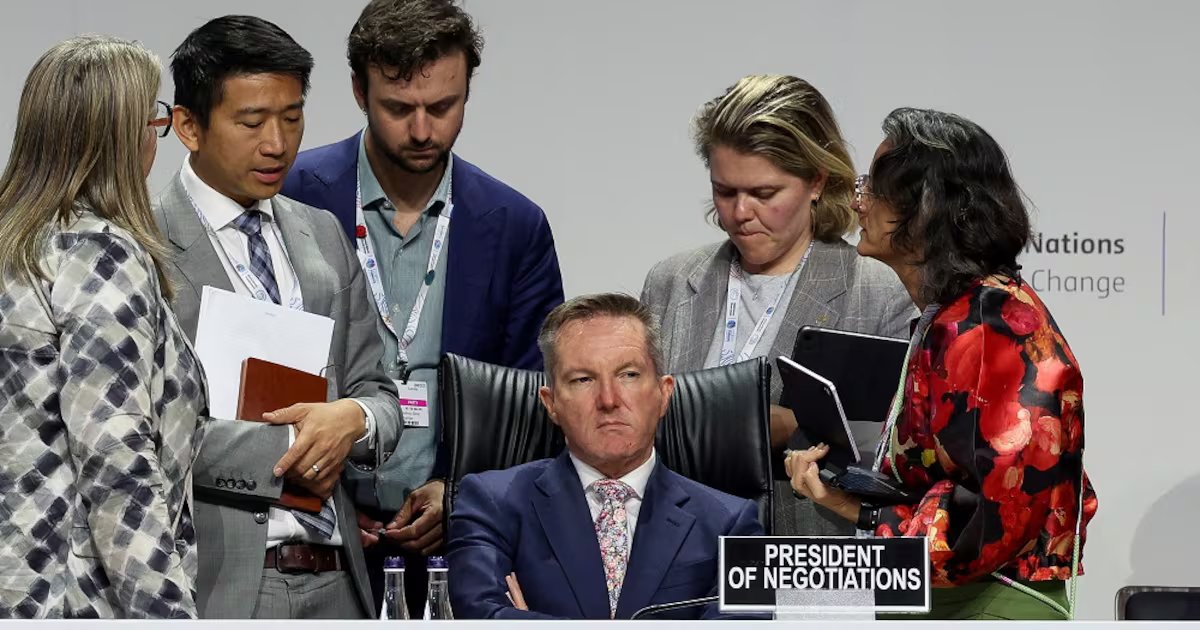
In justifying the exclusion, the president of negotiations, Australian minister Chris Bowen, said previous COP decisions mentioned the phasing out of fossil fuels and these still held legal effect.
The COP was dubbed an “implementation” and “action COP”, and climate financing was a central part of the negotiations.
Developing countries pushed for wealthier nations in the Global North to adhere to the provisions of the Paris Agreement, which states that developed country parties should provide financial resources to assist developing countries with mitigation and adaptation.
Developing countries, during closing statements, lambasted rich nations for their failure to commit to climate financing while speaking of a just energy transition.
African countries and other developing countries did not get what they wanted, which was the proposal for adaptation financing to move from $40bn in 2025 to $120bn by 2035. But some supported the adoption of the cover decision for countries to show consensus on climate change.
The final draft differed from the first draft, which made mention of the $120bn target and marked a significant dent in developing countries’ agendas for grants, not loans, to be made available for implementation in the fight against climate change.
Speaking on behalf of the African group of negotiators, Ghana’s Zanetor Agyeman-Rawlings said African nations struggled with the final draft on the basis that it reflected no concrete plans on climate financing, which the group had advocated for and described as its “red line” in adopting a final COP decision.

Despite not being happy on the climate financing front, African nations accepted the cover decision.
“Permit me once again to candidly state where we see this text falling short. On adaptation finance, the decision reaffirms the goal to at least triple adaptation by 2035, but it gives no baseline and no figure. A commitment without a baseline cannot be called finance,” she said.
“It is unconscionable to place the disproportionate burden on those who contribute the least and yet are suffering the most. Even so, Africa has always chosen to build multilateralism rather than walk away from it. We are allowing this text to be adopted in the interest of and for the protection of multilateralism.”
When it was clear the parties were not agreeing, the African group asked if negotiations could be reconsidered because the lack of adoption was “significant”. This was not done; the outcome was not adopted.
Tasneem Essop, executive director of Climate Action Network International, an organisation representing civil society organisations in over 150 countries, said the EU contributed to the talks collapsing.
“This was the worst COP ever. We are witnessing human suffering on an unimaginable scale and we had hoped this COP would take steps to protect people from the worsening climate crisis. Instead, rich nations gutted the very measures that could have made a difference,” she said.
“In negotiating room after negotiating room, developed countries systematically blocked measures that would require them to provide finance to protect people’s lives and address the climate crisis.
This was the worst COP ever. We are witnessing human suffering on an unimaginable scale and we had hoped this COP would take steps to protect people from the worsening climate crisis. Instead, rich nations gutted the very measures that could have made a difference.
— Tasneem Essop, executive director of Climate Action Network International
“Before we even arrived in Antalya, the EU’s climate commissioner, Wopke Hoekstra, had ruthlessly declared discussions on new climate finance as ‘dead in the water’. Rejecting the text because it does not include language on fossil fuels is the height of hypocrisy. They have failed to phase out their own fossil fuels, and they have failed to meet their obligations to provide finance to developing countries.”
Hoekstra said in a press conference in Antalya that there would be no commitments on “fresh money” but only the fulfilment of previous decisions. This was problematic for developing countries.
With no agreement on commitments from countries on how to deal with climate change from this year’s conference, the previous COP decisions remain binding. Climate financing and the wording on fossil fuels will now feature in the next COP, in Addis Ababa, Ethiopia — in 2027.
Read: SA’s transition from coal will take time, Maynier says at COP31
UN secretary-general António Guterres said he was deeply disappointed that COP31 had ended without consensus on an overarching outcome.
“Major emitters must lead. Developed countries must deliver on finance. And every country must do their part,” he said.
“We also need far stronger protection for those on the front lines. Developed countries must make good on their commitment to lead on tripling adaptation finance and ensuring that support reaches those who most need it. Put dates and dollars behind that pledge now. Lives depend on it.”
UN climate change executive secretary Simon Stiell shared the sentiments. “I share the deep disappointment of many: COP31 has been unable to agree on issues related to both presidency-led decisions. The world cannot afford a repeat,” he said.
BusinessDay