







IN THIS ISSUE:
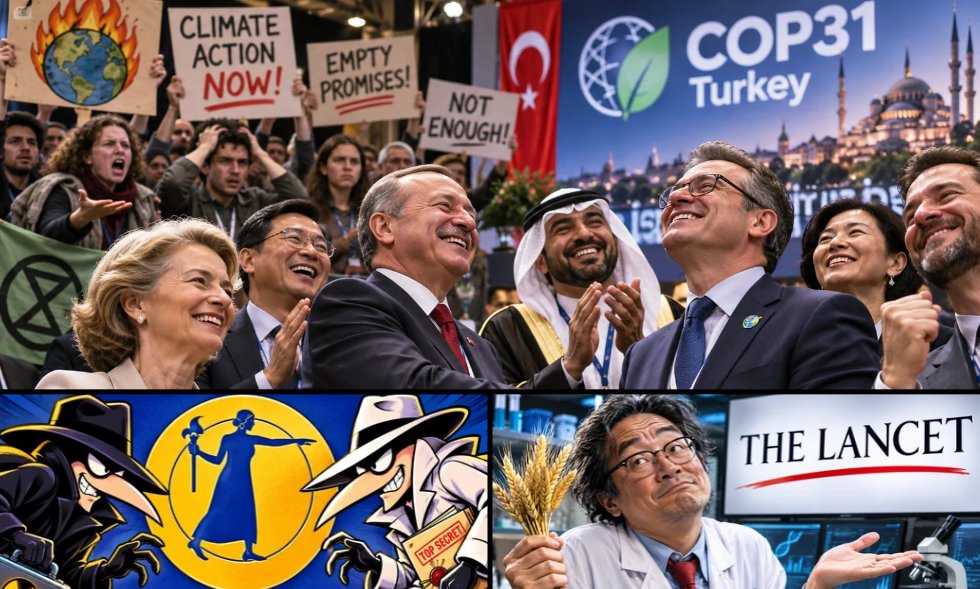
- Did Climate Change Stave off the Next Ice Age? Study Says Maybe
- Stealth Advocacy at the National Academies
- The Lancet Is Misstating the Health Impacts of Climate Change
Prediction: COP31 Will Fail to Prevent Climate Change
Environmental scolds have long embraced predictions, expressed with confidence and certainty. Climate alarmists, a subset of environmentalists, have adopted the same behavior. The problem for both groups is, they often make predictions, in a timeframe, within which their predictions can be proven true or false. History shows they are almost always false, often because they don’t understand how dynamic and adaptive society and markets are to information and scarcity.
The Competitive Enterprise Institute collected a large number, though hardly all, of the failed predictions self-proclaimed experts have made over the past 50 years that were woefully, foolishly, and dangerously (because they did or could have affected policy, investment, and life choice decisions) wrong. In truth, on energy and environment matters, such failed predictions go back more than 100 years, probably longer.
More recently, climate alarmists have a litany of falsified-by-reality predictions, as covered by my colleague Anthony Watts at Watts Up With That.
Some alarmists have seemingly learned their lesson and now make predictions so far out in time that they can’t be falsified in our lifetime – meaning it will be up to our distant descendants to mock them when the predicted disaster fails to materialize.
I’m not a betting man and I rarely am comfortable making predictions because I don’t like to be proven wrong, but I am willing to make a very short- and mid-term prediction, and readers can feel free to send emails calling me out on it if I’m wrong – but I don’t think I will be.
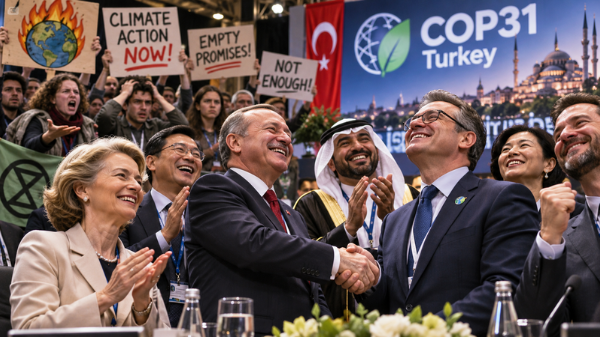
I predict that COP31 will fail in its primary mission of reducing greenhouse gas emissions and preventing climate change. It will even fail in whatever its delegates say its specific mission is – electrifying the world, ending fossil fuel use, getting money for developing countries, whatever. If the past is any guide, a perfect record of failed commitments makes it a pretty safe bet. COP negotiators will hit the final hour scheduled for the conference and still not have an agreement in place. They will extend negotiations, and ultimately hammer out an agreement, hold a press conference, and pat themselves on the back for saving the world from the Apocalypse. However, many at COP31 will leave unsatisfied, saying the agreement is too weak, tepid, with no enforcement mechanisms in place. That’s my short-term prediction. And, concerning the agreement forged, time will show that the parties to the agreement will fail to meet their goals and commitments. That’s my mid-term prediction.
My basis for these predictions is the history of the COP31 process and output, and an understanding of human nature, politics, and economics.
Not a single COP to date has forged a compact, treaty, or agreement that’s goals have been met. Here’s a brief rundown of the COP track record.
In 1992, 165 countries signed the United Nations Framework Convention on Climate Change (UNFCC), agreeing to “stabilize greenhouse gas concentrations in the atmosphere.” To do so, 43 industrialized countries agreed to implement voluntary measures to stabilize their greenhouse gas emissions at 1990 levels by the year 2000. They missed that target badly. More than 30 years after the deadline, that goal has gone unmet and carbon dioxide emissions have increased.
In 1997, parties to the UNFCC negotiated a new treaty: the Kyoto Protocol, with the same developed countries agreeing to legally binding greenhouse gas emission reductions averaging 5 percent below 1990 levels by 2012.
History repeated itself. The parties to the Kyoto Protocol missed their greenhouse gas emission reduction targets by a wide margin—with no penalties.
In the 2015 Paris climate agreement, 196 countries agreed to cut or stabilize greenhouse gas emissions at levels necessary to prevent a warming of 2 degrees Celsius above preindustrial levels. The UN estimated this would mean cutting global greenhouse gas emissions by 80 percent by 2030 and producing net-zero emissions by 2050. In the meantime, the countries set interim timetables with specific emission reduction targets.
No country has met its commitments, and global carbon dioxide emissions are still increasing. The Paris agreement, for all the lofty words spoken in support of it in repeated COPs since then, has not accomplished any of its goals.
Also, at Paris in 2015, world governments agreed to provide $100 billion to a Green Climate Fund (GCF) each year—a fraction of what the new loss and damages agreement would require. The GCF was created to help developed countries adapt to future changes to the climate. As with the carbon dioxide emissions reductions in Paris, nations were not legally bound to fund the GCF, and in fact they have not done so. In the years since the GCF was established, nowhere near $100 billion in total has been provided to it, much less the $100 billion annually required by the agreement.
In 2025, COP30 created an agreement that said essentially, we really, really promise to reduce fossil fuel use and pay reparations/mitigation to developing countries. However, little to nearly no progress toward the goals has been made. Indeed, at COP31, many countries are backtracking, endorsing the continued use of fossil fuels as necessary to economic progress, prosperity, innovation, and opportunity.
When it comes to COP and CO2, the atmosphere just doesn’t care (see the graph below).
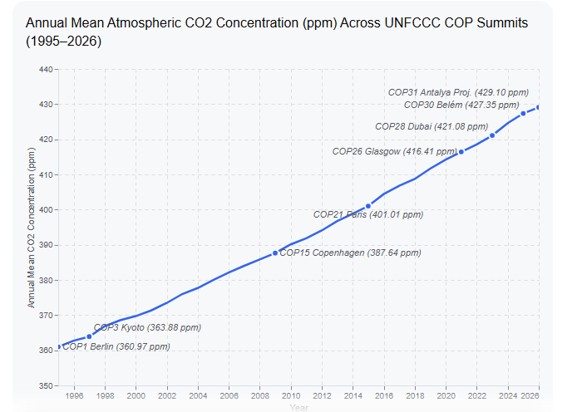
In the end, COP31 will fail for the same two reasons every previous COP has failed. First, politicians want to stay in power and most of the countries active in COP are at least partially representative democracies needing significant public support to stay in power. Over time, in most such situations (the UK being a weird exception, it seems) when climate restrictions are allowed to take force and impose hardships and higher costs on the electorate, the governments are forced to back off, reduce goals or restrictions, or risk losing power. To get real emission reductions, there can be no softening of policy, so real emission reductions don’t take place. By contrast, most authoritarian countries aren’t cutting emissions because they are emphasizing growth with some, simultaneously, demanding climate financing and reparations.
Second, is simpler, an observation stated by Thomas Hobbes centuries ago: “Covenant without the sword is but words, of no strength to secure a man [or in this case government] at all.” Because the UN and its creature, the conference of the parties, has no independent enforcement mechanism, complete with the ability to meaningfully punish parties in non-compliance with their commitments, it can’t force governments to deliver what they promise.
That’s where this and all future climate agreements and COPs stand, or in this case fall. They are futile efforts to entice, encourage, and cajole nations to do what is not in their or their peoples’ interest to do. Each meeting, with their private planes, four-star meat-heavy meals, luxurious accommodations, and power use for tens of thousands of attendees, emits more carbon dioxide than any of the agreements, or all of them combined, have prevented over time. COPs are gross carbon emitters, not even close to net zero.
Sources: Climate Change Weekly; Climate Change Weekly; Climate Change Weekly; The Guardian

Stealth Advocacy at the National Academies
Climate Change Weekly has repeatedly discussed the way the National Academies of Sciences, Engineering, and Medicine (NAS) has been compromised in its discussion and promotion of climate science and climate change, specifically with regard to its production and promotion of a chapter intended to be included in the Federal Judicial Center’s Fourth Reference Manual on Scientific Evidence, here, here, and here, for example. Without rehashing the details, CCW’s and others’ analyses and critiques of the evidence bias in the chapter hit home with the NAS eventually pulling the chapter and its new president Neil H. Shubin begrudgingly admitting:
We looked at the process—just a very cursory look at the process behind this—and it turns out this was a book chapter that followed a very different process than the reports we do. The reports we do are—I hate to use the word ‘gold standard,’ but they’re our top-of-the-line sort of thing.
They have numerous committees that weigh in on conflict of interest, committees that weigh in on peer review. “here’s a strong level of oversight that seeks to produce the most impartial, nonpartisan, free of conflict of interest … reports. [This] book chapter had none of that.
We know the outcome was perceived—and for some, in good reason—as one-sided, because the authors were associated more with the plaintiff’s side than the defense side. That outcome deserves a fresh look.
Problems of bias in the chapter and the compromised way it was produced, as well as how climate activists have worked through “educational” retreats and workshops held with judges likely to hear climate lawsuits, to bias judicial opinions and deliver outcomes favorable to those suing the oil and gas industry, were confirmed in a recent interim report from the U.S. House Committee on the Judiciary (HCJ).
Roger Pielke, Jr., Ph.D., has done a deep dive on the HCJ report and notes that the process was corrupt from the start.
In outlining the scope and content of the Chapter, The NAS held a workshop moderated by the Environmental Law Institute’s (ELI) Climate Judiciary Project. Over the years, the ELI has hosted dozens of retreats for members of the federal judiciary to educate or train them on how to think about climate change – specifically that it is a human caused disaster with greenhouse gas emissions primarily from fossil fuel use, as the cause, and absent legislative action to prevent catastrophic results, the judiciary must and is legally justified to intervene.
The NAS then hired a plaintiff’s attorney involved in the lawsuits to be a co-author on the chapter, working with scholars/staff at Columbia’s Sabin Center for Climate Change Law. The NAS allowed the authors to choose reviewers of their chapter, the reviewers happened to be colleagues who were not just known to agree with the author’s views that the oil and gas industry should be held responsible for supposed climate harms, but who had published work and given public presentations stating such. The NAS then selected a panel to give final approval to the chapter on which it placed a federal appellate judge who had participated in the EIL’s workshops as an advisor and had previously called for writing a manual that would be “credible to judges who are themselves perhaps climate skeptics.”
The report was in the bag for judicial activism on climate change from start to finish.
After the manual with the climate chapter was released, it received significant push back from state AGs and Congress, after the conflicts of interests, poorly documented science, and shoddy review process were raised by groups like The Heartland Institute and the American Energy Institute, among others. Under pressure, the FJC removed the chapter from its website and said it would not be included in the final manual. However, the NAS initially defended the chapter and the process used to produce it.
Before taking that action, the FJC raised its concerns about bias inherent in the chapter, particularly to the confidence in attributions of extreme weather events to human causes, writing:
“The committee had significant discussion about the difficulty of scientifically attributing climate change and its impacts to specific sources and wanted to be sure the chapter reflected this difficulty. . . attribution issues are ones likely to be debated in court.
“[J]udges read the manual for the science not the law . . . It is also the place where bias toward various legal positions might inadvertently surface,” said the FJC.
The FJC asked Burger to remove himself as an author, only to have the NAS tacitly keep him on as a ghost author.
I advocate my audience read Pielke’s detailed analysis in full.
One is left to question whether the NAS has been compromised across the board or is climate change the only scientific issue of concern. How many other scientific disputes has it weighed in on with a preconceived outcome in mind?
Sources: The Honest Broker; U.S. House

The Lancet Backtracks, Misstating the Health Impacts of Climate Change
The Lancet recently published a story claiming climate change is compromising public health and food production resulting in increased number of deaths related to temperatures and worse hunger and malnutrition.
The researchers involved in the study used computer model representations of climate conditions and human health impacts instead of referencing existing data, an analysis of trends overtime, doing a literature review, or examining historical comparisons. Therein, lies the rub: model outputs don’t match reality.
Paul Homewood compared the study’s claims about drought, food conditions, life expectancy, and deaths from malnutrition in countries and regions identified in The Lancet reports as particularly harmed by climate change.
Whereas the study said that Pakistan had suffered crop losses and growing food insecurity over the past decade due to a (modeled) 20 percent increase in the number of very dry months, data from Pakistan shows just the opposite. Agricultural production saw a significant increase over the period, and contrary to the asserted negative health impacts, life expectancy continued to increase and deaths attributable to hunger or malnutrition continued its multi-decade decline.
Homewood conducted the same comparative analysis, data versus the study’s modeled outcomes, for Brazil and sub-Saharan Africa, which produced the same results. Crop production and lifespans increasing, premature mortality from malnutrition falling sharply.
In short, the expectations produced by climate models failed to match reality for any of the countries or regions examined.
Homewood then discusses what is in some ways the most puzzling claim made in the study that climate change is causing a massive increase in heat related deaths. This claim is puzzling because it contradicts both data and the findings of multiple comprehensive studies on temperature related deaths previously published in The Lancet.
The computer simulations run by the researchers estimate that in 2023, heat killed 710,000, 71.5 percent of which were attributed to climate change. In other words, they are claiming that absent a modest warming of about 1.5℃ over the past century and a half, 500,000 people wouldn’t have died from climate change. By contrast research, citing deaths attributed to heat related problems, found 178,000 excess deaths due to heatwaves in 2023. That figure is high, but a lot lower than The Lancet study’s computer-generated estimates. If even the entire number of estimated deaths attributed to heat related illnesses were the result of human caused climate change, it would still amount to 1.1 percent of all deaths globally.
More importantly, the study did not estimate the lives saved by warmer weather. Repeated studies, two comprehensive studies published by The Lancet, here and here, show that many more lives, 10 to 17 times more, are lost each year due to cold related illness or fatal health events than to heat related ones. Those same studies show that as the planet has modestly warmed, deaths attributable to non-optimum temperatures have fallen significantly.
So warming is saving lives directly, and indirectly due to more food, better nutrition, and economic growth; all of which is due in large part to the development and use of fossil fuels.
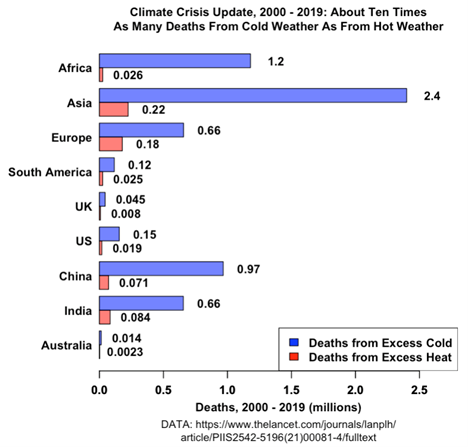
Unless The Lancet is going to withdraw those previous studies, perhaps it should ask for corrections to this one, or at least ask its authors to revise it with numbers actually recorded as opposed to computer estimated deaths and to give balance by estimating the lives saved by warming to put the full picture in context.
In the end, each of the major claims about food production, malnutrition, excess drought, and heat related deaths is refuted by real-world observations and collected data. Sadly, if this is the quality of the research that is now slipping through The Lancet’s internal peer review process, it seems the journal is on the road to being considered second rate, or in the bag for at least one type of alarming scientific narrative. If The Lancet has become biased concerning climate change and health, it leads one to ask how much confidence one should give the research they publish on cancer, vaccines, infectious diseases, and other vital health topics.
Sources: Not a Lot of People Know That; The Lancet
Climate Funny