









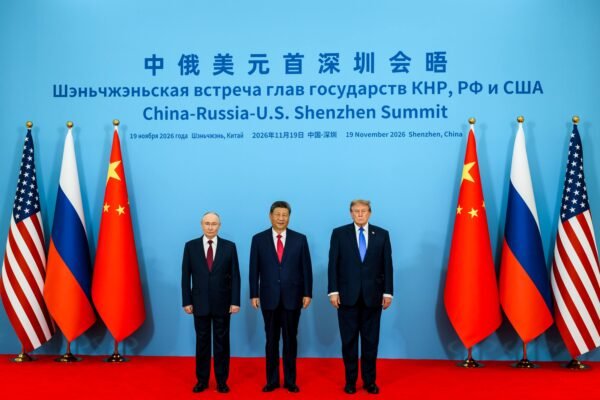
On November 19, an groundbreaking meeting between United States President Donald Trump, Chinese President Xi Jinping, and Russian President Vladimir Putin took place on the sidelines of the APEC Summit in Shenzhen. Described as a potential Yalta Conference by Putin, the summit produced a four-point “Declaration Toward Peace,” in which the fourth point explicitly “reaffirmed” the three major nuclear powers’ position that a “nuclear war cannot be won and must never be fought.” It also committed China, Russia, and the United States to “conduct a dialogue on reducing nuclear risks and preventing the proliferation of nuclear weapons.”
Experts have been cautious and realistic about the prospects of achieving a major breakthrough in arms control, articulating that progress would require more than one meeting. That said, the Shenzhen summit offered a renewed political opening for cooperation and dialogue among the world’s three largest nuclear powers. Indeed, the importance of continual talks was underscored by all three leaders and best summarized by Trump’s statement: “No peace was ever forged by declining opportunities for engagement.”
Denuclearization might be subject for a further engagement, as it was high up on Trump’s agenda for the trilateral summit. Yet, despite Xi’s reiteration that nuclear weapons should be comprehensively prohibited and destroyed, China has remained resistant to joining arms control agreements with Russia and the United States, citing the disparity in the size of their nuclear arsenal. As a result, Trump has acknowledged that limiting nuclear weapons would be hard.
Nevertheless, considering Trump’s remark that China, Russia, and the United States are “uniquely positioned to discuss nuclear weapons and lowering the risk of nuclear use,” the present impasse in nuclear arms reduction may suggest that greater priority should be placed on the agenda of nuclear risk reduction. Indeed, the three presidents have agreed to open a dialogue on “reducing nuclear risks.”
This momentum creates a new and unprecedented political opening among the three major powers that must be capitalized on. A more substantive agenda for nuclear risk reduction would have to be constructed to advance this political breakthrough. Specifically, subsequent meetings can be anchored on translating the political understanding and consensus for nuclear risk reduction into practical measures that can reduce the possibility of nuclear miscalculation and inadvertent escalation. Xi has even underscored that dialogues and consultation should “ensure that misjudgements occur less.”
An immediate and clear area where the three states can work together would be a joint ballistic missile launch notification agreement, precisely because such agreements are not new. A joint notification system would present an achievable and feasible topic for nuclear risk reduction, as existing arrangements provide a working foundation. Russia already signed separate notification agreements with the United States and China in 1988 and 2009 respectively. China, although not in any formal arrangements with Washington., demonstrated a willingness to provide advance notification when it informed its U.S. counterparts of its two recent launches in September 2024 and in July 2026 (although China offered short notice for the 2026 launch).
These established precedents attest that a trilateral notification arrangement may now be a realistic subject for further discussion. As such, it is only natural that the three nuclear powers explore a trilateral arrangement for advance notification of ballistic missile launches, and discuss the nature, standards, and content of notifications, all within the frame of nuclear risk reduction dialogues.
Beyond a joint launch notification arrangement, subsequent rounds of trilateral meetings can also address other pressing areas of nuclear risks, such as Xi’s recommended focus on “crisis communication and prevention mechanisms.” The maintenance of military hotlines and advance launch notifications of military exercises or activities could also help alleviate uncertainty surrounding military activities, particularly during periods of heightened tensions. In any case, feasible areas that might lessen doubt and offer predictability could provide a proper foundation for subsequent negotiations and talks.
Focusing on the practical arrangements that mitigate the risk of miscalculation and inadvertent escalation leading to a nuclear war would have several merits agreeable to all three nuclear powers. First, none of the three powers would have to explicitly commit to limiting their respective arsenals. Given the major complications of getting China and Russia to discuss arms control, coupled with the tremendous psychological difficulty and pressure that surrounds giving up nuclear weapons once a state has it, discussions on reducing or limiting nuclear weapons would be unlikely. Discussing nuclear risks and escalation would be more politically palatable, as none of the nuclear powers would have to accept any hard limits. It would still allow them to address the dangers associated with nuclear weapons while without requiring major changes to their respective nuclear force structures, doctrines, or arsenal sizes.
Second, focusing on reducing nuclear miscalculation and inadvertent escalation as the basis for dialogue would operationalize the shared responsibility of strategic stability the leaders acknowledged at the summit. Establishing arrangements that improve communication, reduce ambiguity, and lower the likelihood of miscalculation would not only provide substantive meaning to the joint declarations but it offers a clear signal that Washington, Beijing, and Moscow are responsible powers that could cooperate on matters of shared security even when the three countries remain at odds in terms of their strategic interests.
Third, discussing nuclear miscalculation and inadvertent escalation would offer a pragmatic, yet productive, starting point for subsequent broader agendas on nuclear weapons. While dialogues are unlikely to resolve fundamental disagreements surrounding nuclear doctrines, force structures, and modernization, cooperation and continual talks on narrower and relatively attainable topics could provide an initial basis for regular engagement.
For instance, the trilateral ballistic missile launch notification agreement would require the establishment of working level relationships and regular channels for greater communication and interactions. Over time, these mechanisms could help institutionalize dialogues and ensure that cooperation becomes less dependent on political momentum and evolves into a more durable feature of trilateral nuclear engagement. Viewed this way, approaching nuclear risk reduction discussions through practical measures would certainly provide a stronger basis for subsequent cooperation and future negotiation and meetings.
The Shenzhen trilateral summit offered a rare political opportunity for the three nuclear powers to move beyond declaratory commitments and pursue cooperation in preventing nuclear war. Focusing on actionable measures within nuclear risk reduction talks, such as reducing uncertainty surrounding nuclear and military activities, could help establish conditions necessary for sustained engagement among the three countries. Over time, these ongoing interactions would necessarily create the vital conditions for more substantive cooperation in managing their nuclear arsenals and the prevention of nuclear war.
While Trump declared the Shenzhen summit to be “historic” and Xi called it “groundbreaking,” its significance will ultimately be determined by what the leaders choose to do with this political opening.