






Despite its longstanding security alliance with the United States, Thailand—like most ASEAN states—has traditionally hedged between Washington and Beijing, seeking to benefit from both without choosing sides. But President Donald Trump’s increasingly unpredictable foreign policy is complicating Bangkok’s delicate balancing act. As confidence in Washington erodes, Thailand appears to be gravitating toward Beijing, which Thai leaders increasingly regard as a more stable and predictable partner.
In April, for example, Foreign Minister Sihasak Phuangketkeow criticized the “unpredictability” of U.S. foreign policy, arguing that Washington’s actions were “forcing us to rethink some relationships,” while suggesting that China, despite its own coercive tendencies, was comparatively more predictable. In September, Sihasak warned that intensifying strategic competition was putting ASEAN’s economic relationships and unity under pressure. More recently, on October 12, Royal Thai Air Force Commander Seksan Khantha declared that “there is no such thing as neutrality, but we must maintain a balance,” adding that Thailand’s best approach was to “love them both.” Meanwhile, Prime Minister Anutin Charnvirakul has sought to preserve strong economic ties with Washington while expanding cooperation with Beijing. Taken together, these remarks suggest that Thailand remains committed to hedging, but growing doubts about American reliability are creating opportunities for China to expand its influence.
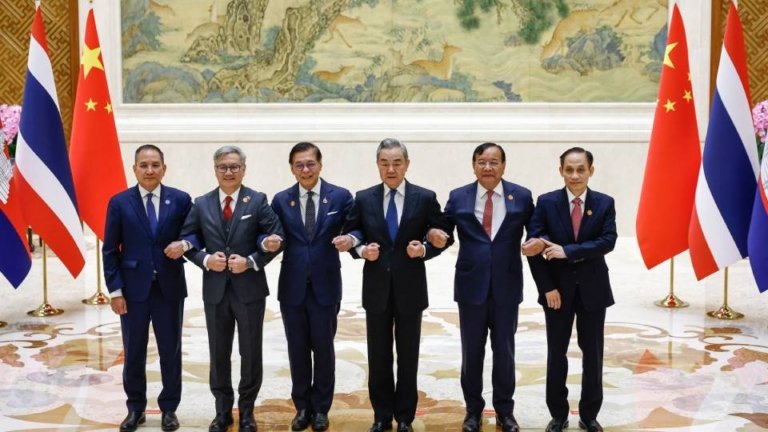
Beijing, for its part, is wasting little time capitalizing on Bangkok’s growing uncertainty about Washington. During Prime Minister Anutin’s July 16th visit to China, he met President Xi Jinping and Premier Li Qiang, with both sides agreeing to significantly expand their strategic partnership. The visit produced 15 agreements covering trade, investment, artificial intelligence, space technology, nuclear fusion, and other sectors. Perhaps most significantly, Beijing and Bangkok agreed to establish a new “2+2” dialogue between their foreign and defense ministers, expand defense-industrial cooperation and military training, and accelerate construction of the China–Thailand high-speed railway. Xi also portrayed China as a “trustworthy and reliable strategic cooperative partner,” reinforcing Beijing’s efforts to present itself as a dependable alternative to Washington. China is likely to continue engaging with Thailand at Washington’s expense.
But Thailand’s growing tilt toward China is not simply about Trump, even if his policies have accelerated the trend. His reciprocal tariffs, in particular, have angered and frustrated Bangkok, which expected more favorable treatment from its longtime American ally. Thailand initially faced a proposed 36 percent reciprocal tariff, later reduced to 19 percent. Sihasak has explicitly criticized American unpredictability, including tariffs, and acknowledged that Thailand is reconsidering some relationships. Yet the U.S.-Thailand alliance has struggled to find a clear strategic purpose since the end of the Cold War, and successive Thai governments have increasingly questioned its relevance. More fundamentally, Bangkok simply does not view China as a threat in the same way Washington does, making closer cooperation with Beijing a far more attractive proposition than American policymakers might appreciate.
Going forward, the United States and Thailand will need to identify new areas of cooperation to reinvigorate their longstanding alliance and broader strategic partnership. Trump’s interest in securing critical minerals, for example, could offer one such opportunity, particularly as Washington seeks to diversify supply chains away from China. Other promising areas include defense technology, cybersecurity, maritime security, and joint responses to transnational threats. But Washington will also need to recognize that Bangkok has little interest in choosing sides between the United States and China. Ultimately, the future of the U.S.-Thai alliance may depend less on countering Beijing directly than on demonstrating that Washington remains an indispensable partner in its own right.
Derek Grossman is CGSP’s Non-Resident Fellow for the Asia-Pacific