






ASEAN Summit 2026 opens in Manila as global leaders gather for high-stakes talks on regional security and conflicts.
By Michaela Del Callar
Leaders from Southeast Asia and their counterparts from major world powers will open their three-day summit in Manila on Sunday for crucial talks on conflicts in the South China Sea, Myanmar, the Middle East and Ukraine, as wars and geopolitical tensions threatened regional security, economic stability and livelihoods.
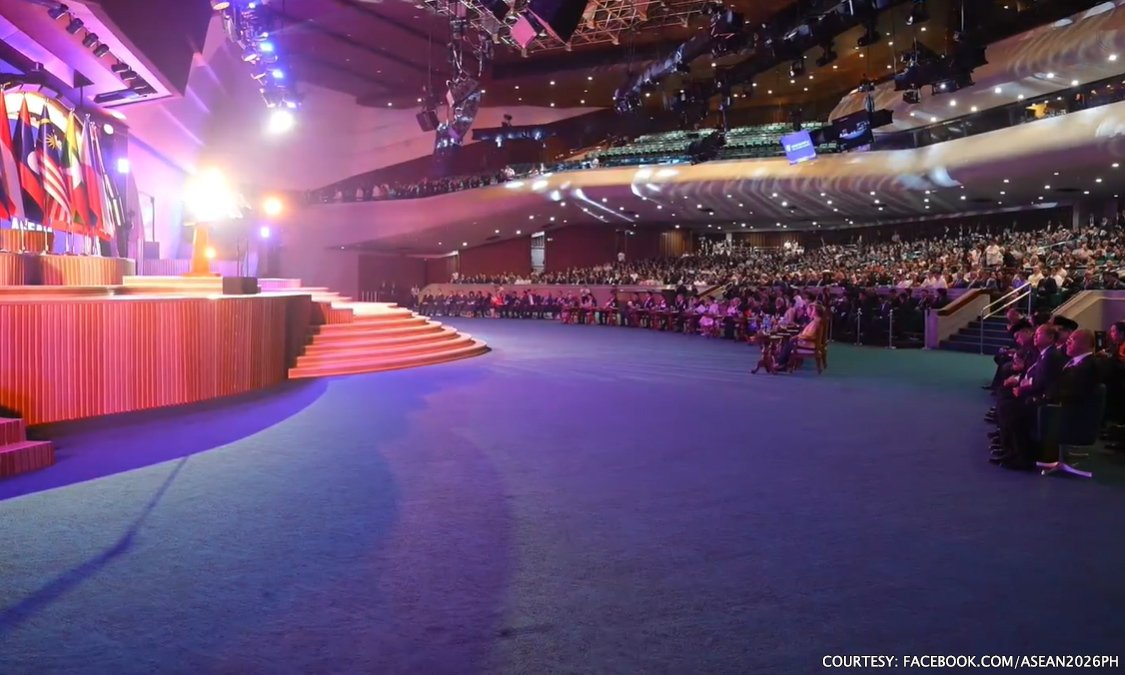
President Ferdinand Marcos Jr., who holds the rotational chairmanship this year of the Association of Southeast Asian Nations (ASEAN), will lead the opening ceremony of the 49th ASEAN Summit and Related Summits at the tightly secured Philippine International Convention Center (PICC) in Pasay City, overlooking Manila Bay.
Leaders of the 11-member regional bloc will hold separate dialogues with major world powers, including the United States, represented by President Donald Trump, and China, represented by Premier Li Qiang, in the succeeding days.
Trump was expected to arrive at Ninoy Aquino International Airport late Tuesday afternoon with US Secretary of State Marco Rubio after most of the major ASEAN meetings have concluded and the Philippines has handed over the bloc’s annual chairmanship to Singapore.
The summit will include meetings with ASEAN’s dialogue partners, including Japan, China and South Korea, before culminating in the East Asia Summit (EAS), a leaders-led forum bringing together ASEAN and eight dialogue partners, among them the US, Russia, India, Australia and New Zealand.
With the theme “Navigating Our Future, Together,” the Nov. 15 to 17 gathering was expected to project regional unity with their traditional group handshakes and photographs.
The meetings will take place against the backdrop of escalating global conflicts, particularly the war involving the US, Israel and Iran, which has disrupted energy supplies and fueled inflation worldwide.
Many of the leaders of countries involved in the conflicts will be cloistered in the same summit rooms at the PICC.
Li, however, was expected to leave Manila before Trump’s arrival, with no meeting planned between the two leaders.
Among those attending were Canadian Prime Minister Mark Carney, Brazilian President Luiz Inácio Lula da Silva, United Nations Secretary-General António Guterres and International Monetary Fund Managing Director Kristalina Georgieva.
Li was scheduled to meet ASEAN leaders on Monday, while Russian Foreign Minister Sergey Lavrov will represent President Vladimir Putin.
Lavrov was also not expected to meet Trump in Manila.
Myanmar, whose political leaders remained barred from ASEAN’s high-level meetings, will be represented by a director-general from its Ministry of Foreign Affairs.
A diverse bloc of democracies, monarchies and authoritarian regimes, ASEAN is composed of the Philippines, Singapore, Thailand, Indonesia, Malaysia, Brunei, Vietnam, Laos, Cambodia, Timor-Leste and Myanmar.
Myanmar’s political leaders and foreign minister were still excluded from top-level ASEAN meetings because of the military-backed government’s refusal to implement the Five-Point Consensus, a peace plan adopted after the military overthrew the democratically elected government of Aung San Suu Kyi in 2021.
ASEAN leaders will exchange views on “regional and international issues of concern, including the situation in Ukraine and in the Middle East, the developments in the Korean Peninsula, the developments in Myanmar, and the situation in the South China Sea,” according to a draft communiqué seen by Bilyonaryo News Channel.
They were also expected to express concern over mounting global trade tensions and growing uncertainties in the international economic environment.
Transnational crimes, particularly online scam operations in Southeast Asia and artificial intelligence-driven child exploitation, as well as maritime security, were also high on the summit agenda, according to the draft.
South China Sea Code of Conduct
Negotiations between ASEAN and China on a proposed Code of Conduct (COC) in the South China Sea have made substantial progress, with about 80 percent of the accord provisionally agreed upon.
However, negotiators would miss their target of concluding the agreement this year, four Southeast Asian diplomats earlier told BNC. Talks will resume in 2027 under Singapore’s ASEAN chairmanship.
The closed-door COC negotiations have been led this year by China and Malaysia, which coordinated ASEAN’s relations with Beijing.
Laos was scheduled to succeed Malaysia as the regional bloc’s country coordinator for relations with China next year.
The remaining 20 percent covered some of the most contentious provisions, including the agreement’s geographical scope, whether it should be legally binding and the definition of sensitive terms, according to the diplomats.
ASEAN leaders were expected to reaffirm “the importance of any Code of Conduct in the South China Sea (COC) being consistent with and not undermining international law, particularly the United Nations Convention on the Law of the Sea (UNCLOS), and safeguarding the rights and freedoms of all States under international law,” the draft communiqué said.
Myanmar peace deadlock
Another major challenge confronting ASEAN was the continuing civil war in Myanmar and the regional bloc’s failure to secure the military-backed government’s compliance with its five-point peace plan.
Ahead of the summit, ASEAN foreign ministers met in Manila on Saturday, with Philippine Foreign Secretary Theresa Lazaro ruling out the possibility of easing the Five-Point Consensus as she reiterated the bloc’s commitment to put an end to the continuing civil war and political crisis in the military-ruled country.
Lazaro, the ASEAN’s special envoy to Myanmar, said several proposals concerning the country’s political crisis remained under negotiation and would be submitted to ASEAN leaders for consideration during their meetings.
After five years of unsuccessful efforts to secure compliance with the agreement, some ASEAN member-states have started advocating renewed engagement with Myanmar’s military-backed government.
Lazaro visited Myanmar in October to lead a humanitarian mission aimed at strengthening ASEAN’s response to the crisis and improving assistance to communities displaced by the conflict.
During her visit, Myanmar officials expressed willingness to expand humanitarian access to communities sheltering internally displaced people, a longstanding demand of ASEAN and the international community.
Iran war and global fuel price surge
The continuing war involving the US, Israel and Iran will also figure prominently in the Manila discussions as ASEAN confronts disruptions to energy supplies, shipping routes and regional economic activity.
The conflict has threatened maritime traffic through the Strait of Hormuz, a vital shipping passage through which approximately one-fifth of the world’s oil supply passed before the war.
ASEAN governments feared that a prolonged conflict could further increase fuel prices, disrupt international trade and undermine economic stability across the region.
The war was particularly significant for the Philippines, which has more than 2.4 million citizens living and working across the Middle East, exposing overseas Filipino communities to security threats and economic disruptions.
ASEAN-US special summit, QUAD meeting
Trump was expected to participate in three major events on the evening of Nov. 17, including a special summit with ASEAN leaders, a meeting of the Quadrilateral Security Dialogue (QUAD) involving the United States, Japan, India and Australia, and a dinner reception hosted by Marcos for visiting leaders, according to two Philippine government officials who spoke to BNC.
Before proceeding to Shenzhen, China, for the Asia-Pacific Economic Cooperation (APEC) Summit, Trump was also set to undertake a brief state visit hosted by Marcos on Nov. 18, during which the two leaders would discuss defense, security and economic cooperation.
The Philippines is a longstanding US treaty ally in Asia, with both countries bound by a Mutual Defense Treaty that provides for collective action in response to armed attacks covered by the agreement.
Although the Republican Party’s setbacks in the US midterm elections have strengthened the Democrats’ position in Congress, Trump retained significant executive authority over foreign policy and international relations.
“He can still veto the bill if needed be,” Lupita Wijaya, a research fellow at Australia’s La Trobe Centre for Global Security, told BNC.
Wijaya said Trump was likely to continue pursuing trade agreements and cooperation on artificial intelligence during his meetings with Asian leaders, particularly as economic and national security interests increasingly overlap.
“As Southeast Asian countries build data centers and invest in AI, I’d expect him to keep pushing for greater market access for American products through supply chips, equipment and software,” she said.
While ASEAN leaders would generally welcome a stronger US presence in the region, Wijaya said they also want to maintain the flexibility to determine their own economic and diplomatic relationships with China.
She said Trump’s meeting with Marcos would underscore Washington’s continuing security commitments to Manila amid regional tensions.
At the same time, Wijaya said the US president was expected to seek greater access to the Philippine market for American products and services.