


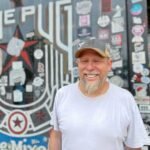




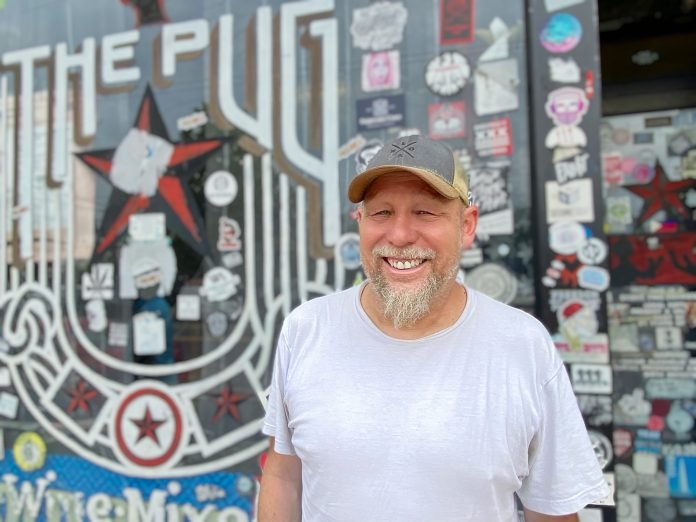
Tony Tomelden had barely settled in after opening The Pug on H Street NE in 2007 when crews tore up the sidewalk outside his bar. He remembers going at least six months without one. By then, he had worked at the Capitol Lounge for 11 years, and some of his regulars lived closer to his new place and followed him there. “Those regulars sort of carried me over,” he said.
Tomelden supported the streetcar then and supports the proposed Gold Line now. But with one caveat: he and other business owners had pushed for the streetcar tracks to run down the middle of H Street, in part to leave room at the curb for deliveries.
The new bus rapid transit line would put transit in the center of the street, as business owners wanted twenty years ago. But the give comes with a familiar take: putting it there would mean another round of construction outside their doors.
Metro and the District Department of Transportation (DDOT) released concepts for the Gold Line Nov. 17, and will host a Nov. 30 open house at the Atlas Performing Arts Center. For businesses along the corridor, the plans offer the prospect of more customers and easier trips for employees. But they raise questions about parking, deliveries, doorway access and how businesses will get through the work.

A Familiar Plan
The H Street installation is only the first step in a more comprehensive plan that also echoes the streetcar. Phase 1 roadway construction would run from Union Station along H Street and Benning Road NE to 34th Street NE, with a connection into the RFK campus. The project proposes 3.2 miles of new center-running bus lanes.
Gold Line service is proposed to extend beyond that construction in later phases, running from Farragut Square through Union Station and branching to the Minnesota Avenue and Benning Road Metro stations. The proposal would upgrade the D20 and D2X routes, with buses every five minutes on the shared route and every 10 minutes on each eastern branch. During RFK events, Metro proposes service every two minutes between the campus and Union Station and every three minutes toward Minnesota Avenue and Benning Road.
Then there’s the question of stops. On H Street, the map identifies four potential stops on H Street itself, at Fourth, Eighth and 12th streets NE and at Bladensburg Road.
Like the streetcar, the Gold Line would give people a way to travel along H Street and connect to other transit at Union Station. But where the streetcar shared lanes with cars and so could (and often did) get stuck behind a double-parked vehicle, Metro proposes dedicated lanes down the center of the street for the BRT. Buses will have priority at traffic signals and stations where riders could board through any door with little difference in height from platform to bus.
But will it just be bus lanes coming to H Street? That hasn’t been decided yet. The public concept page lists two options: one with bus lanes, and one without. Plans also look at a two-way bike lane on Benning Road, where the width of the street allows for more uses.
To fit the bus lanes along H Street, Metro’s street cross sections show one lane for general traffic in each direction outside the two bus lanes. At Eighth Street, Metro situates the boarding platforms on opposite sides of the intersection so only one has to fit across the street at a time. At Sixth Street, a rendering shows a dedicated, signalized left-turn lane.
The plans leave stretches where the curb can still be used for parking and loading, with less room for those uses near platforms and turning lanes. Metro’s preliminary curb count projects a drop from 230 to 151 spaces on H Street itself, a loss of 79, or 34 percent. The count includes parking, loading and pickup or drop-off space. That decreases to 19 percent when the numbers for Benning Road and its side streets are included.
What remains to be worked out is which blocks keep loading or short-term parking and whether drivers making deliveries can use those spaces when they need them. Business owners have questions. Tomelden wants to know what happens to rush-hour parking if existing sidewalk extensions are removed. Saleem worries that the lane changes could create overflow traffic, particularly at rush hour and if drivers continue to double park. Coppage also wants the agencies to plan for stopped cars and trucks.
With one general traffic lane in each direction, a delivery needed to a business outside an available loading zone could have big consequences for the bottom line.

Rebuilding the Street, Reinforcing the Businesses
The work people remember as streetcar construction was also a rebuild of H Street. DDOT’s annual report dates the main streetscape project from September 2008 to June 2011. Crews rebuilt the roadway and installed sidewalks, parking lanes, streetlights and tracks. Streetcars began carrying passengers in February 2016, nearly five years after that first phase of work was complete. Streetcar service ended March 31, 2026.
In 2010, The Washington Post reported reported that a lunch counter closed for six months after construction took out its sidewalk, leaving only a wooden board to bridge the distance between curb and the entrance. Later that year, property owners asked for tax relief and a halt to tax sales, citing blocked storefronts and limited parking. While Tomelden remembers tax payments being deferred, he also remembers that other bills still came due. And then, six months later, so did the tax bill, plus the bill for the time in-between. He said a delay only went so far in helping a business through months of disruption.

But it’s more nuanced than that, Tomelden adds. Businesses are going through a challenging economic period lined with a number of challenges, including I-83 and the many fees required by District agencies. “It would take a smarter person than me to figure it out,” Tomelden said.
H Street Main Street Director Anwar Saleem thinks businesses will need subsidies during construction. “Businesses already have a hard time dealing with the economic challenges we have now,” he said. He wants DDOT to explain the lessons it learned from the streetcar project and how it will apply them. “I don’t know what they learned, they never got back to us,” he said.

Phil Coppage, who owns Cynthia Bar and Bistro and leads the effort to form a Greater H Street BID Association, said his group has already met with planners from Metro, DDOT and the District’s Office of Planning (OP) as well as a beverage distributor to talk through where deliveries could go. He said the early communication gives him hope that businesses can influence the design, including the placement of stations and improvements for pedestrians.
“No one’s really in a position to say yes,” Coppage said of requests still being evaluated. He said planners have been willing to hear the association’s priorities, even as questions of feasibility remain.
Coppage sees grants as one way to help businesses stay open during the work. How much help they would need, he said, depends on the scope and timing of construction.
Hill Rag asked DDOT how long work could last on an individual block, whether contractors would be required to maintain accessible storefront entrances and whether the District was considering direct financial assistance. DDOT had yet to respond at the time of publication.
A stop along the way
Coppage acknowledges that he didn’t suffer through the street car construction. But he sees the BRT project as a chance to make H Street easier to find and reach from the Red Line and worries that H Street could lose the investment.
Metro estimates its proposed bus stops at Union Station could shorten the transfer from about eight minutes to two to five. Its position between two major District investments, Union Station and RFK, he said, makes reliable transportation along H Street particularly important.
Coppage wants stops where riders can easily reach businesses and service that works for the corridor every day, even as Metro plans for stadium crowds. “We just want to give people the options of coming to hang out on H Street,” he said. He said the H Street businesses would consider proposals and tradeoffs as long as they had a chance to discuss them with agencies.
Tomelden remembers what that could look like. When DC United still played at RFK, he said, people made their way to The Pug after matches even without a direct transit connection. He also knows what it took to keep the bar open through the earlier work. He worries, however, that losing on-street parking will cut down on H Street customers that come from the suburbs and proposes the city set up alternative parking, perhaps down at the Starburst Plaza or in the former Safeway. Saleem also wants replacement parking, potentially through temporary changes to restrictions on residential streets during construction.
He said the corridor’s customer base has to reach beyond its immediate neighbors.
“We have 307 businesses on H Street and not enough residents to support them,” Saleem said, hoping that stadium visitors using the Gold Line will stop to shop, eat and drink along the way.
Because while neighbors sustained the Pug through streetcar construction, sometimes neighbors aren’t enough. The owners of Henceforth noted in an Instagram message announcing the closure of the brewpub and third space, set for the end of December. “Despite our best efforts to find a sustainable way to operate, the customer traffic at this location hasn’t been enough to support the size of our space and the costs of running it,” the owners wrote. They expressed hope for a resurgance after the Gold Line comes to H Street, but, they said, they lacked the financial runway to stay to see if it ever comes. For the businesses planning to stay, construction could add another challenge to bringing people through the door.
Selection of a preferred concept is expected in winter 2027. But the project is still unfunded; WMATA has an April 2027 target for identifying funding for final design and construction. Metro targets a summer 2028 construction start and summer 2030 opening, timed to the stadium.
See and discuss the plans yourself at the Nov. 30 open house, from 6 to 8 p.m. at the Atlas (1333 H St. NE).
Saleem hopes the city listens to businesses throughout the process. “It sounds sexy,” he said of the Gold Line. “But we don’t need sexy anymore; we had the street car. We need something that’s practical and that’s going to work.”