









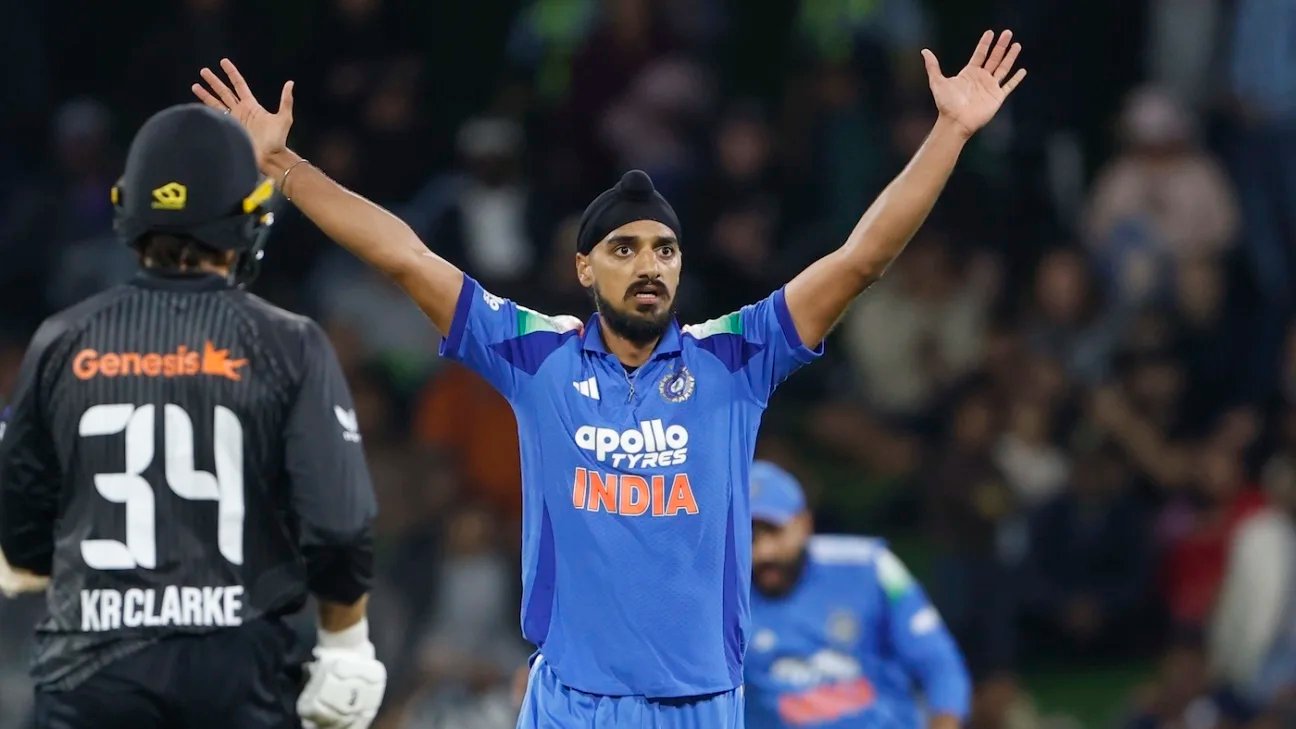
Two images might immediately come to your mind. You might picture him running in with the new ball and swinging it both ways. Or you might think of him bowling in the death overs, and firing yorkers that either attack the base of the stumps or hug the wide guideline outside off stump.
This has been a series of pitches with either steep bounce or uncertain bounce or uncertain pace or various combinations of those ingredients, and of the 57 wickets taken by fast bowlers from both sides, 31 have come from short or short-of-good-length balls, according to Cricinfo’s data.
It might surprise you, however, that Arshdeep was the next-most-frequent user of the short ball, at 47.30%. He bowled short more often than bowlers you would more readily associate with that mode of attack, such as the towering Kyle Jamieson (47.10%) and Jacob Duffy (46.67%), and the rapid Matthew Fisher (41.67%).
If Arshdeep has dug it in as often as he has, it’s because he has caused a lot of discomfort while doing so. Brar once again leads the way when it comes to this metric, with batters only achieving a control percentage of 58.10 against him when he has bowled the shorter lengths, and Arshdeep hasn’t been far behind, at 60.
New Zealand were 64 for 1 in their chase of 210, with their second-wicket pair looking settled at the crease, when Arshdeep sent Will Young on his way with a perfectly executed bouncer – angling across the batter from left-arm over and finishing above the right shoulder – that he failed to keep down with the hook.
As is so often the case when Arshdeep bangs it in, the ball seemed to reach the batter quicker than expected. This was certainly the case late in the game when Mitchell Santner, New Zealand’s captain and last hope when they were six down and 74 runs from victory, fended awkwardly at Arshdeep and took a blow to his wrist.
There’s something about the way Arshdeep finishes his action, rushing through the crease and delivering with a fast-arm whip, that must make it challenging for batters to pick up his short ball.
Iyer communicated the last part of his answer via gesture as much as speech, and it seemed as if he may have been referring to batters lacking obvious cues from Arshdeep’s load-up and delivery action to get into position early to deal with the short ball.
And if this ODI series has been the perfect showcase for Arshdeep’s short ball, it has also brought another weapon to the fore: his wobble-seam ball. He has used it skilfully in all phases of the game, typically getting it to leave the right-hander and nip into the left-hander, and typically to accentuate his stock left-arm-over angle. This has been particularly effective when he has bowled with the new ball, creating uncertainty in batters’ minds when they’re setting up for the ball that swings into the right-hander and away from the left-hander.
He has also used the wobble seam when the ball has stopped swinging, and on Sunday, it brought him two of his three wickets: the left-hand batter Nick Kelly, bowled off the inside edge while jabbing with an angled bat at one that deviated into him, and the right-hand Kristian Clarke, caught behind while driving on the up against one that left him.
It would have pleased Arshdeep and India immensely that the Clarke wicket came from around the wicket: he used that angle extensively on Sunday, delivering 23 of his 43 balls to right-handers from that side of the stumps.
“I think he’s a very skilful bowler, and he has shown that throughout this series,” Santner said of Arshdeep at his post-match press conference. “We know what he can do with the new ball, obviously swinging it but going across [the right-hand batter] with the three-quarter [seam] ball as well.
“And throughout the series, when everyone has bowled short and made sure it’s the right height and right line, it has been trouble for both teams. So I guess that was our gameplan through the middle with our seamers at the Indian players, and I think we probably didn’t play the short ball as well as we could have throughout the series, knowing that we do get a lot of it over here. But the well-directed bumpers were a challenge throughout the series.”
Arshdeep is India’s highest wicket-taker in T20Is, and has played over 100 matches in that format, but he was far from a 50-overs regular until recently. From his debut in November 2022 to the end of 2025, he had only played 14 ODIs.
But since the end of last year’s Champions Trophy – he was a non-playing member of India’s squad in that tournament – he has become something of an ODI mainstay, playing more matches (14) than any other India bowler, and taking the joint-most wickets (24) along with Prasidh Krishna. And of all of India’s bowlers with at least ten wickets in this time, he has the best average (25.16) and the second-best economy rate (5.37) behind Axar Patel (4.48), a spinner.
It’s no coincidence that all this has happened when Arshdeep has become the most rounded version of himself he has ever been.
Karthik Krishnaswamy is an assistant editor at Cricinfo