
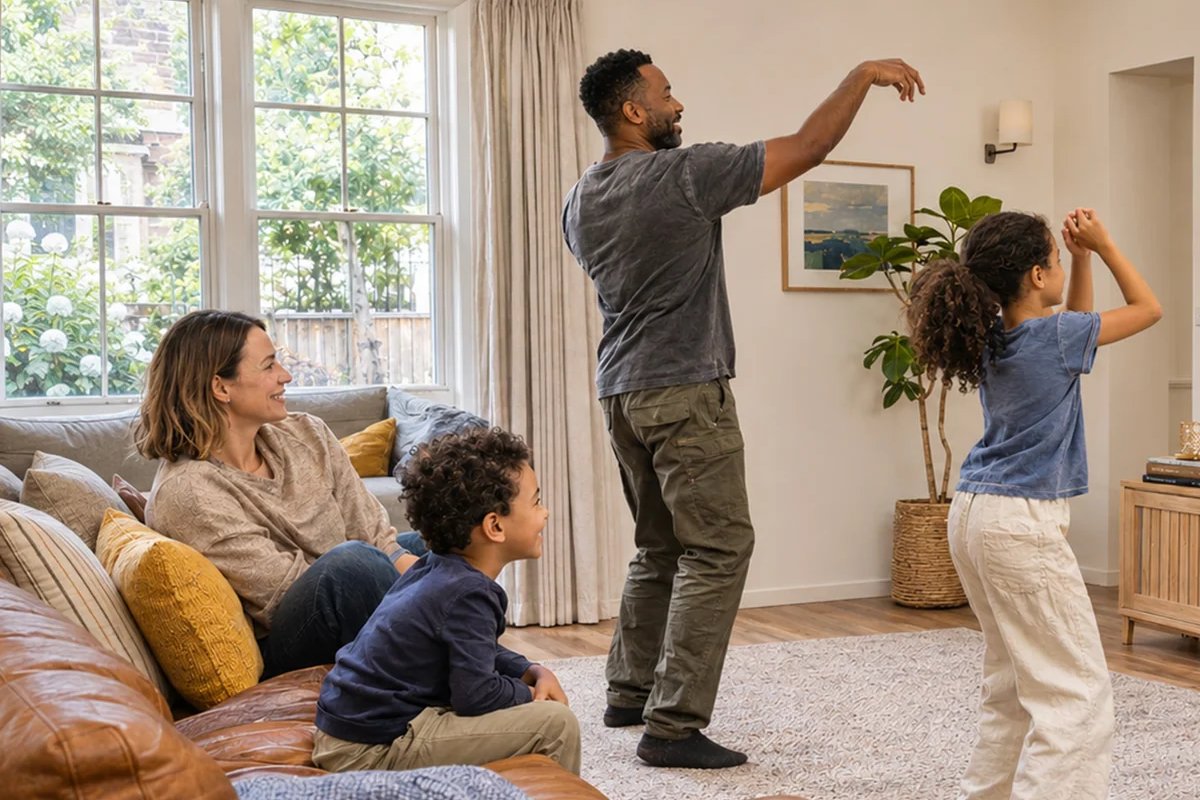
From the Nintendo Wii to Xbox Kinect, motion-controlled gaming once transformed living rooms into playgrounds, bringing families and friends together through a new way to play. PLAYMOVO aims to recapture that magic with a controller-free gaming system that uses AI-powered motion tracking to translate physical movements into on-screen actions.
Cubed3 caught up with the AISLPC team ahead of the console’s 11th November launch to discuss the challenges of developing accessible motion controls and the importance of creating shared gaming experiences.

Adam Riley, Director at Cubed3: PLAYMOVO is entering a space that Kinect and Wii made famous, then largely abandoned. What did you learn from why those systems faded, and what is PLAYMOVO doing differently to avoid the same fate?
Felix, Social Media Operations & Business Development, AISLPC: Our main takeaway is that motion gaming is most memorable when it creates simple, shared moments, but it can lose momentum when it feels difficult to return to or when the content stops evolving.
PLAYMOVO is designed to be something families can come back to regularly: connect it to the TV, choose a game, move into the play area, and start playing. The five included beginner games and the planned addition of new content are intended to make it an expanding platform rather than a one-time novelty.
Our product philosophy is simple: Your body joins the game, and your living room becomes the playground.

Adam Riley: The pitch is “active play for the whole family” rather than “fitness” or a “party game.” Why was that distinction important to you from the start, and how did it shape the games you chose to build first?
Felix, AISLPC: Movement is important, but it isn’t the only purpose of PLAYMOVO.
We wanted the focus to remain on family interaction, shared entertainment, friendly competition, and getting people involved in the same activity. It isn’t intended to be professional fitness equipment or a product that promises specific health results. That approach shaped the content from the beginning, with games across sports, action, casual play, family activities, puzzles, music, and dance.
We are not asking people to move away from screens. We are trying to turn screen time into an opportunity to stand up, move, and play together.

Adam Riley: You’re using a 12-megapixel camera with AI-powered motion recognition and no controller in hand. What was the hardest movement to get right – tracking one player cleanly, or tracking up to four players at once in a messy living room?
Felix, AISLPC: The real challenge is not necessarily one specific movement. It is making the experience feel natural and understandable for different players, including people of different ages, heights, movement speeds, and play styles.
Players should be thinking about the game, not worrying about whether they are performing a gesture in an overly precise way. Multiplayer also adds another layer because several people may be moving within the same physical space.
For that reason, each game is designed around its own supported movements and on-screen guidance.

Adam Riley: The recommended play distance is 150–300 cm, with an ideal play area of roughly 250 × 300 cm. How much did real living rooms – small flats, kids, pets, coffee tables in the way – force you to compromise on that ideal?
Felix, AISLPC: The recommended play area is an ideal reference, not an assumption that every family has a perfectly empty room.
Real homes have sofas, tables, children, pets, different lighting conditions, and different room sizes. That is why we provide clear recommendations about distance, lighting, camera visibility, and keeping the play area free from obstacles.
We would rather be honest about the space needed for a comfortable and safe experience than pretend every room is the same.

Adam Riley: In your imagery, we see skeletal tracking overlays on kids playing. How literal is that to how PLAYMOVO “sees” a player, and what happens when it loses someone mid-game?
Felix, AISLPC: The skeletal overlays in promotional imagery are intended to visually explain the idea of motion recognition. They should not be interpreted as a promise that users will always see that exact overlay during gameplay.
PLAYMOVO recognises supported movements according to each game’s design. If tracking is interrupted, the player should return to the recommended tracking area and make sure the camera is unobstructed, the room is adequately lit, and there is no strong backlighting or highly reflective background.

Adam Riley: A camera in the living room is an instant deal-breaker for a lot of families. You’ve included a physical cover and say images and motion data aren’t stored locally or uploaded to the cloud. Was that a technical decision, a trust decision, or both – and how do you convince a sceptical parent?
Felix, AISLPC: It was both. From a technical perspective, camera images and motion data used for motion-based gameplay are not stored locally on the device and are not uploaded to the cloud.
From a trust perspective, we felt that families should also have a simple, visible way to control the camera. The physical camera cover means users do not have to rely only on a written privacy statement, they can physically cover the lens whenever motion tracking is not needed.
Our approach is: Play when you want. Privacy when you don’t.

Adam Riley: You launch with five free beginner games, with the rest behind the Play Pass and a promise of new games each month. How do you balance making those first five feel like a complete experience while still making the Pass feel worth paying for?
Felix, AISLPC: The five free beginner games are intended to let families set up the system, understand how the motion-based experience works, and begin playing without immediately purchasing a subscription.
The Play Pass is for users who want access to the wider game library and new content planned for release over time.
The goal is not to make the included experience feel incomplete. It should be useful from the first day, while still giving families the option to expand it later.

Adam Riley: The images show very different modes – a single-player whack-a-mole style game, a competitive mode, a balloon-popping game, and basketball. Are you designing games around specific movements first, or around specific social moments first?
Felix, AISLPC: We think the social experience should come first.
A movement is only meaningful when it creates a clear and enjoyable relationship between the player and what happens on screen. We first consider what kind of moment the game should create—competition, cooperation, concentration, laughter, or shared activity—and then choose movements that support that experience.
The product is built around the idea of MOVE. PLAY. TOGETHER. The technology matters, but the shared moment is the reason for using it.

Adam Riley: Multiplayer is 1–4 players depending on the game. What does a great four-player PLAYMOVO session actually look like in testing, and what breaks when you add that third and fourth person?
Felix, AISLPC: A good four-player session should be easy to understand, quick to start, and enjoyable even for someone watching from the side.
Adding more players also adds practical challenges, including space, camera visibility, players blocking one another, and ensuring that everyone feels involved. This is why player support depends on the individual game rather than every title automatically supporting four players.
The ideal result is not simply four people standing in front of a screen. It is four people reacting to one another, competing, cooperating, and sharing the same moment.

Adam Riley: The console itself is striking; an orange and dark grey cube with the central lens. What was the design brief? It looks like it’s meant to sit on a TV stand and not be hidden away like most consoles.
Felix, AISLPC: The design is intended to feel like part of the living room experience rather than a device that needs to be hidden away.
The central camera makes the purpose of the product immediately understandable, while the orange color gives it a more playful and approachable identity than a traditional black electronics box.
Because PLAYMOVO is normally positioned near the television, we wanted it to feel connected to the activity taking place in the room.

Adam Riley: At $399.99 plus a Play Pass at $39.99 for 3 months / $79.99 for 12 months, you’re asking families to invest in both hardware and a subscription. Why did you land on that model instead of a higher upfront price with everything included?
Felix, AISLPC: We see the hardware and the content library as two related but separate parts of the experience.
The console provides the long-term foundation, while the Play Pass supports access to a wider library and planned new content. The five included beginner games mean that the console can still be used without immediately purchasing a subscription.
Families who want more variety can then choose either a three-month or twelve-month plan, depending on how they prefer to use the system.

Adam Riley: Launching November 11, 2026 with a free 3-month Pass through December 2, what does success look like for you in that first month? Is it sales, retention after the free Pass ends, or something you’re seeing in playtesting that numbers won’t capture?
Felix, AISLPC: Sales are important, but they are not the only measure.
We would also consider the launch successful if families understand the concept, use PLAYMOVO together, return to it after the first session, and give us meaningful feedback about the experience.
Some of the most important results may not appear in a sales chart – for example, a child inviting a parent to play, friends laughing together during a multiplayer game, or a family turning ordinary screen time into a shared activity.
PLAYMOVO is ultimately about changing not only what people play, but how families and friends play together.





Leave a Reply