“The virus is the spark. The structural conditions are the accelerant.” These words from Dr. Tyler Evans, an infectious disease specialist who worked in West Africa and the eastern Democratic Republic of the Congo (DRC), summarize the unfolding catastrophe.
Six months ago, on May 17, the World Health Organization (WHO) declared a public health emergency of international concern (PHEIC) over eight laboratory-confirmed cases across three health zones in Ituri Province. Today, official bulletins record 11,254 confirmed cases and 5,505 confirmed deaths across 68 health zones in eight provinces, establishing this outbreak as the second-largest Ebola epidemic on record.
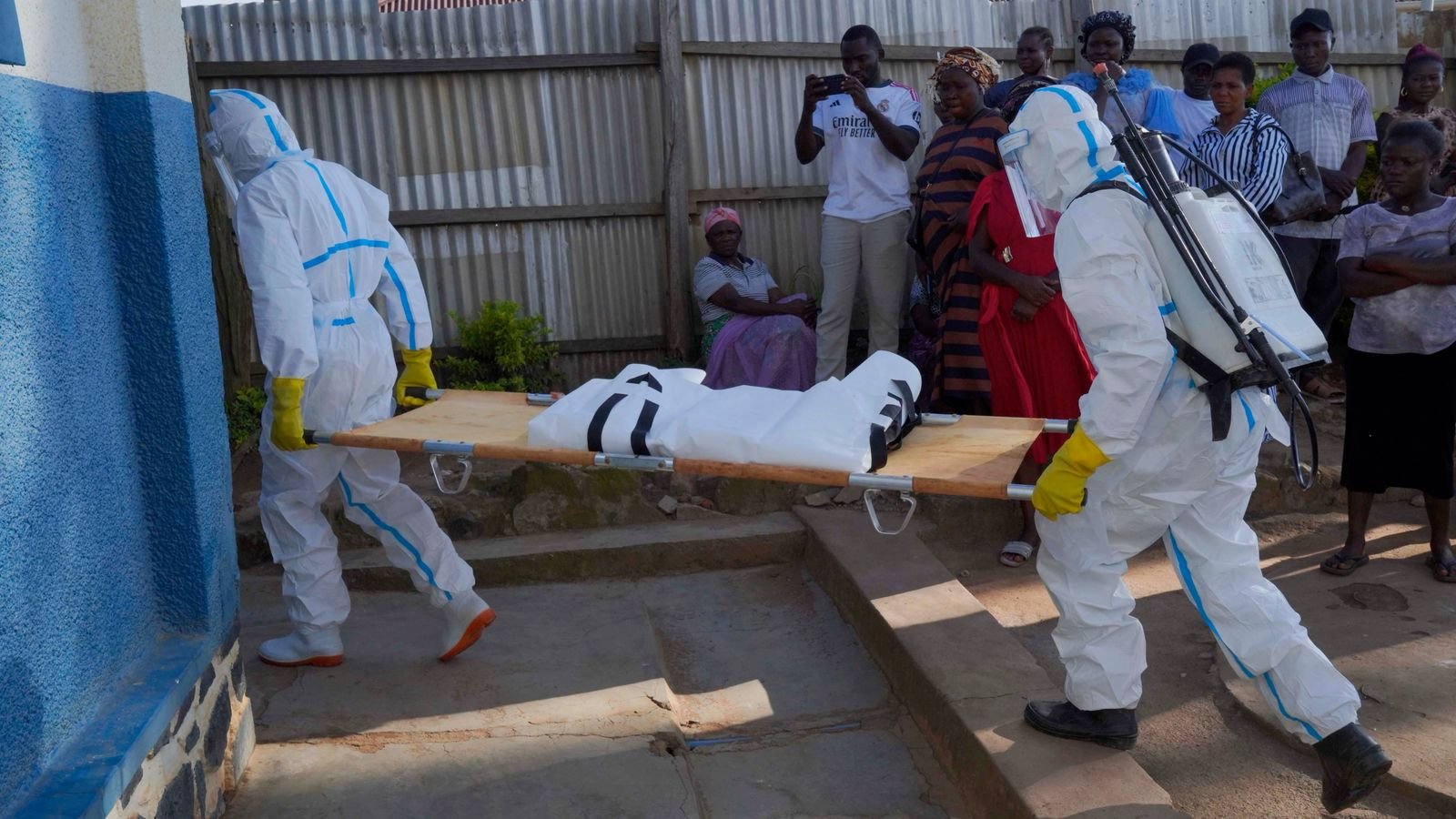
Healthcare workers carry the body of Ariella Anyiro, a 10-month-old who died of the Ebola virus, outside a morgue in Bunia, Congo, Sunday, Nov. 15, 2026. [AP Photo/Dieudonne Dirole]
Beneath the Ebola crisis lies relentless warfare, acute hunger, mass displacement and unpaid health workers, even as the imperialist powers continue looting the Democratic Republic of the Congo for valuable minerals and corporate profits. The people of Congo-DRC have been left defenseless, but where other states possessed functioning health systems to trace and isolate contacts, transmission was stopped.
Modeling by the US Centers for Disease Control and Prevention (CDC) places the first infection between late January and February, while Médecins Sans Frontières (MSF) recorded 55 deaths dating from early April before the first laboratory confirmation. The WHO finally declared an international emergency on May 17.
The epidemic reached 1,000 confirmed cases in 37 days and 1,000 deaths in 67 days, compared with 142 days in the 2014 West African epidemic. It passed the 3,470 cases of the 2018–20 Kivu outbreak in 76 days, against Kivu’s 23 months, making this the fastest-growing Ebola epidemic on record. At the current pace of 400 to 500 new cases a week, the cumulative laboratory-confirmed count would surpass West Africa’s 15,261 confirmed cases by early next year.
Beyond the Congolese border, the outbreak was contained wherever functional public health machinery could trace and isolate contacts. Uganda recorded 20 cases and two deaths before transmission ended, Kenya logged nine cases with every secondary infection occurring among contacts already quarantined, and an isolated case in Nigeria was medically evacuated to Geneva. The Africa Centres for Disease Control and Prevention (Africa CDC) is investigating whether the Kenyan and Nigerian infections trace back to Entebbe airport in Uganda, through which both patients passed on October 3. Infected foreign aid personnel were evacuated to specialized hospitals in Germany, the Netherlands, Switzerland and Britain, but Congolese healthcare workers face the virus without an evacuation route.
Ebola’s spread beyond the Congo, at six months [Photo: WHO]
Among laboratory-confirmed patients whose illness has ended, 64.3 percent have died, matching the 62.9 percent recorded among confirmed patients with a recorded outcome during the 2014–16 West African epidemic. In its six-month release, WHO reported that two-thirds of confirmed deaths occurred in the community, outside clinical facilities. The agency claimed transmission has slowed in initial epicenters, such as Mongbwalu, Nyankunde and Butembo, while stating new cases in Bunia have halved. These claims stand beside the agency’s own admission that contact follow-up remains persistently below target and that widespread community mortality suggests infections are identified too late.
Fewer than one in four newly diagnosed patients emerge from registered contact lists, while WHO’s Patrick Otim estimates that about one-third of deaths occur outside treatment centers among people never tested.
Case fatality ratio, the Congo 2026 versus West Africa 2014–2016 [Photo: WHO]