








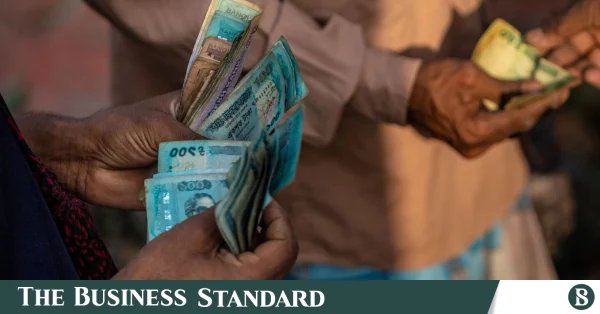
Imagine a schoolteacher named Suma who lives in Sylhet. On the first of the month, she collects her salary and walks to the market, as she always does. A few years ago, that money lasted the whole month.
Today it barely lasts three weeks. Rice, cooking oil and fuel all cost more, and the imported medicine her father needs has become a monthly worry. She has not changed her habits or lost her job, yet her salary is far less than before. The evening news says the taka “has lost value against the dollar.” She barely understands the sentence, but she is living its meaning.
Suma is imaginary, but millions of families in the country live versions of her story, with headline inflation around 8 to 9% through 2025-2026, driven heavily by imported fuel, fertiliser and food. The exchange rate can look like a technical matter for central bankers, yet it decides what a family pays for dinner, what a farmer pays for fertiliser and whether a small business can afford imported machinery.

It is tempting to blame global markets, a strong dollar or foreign speculators, but the taka’s fall was not an accident, and it was not mainly the work of outsiders.
For years, the government covered part of its budget deficit by borrowing from the central bank, which in plain terms means creating new money. More money chasing the same goods pushes prices up and weakens the currency. At the same time, Bangladesh Bank sold dollars from its reserves to hold the exchange rate steady, hoping to keep the taka from sliding.
That was a losing combination. Gross reserves fell from nearly $48 billion in August 2021 to roughly $20 to $25 billion by mid-2024, and a central bank cannot sell dollars forever to defend a rate the market does not believe.
When the defence became unaffordable, the taka slid from around 85 to over 122 per US dollar. The adjustment came anyway; it simply came later, and it came harder. The pain then spread through the economy.
Our biggest export, ready-made garments, depends on imported cotton, yarn and machinery, so when the taka weakens, those costs rise and cancel much of the advantage a cheaper currency is supposed to give exporters.
Fuel, LNG, fertiliser and edible oil are imported too, so when global energy prices rose while the taka weakened, the import bill and the government’s subsidy burden grew together. Companies and power producers that had borrowed in dollars saw their repayment costs jump almost overnight, and money that could have gone to new machines and new jobs went to debt service instead. Large infrastructure and energy contracts priced in dollars put the same pressure on the budget.
Banks made things worse. Weighed down by bad loans, thin capital and long-standing governance problems, they lent less; businesses could not expand, and confidence suffered. A weak taka is therefore not a gift to exporters. It is a bill that households, firms and the budget all pay, and the exchange rate cannot be repaired in isolation from the banks and the budget behind it.
Bangladesh is not the first developing country to face this, and the encouraging lesson from others is that the crisis can be overcome. The older success stories show the pattern clearly.
Brazil suffered decades of hyperinflation, large deficits and a constantly sinking currency. It launched the Real Plan in 1994, and after being forced to float its currency in 1999, it adopted a package of inflation targeting, a flexible exchange rate and strict fiscal targets. Trust returned because the rules were clear and the government kept to them.
South Korea faced a severe dollar shortage in late 1997, with heavy foreign debt, thin reserves and a banking system full of bad loans. It let the won float, rebuilt reserves aggressively, set up a powerful financial supervisor, closed weak institutions, enforced capital standards and curbed unhedged foreign borrowing. Its lesson is that a currency cannot be fixed without fixing the banks.
India reached its breaking point in 1991, when reserves covered less than three weeks of imports. It devalued in steps, moved from a fixed rate to a market-determined one, cut tariffs, scrapped rigid licensing, attracted deposits and remittances from overseas Indians and pushed exports beyond traditional commodities.
More recent examples show the same lesson still holds. Sri Lanka defaulted on its foreign debt in 2022, with long queues for fuel, shortages of medicine and inflation that peaked near 70%. It then turned to an IMF program in 2023, raised taxes, allowed the rupee to move more freely, tightened monetary policy, restructured its debt and strengthened the central bank’s independence.
Inflation fell sharply and reserves began to rebuild, though the social cost was heavy and the recovery remains fragile. Egypt, struggling with severe dollar shortages and a parallel market for foreign currency, floated its pound in March 2024.
The move caused a large one-time fall in the currency, but it came with a larger IMF program and big foreign investment inflows, and it narrowed the gap between official and parallel rates and eased the dollar shortage. These recent cases are not clean victories, and both countries still face high prices and heavy debts. But they carry the same message as Brazil, Korea and India: an honest exchange rate, disciplined budgets, healthier banks and a stronger base of foreign currency earnings. None of them found a shortcut. Each accepted short-term pain for long-term credibility, and the common thread is that delay is the most expensive choice, because defending an unrealistic rate burns reserves and deepens the eventual fall.
Bangladesh has already taken some of the same steps, and it deserves credit for them. It has largely stopped financing the deficit directly through the central bank, raised the policy rate to 9.50% to fight inflation, and moved from a rigid peg toward a crawling system and then market-based reference rates. Reserves have recovered, reportedly to around $31 to $32 billion by late 2026, and remittances have reached record levels.
But inflation is still high, banks are still fragile, and the economy still leans heavily on imported energy and raw materials, so harder work lies ahead. A recovery that rests on tight money alone can slow growth and cost jobs, which is why it must be matched by reforms that make the economy stronger, not just tighter.
First, the budget must stay honest. The government should put a legal limit on central bank financing of deficits, so that the promise does not depend on who is in office, and move gradually toward an explicit inflation target guided by an independent monetary policy committee.
Second, the exchange rate should tell the truth. Returning to artificial caps would invite another round of falling reserves and a bigger fall later, and the central bank should publish clear and regular data on its interventions and reserves to keep expectations calm.
Third, banks need serious repair: independent reviews of loan quality, firm action against willful defaulters, stronger capital requirements and strict limits on unhedged dollar borrowing by companies, so the next depreciation does not wreck their balance sheets.
Fourth, migrant workers, the quiet backbone of our dollar supply, should be encouraged to send money through formal channels with lower fees, better mobile banking links and competitive conversion rates.
Fifth, the economy must become less dependent on imports. Growing local cotton, yarn and intermediate input industries would add more value to each garment exported, and incentives should reach pharmaceuticals, leather and IT services so that foreign earnings do not rest on a single sector.
Finally, over the longer term, deeper taka bond markets supported by pension and insurance funds would reduce reliance on borrowing in dollars. None of this is easy, and some of it will be painful in the short run, as Sri Lanka and Egypt remind us. But the dilemma is real only as long as it is avoided, and its causes are within our control.
If Bangladesh keeps money creation in check, lets the exchange rate reflect reality, cleans up its banks and strengthens its earnings of foreign currency, it can follow Brazil, Korea and India out of the trap. That would also let someone like Suma trust, once again, that today’s salary will buy tomorrow’s food.
Dr Mohammad Abdul Hannan Pradhan, Professor at the Department of Economics, Shahjalal University of Science and Technology (SUST), Sylhet; Email: [email protected];
Murad Mia, Undergraduate Student at the Department of Economics, Shahjalal University of Science and Technology (SUST), Sylhet; E-Mail: [email protected];
Disclaimer: The views and opinions expressed in this article are those of the authors and do not necessarily reflect the views and opinions of The Business Standard.