Members of Congress return to work today after several weeks in recess and in the wake of Democrats’ dramatic victories in the midterm elections. The lame-duck Congress has until Dec. 11 to pass funding legislation or face a government shutdown.
House Science Committee Ranking Member Zoe Lofgren (D-CA) announced
she will seek to chair the committee in the next Congress. If selected, she said the committee will focus on stopping the Trump administration’s “politicization” of science. “We will build protections for federal science and innovation programs so Trump-era corruption cannot happen again,” she said.
Lofgren and every other Democrat on the committee running for reelection won their contest last week. In contrast, three Republican members are retiring, and James Gallagher (R-CA) lost his reelection bid. As of Monday morning, four races involving Republican members of the Science Committee remain too close to call. The one departure on the Democratic side is Rep. Haley Stevens (D-MI), who is leaving Congress this year and facing possible expulsion
from the Democratic caucus.
On the Senate Commerce Committee, the big question is whether Sen. Dan Sullivan (R-AK) will prevail against Democrat Mary Peltola, who is currently leading him by a few hundred votes. Democrats and Republicans are both losing a few members on that committee to retirements.
On the funding front, one change to watch will be the effect of Senate Appropriations Chair Susan Collins’ (R-ME) loss to Democrat Troy Jackson. As chair, Collins holds considerable power over funding decisions and will play a major role in whatever funding process emerges ahead of the Dec. 11 deadline. Collins has previously pushed back on some of the Trump administration’s cuts to science agencies and changes to grantmaking.
a “Declaration of Freedom in Space” proclamation on Tuesday, reaffirming human space exploration as a national goal. The announcement came ahead of a weekend exposition
and air show at NASA’s Kennedy Space Center. (The space agency opened
applications for Moon landing astronauts there, as well as announcing
new lunar lander missions and a rover mission.)
The White House’s election day proclamation underlined
the administration’s continued push for human space exploration, notably Moon landings. Its stated adherence to international space obligations, which would include the 1967 Outer Space Treaty, seems intended to head off any future claims
over lunar territory from China or other actors, noted
some observers. Both the US and China plan human landings on the Moon’s south pole within the next decade.
“Space is the one area that really brings people together across the electorate, across the general public, and across the Congress,” said Jack Kiraly of the Planetary Society, in a post-election briefing on space policy that discussed the proclamation. “Good to see the administration, any administration, sort of showcasing their support for the space program,” he said.
Federal science agencies “are proceeding in direct contravention of Congress’s explicit instructions” by implementing a blocked OMB grant rule’s provisions, warns
a coalition of public service organizations. (Several signatories are AIP Member Societies.)
The American Academy of Sciences & Letters has announced the 10 recipients of this year’s Barry Prize, awarded to scholars at U.S. colleges and universities for distinguished intellectual achievements in the arts, sciences and learned professions.
An annual award, the Barry Prize “honors those whose work has made outstanding contributions to humanity’s knowledge, appreciation, and cultivation of the good, the true, and the beautiful.” Winners of the Barry Prize receive a cash award of $50,000 and also become members of the Academy.
The 2026 Barry Prizes were awarded in a November 4th ceremony at the Library of Congress in Washington, D.C. to:
Lara M. Buchak is professor of philosophy at Princeton University specializing in decision theory, social choice theory, epistemology, ethics and the philosophy of religion. Her work on decision theory has led to new insights into how to determine what we ought to believe and do. The Academy honored Buchak for her “distinguished contributions to humanity’s understanding of rational decision-making across all areas of knowledge and activity.”
G. Marius Clore is an investigator at the National Institutes of Health. In addition to being a Fellow of the Royal Society, he’s also a member of the National Academy of Sciences and a fellow of the American Academy of Arts and Sciences. He has also been the head of the Biological MNR Group at the Max Planck Institute for Biochemistry. His use of multi-dimensional nuclear magnetic resonance spectroscopy has advanced our knowledge of biological macromolecules and how they are assembled to form the structures underlying the functioning of living cells.
G. Marcus Cole is the Joseph A. Matson Dean and professor of law at Notre Dame Law School. His scholarship has enabled legislators and jurists to understand how laws can more effectively promote justice, religious freedom, and economic development in the face of rapid technological and social change.
Farr A. Curlin is the Josiah Charles Trent Scholar in Medical Humanities in the Trent Center for Bioethics, Humanities, and History of Medicine, and co-director of the Theology, Medicine, and Culture Initiative at Duke University. He works at the intersection of medicine, ethics, and theology. His citation reads in part, “His scholarship has shown that widespread ethical problems created by the dominant service-provider model of medical care can be alleviated if medical personnel develop a personal understanding of their professional calling.”
Jesus Fernandez-Villaverde is the Howard Marks Presidential Professor of Economics at the University of Pennsylvania and a research associate for the National Bureau of Economic Research. A macroeconomist, he is credited with advancing our understanding of the social basis of modern market systems.
Alexander B. Givental is professor of mathematics at the University of California-Berkeley. The author of several textbooks, Givental was described as a mathematician who had created “methods that connect symplectic geometry, algebraic geometry, singularity theory, and mathematical physics,” which has “improved our ability to solve problems across numerous areas of modern mathematics.”
Jane Kamensky is president and CEO of Thomas Jefferson’s Monticello and the Jonathan Trumbull Professor of American History Emerita at Harvard University. At the Radcliffe Institute for Advanced Study, she was the Carl and Lily Pforzheimer Foundation Director of the Arthur and Elizabeth Schlesinger Library on the History of Women in America and she has served as a commissioner for the Smithsonian’s National Portrait Gallery. Her citation credited her with helping “the American people to know themselves more fully by understanding the history of their founding and early development.”
Bertha Kalifon Madras is professor of psychobiology at Harvard Medical School, where she has focused on translational research, the neurobiology of therapeutic and addictive substances, brain imaging, and medications development. The academy’s citation praised her work for advancing “our understanding of the biological, chemical, and neurological aspects of addiction, as well as the relative effectiveness of public policy approaches addressing addiction’s personal and social impact.”
Harvey C. Mansfield is the William R. Kenan, Jr. Professor of Government at Harvard University, where he was once chairman of its Government Department. He has held Guggenheim and NEH Fellowships and has been a Fellow at the National Humanities Center. His citation read in part, “over a sixty-year academic career, Harvey Mansfield’s fearless exploration of the central political ideas of the modern world, and their relationship to ancient ideas, has established him as the Nation’s foremost scholar of modern political philosophy.”
Steven Pinker is the Johnstone Family Professor of Psychology at Harvard University. An experimental psychologist. Pinker is one of psychology’s leading researchers in visual cognition, psycholinguistics, and social relations. The winner of several awards and scholarly recognitions that have helped make him a public figure, Pinker has advanced our understanding in several domains, including language, emotion, moral norms, and socialization.
AASL gave out its first Barry Prizes in 2023 when the Academy was launched and its initial members inducted. In addition to its awards, AASL seeks to recognize the importance of excellent scholarship and champion “the intellectual rigor and diversity of American colleges, universities, and public intellectual discourse.”
This article was originally published on Forbes.com
Here’s what you’ll learn when you read this story:
Scientists made mice “see” phantom shapes when they activated just a tiny cluster of neurons with holographic lasers.
The experiment shows that your brain starts “filling in” a perception of reality in the brain’s first visual processing area even though it has to go through more steps to correctly identify what you see.
It turns out your brain creates an illusion of reality, partly based on your previous experiences, letting you make decisions quickly when needed.
How do you make a mouse hallucinate? (And why would you even try?)
Hyeyoung Shin, PhD, an assistant professor of neuroscience at Seoul National University, turned to mice to help explain what makes one person perceive reality differently from another. Take the great dress debate from 2015, for example, when people across social media argued over whether an online post depicted a white-and-gold or a blue-and-black garment (Spoiler: It was the latter).
Shin herself wondered what her brain was doing when she looked at the dress image online. More than 10 years later, in a study published in Nature Neuroscience, she was finally able to explain why.
In their study, Shin and her colleagues zapped the brains of six mice with ultraprecise holographic lasers, targeting a tiny cluster of cells in the brain’s first layer of image-sensing neurons, an area called V1. Researchers asked whether sparking those cells alone could make the brain “see” something that wasn’t really there.
The animals’ brains lit up as if they were seeing phantom shapes, like the Kanizsa triangle, where Pac-Man cutouts trick you into seeing a triangle that isn’t actually present. The team baptized these cells “IC-encoder neurons,” because a spark from them can ripple outward, recruiting tens of thousands of other neurons to finish the picture.
Shin says she hadn’t expected this “filling-in” to happen so early, right in the brain’s first visual processing area.
That means reality is in the eye of the beholder. It implies that “perception is not a direct recording of reality, but a process of inference,” says Shin. In neuroscience, inference means the brain makes its best guess about what’s out there—filling in perception gaps and leaning on past experience. She’s quick to dismiss going so far as to call reality a “controlled hallucination,” though, since hallucination means experiencing things that don’t exist in any form. “Instead, illusion—and perception in general—is the brain interpreting sensory evidence based on your beliefs about the sensory world,” she says.
It turns out our brains create an illusion of reality based on both our previous experiences and the evolutionary design of our primary visual cortex. Located at the back of the brain, where it receives signals from our eyes, this first layer of image sensing (called V1) doesn’t just take pictures. In fact, it helps decide—if not dictate—what we see.
And that’s crucial, because this design enables our ability to make decisions quickly based on how we perceive the world around us, scientists say. Otherwise, we might spend too much time trying to recognize important stimuli in our environment, such as danger.
In everyday life, we mostly do agree on what we see. Even in the dress debate—a perception anomaly in itself—no one saw red or fuchsia. The fight was only between two specific color combinations. So are our brains all running on the same basic code?
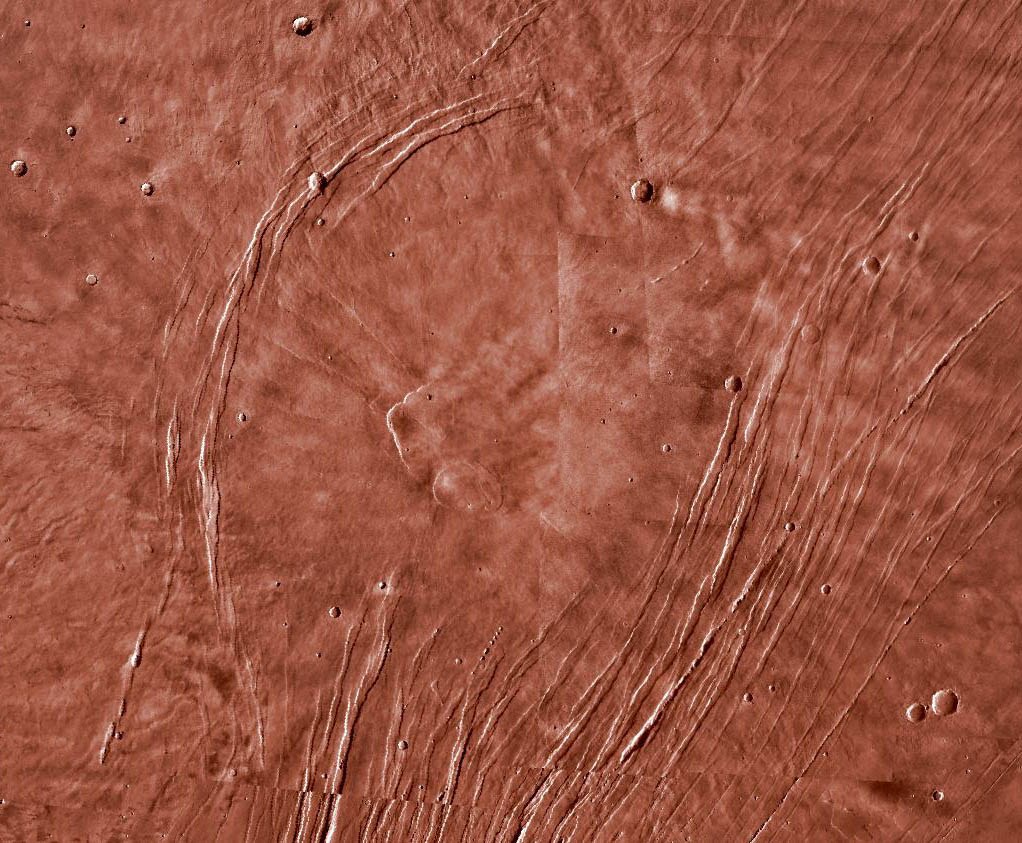
The summit of Alba Mons at center is encircled by the sweeping fracture systems of Tantalus Fossae to the east (right) and Alba Fossae to the west in this mosaic of images taken by NASA’s Viking orbiters in the late 1970s. Researchers think hydrogen chloride gas recently detected nearby may be seeping from magma below. Credit: NASA/JPL/USGS
Something is leaking from the ground near one of Mars’ largest volcanoes, and scientists think it’s a sign that active magma is buried below.
In a study published Nov. 4 in Science Advances, researchers report detections of hydrogen chloride (HCl) gas within 6 miles (10 kilometers) of the planet’s surface near the volcano Alba Mons. Notably, the detections came during aphelion, when Mars is farthest from the Sun and HCl is typically absent from its atmosphere. The location and out-of-season timing combined with the site’s unique geology likely point to volcanic outgassing — gas escaping from magma as it rises toward the surface — the authors argue.
“It seems that we are showing that there may still be more heat inside Mars than we thought, enough heat to have still fluid magma at depth,” co-author Daniel Mège, a professor at the Space Research Centre of the Polish Academy of Sciences, tells Astronomy.
The detection adds to mounting evidence, including recent detections of marsquakes, that the martian interior is not the dead world scientists once assumed. While scientists know volcanism influenced the planet’s evolution, it has remained unclear whether it continues today.
A volcanic past
There’s no question that igneous activity shaped Mars into the planet we see today. Between 3.7 billion and 3 billion years ago, eruptions flooded the planet’s surface with vast lava plains. Later volcanic activity built some of the solar system’s largest volcanoes, including the roughly 16-mile-high (25 km) Olympus Mons — the tallest — and the 4.2-mile-high (6.8 km) Alba Mons, the largest by surface area. Though it rises just 4.2 miles (6.8 km), Alba Mons sprawls roughly 870 by 620 miles (1,400 by 1,000 km).
Those colossal peaks formed not through shifting plate tectonics like on Earth, but through stagnant-lid tectonics. Mars’ outer shell is a single rigid plate, meaning magma repeatedly erupted at the same sites, piling lava to towering heights over millions of years.
Many of these giants, including Olympus and Alba Mons, sit atop Tharsis, a volcanic plateau roughly 3,000 miles (5,000 km) across. Some lava flows at Tharsis are relatively young, dating back only tens of millions of years, yet there has been no definitive evidence for ongoing volcanic activity at the plateau or on the planet as a whole. Nevertheless, the case has been slowly building.
Mounting evidence
Before its mission ended in 2022, NASA’s InSight lander recorded more than 1,300 marsquakes. Quakes alone don’t prove volcanic activity. “Marsquakes can happen for multiple reasons, only one of which is faulting or other tectonic activity around volcanoes,” says R. Aileen Yingst, a senior scientist at the Planetary Science Institute who studies Mars geology and was not involved in the study. For example, some of the marsquakes InSight detected were caused by meteoroid impacts. And a cooling and contracting crust can cause seismic activity without magma.
Most of the quakes, though, were traced to a system of young volcanic fissures — long, parallel cracks where the martian crust was once pulled apart by rising magma — called Cerberus Fossae. Deposits of volcanic ash at Cerberus Fossae date to as recently as 53,000 years ago. Some scientists argue the large number of marsquakes in this setting could hint that magma is still moving below. In 2022, researchers proposed that a 2,500-mile-wide (4,000 km) active mantle plume lies beneath the Elysium Planitia region that surrounds Cerberus Fossae. On Earth, such columns of hot solid rock rise from deep in the planet’s interior, melting rock and creating magma, which could explain both the marsquakes and the ash deposits.
Orbiters searching for evidence of active volcanism on the martian surface have yet to turn up anything conclusive, the authors say. Sulfur dioxide (SO₂), the gas most often used to track volcanoes on Earth, has never been detected on Mars at concentrations that would point to magma. But that absence doesn’t mean Mars’ magma has gone quiet. Measurements at volcanoes on Earth show that SO₂ dominates during eruptions but drops sharply between them, when HCl becomes the more abundant gas. “[A]s long as we do not observe an active lava flow, or lava fountain, or explosion on Mars, we do not expect SO₂ emissions to be very high,” Mège says. Mars is also about 2.5 times richer in chlorine than Earth, and some martian volcanic meteorites are “up to four times richer” in chlorine than sulfur. “All this suggests that HCl is the best gas to look for on Mars if we want to identify active magma at depth that is not being erupted,” Mège explains.
An out-of-season signal
The detections in the study come from the Atmospheric Chemistry Suite (ACS), a set of three infrared spectrometers aboard the Trace Gas Orbiter, a joint mission of the European Space Agency and Russia’s space agency, Roscosmos. The orbiter began science operations in 2018. ACS’s spectrometers analyze the sunlight filtering through the martian atmosphere, picking out the wavelengths each gas absorbs to reveal what’s in the air and at what altitude. In 2020, ACS made the first detection of HCl on Mars. It appeared planetwide during the warm, dusty season near perihelion, reaching concentrations of 4 to 5 parts per billion. Researchers attributed the presence of that HCl to chemical reactions involving dust, ice, and water vapor in the atmosphere during the warm season, not to volcanic activity.
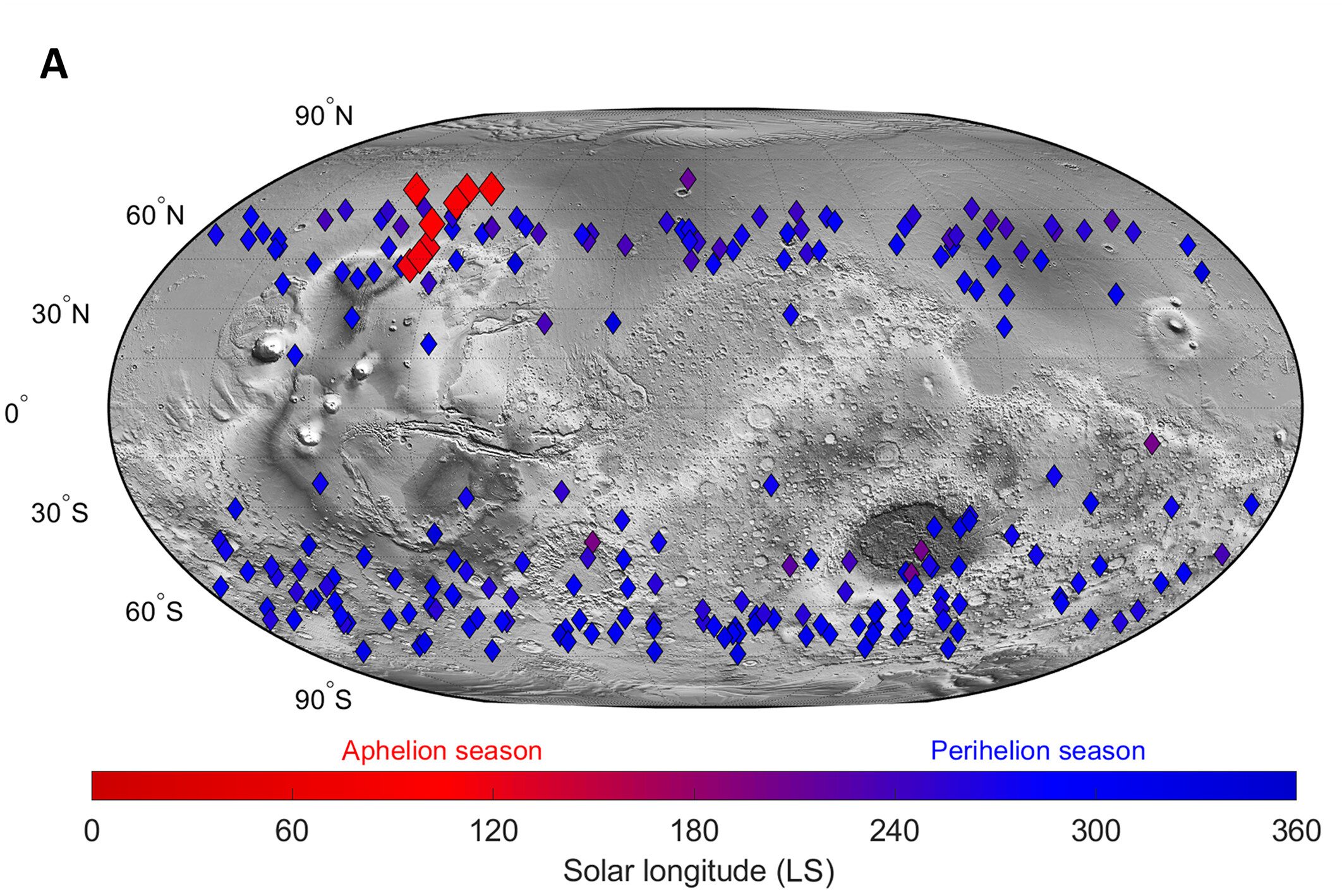
What’s different about the new finding is that they detected HCl not at perihelion, but near aphelion, when the gas is otherwise absent from Mars’ atmosphere. The HCl was also localized above an interesting geological location: the region around the sprawling, low-profile volcano Alba Mons, located on the northern edge of Tharsis. After two tentative detections in one Mars year, a dedicated search two Mars years later turned up six more, mostly northeast of the volcano. The gas hugged the lowest 6 miles (10 km) of the atmosphere at concentrations up to 1.5 parts per billion.
Hydrogen chloride detections by the ExoMars Trace Gas Orbiter during Mars’ warm perihelion season (blue) are scattered widely across the planet, while those from the cold aphelion season (red) cluster in a single region near the Alba Mons volcano. That isolated signal led researchers to suspect the gas is seeping from magma below. Credit: Trokhimovskiy et al., Science Advances (CC BY 4.0)
Tracing the source
The team ruled out atmospheric processes for the HCl and considered three possible ground sources: volcanic activity, mud volcanism, and the breakdown of chlorine-bearing salts called perchlorates. Mud volcanoes — likely inactive for billions of years — are widespread across Mars’ northern lowlands, so they alone couldn’t explain why the gas showed up in only one isolated place. And even if mud volcanism were active and releasing the HCl, it would likely still point to magma beneath the surface. Perchlorates are likewise found across the northern lowlands, which rules them out on the same grounds. “[I]f this mechanism were involved, HCl would be detected throughout the northern hemisphere, it would not be local,” Mège says. That leaves localized volcanic activity, which fits with models of the planet’s formation suggesting HCl should be among the most abundant gases in its volcanic emissions.
To gather more data, the team turned to high-resolution images from the High Resolution Imaging Science Experiment (HiRISE) camera aboard NASA’s Mars Reconnaissance Orbiter, and the Colour and Stereo Surface Imaging System (CaSSIS) aboard the Trace Gas Orbiter. They were looking for features near Alba Mons that could explain the seepage. They found a grouping of several narrow fissures that had not previously been identified. Many were just tens of centimeters wide, and some extended for up to 6.21 miles (10 km) long. Some were ringed by dark halos, suggesting material may have recently been ejected from within. The fissures were so thin that seasonal dust and ice activity should have already covered them up unless something was actively keeping them open. The authors did not confirm that the HCl came from the fissures, but they suggest the cracks may run from the icy ground near the surface all the way down to magma. Gas rising through them could escape directly or become trapped in the frozen ground, seeping into the atmosphere over time as the ice turns to vapor.
The case isn’t closed. The team didn’t catch gas escaping from any specific fissure. And although the cracks hadn’t been described before, they appear in older orbital images, with no visible changes between then and now. The authors stop short of a firm conclusion, saying only that ongoing volcanic activity is the best explanation for what they found. “What we can say today is: when we consider all the alternatives, it is the best explanation,” Mège notes. The next step is to keep watching. Future searches could reveal more hidden pockets of gas, and with them, more signs that Mars’ interior is still stirring. Ultimately, “to confirm the source,” Mège says, “we would need someone or some robot to check, with a very multidisciplinary payload.”
If there is still magma beneath Alba Mons, the implications reach beyond geology. Mars is smaller than Earth, so it should have shed its internal heat faster. “If it’s the case that Mars is still volcanically active, then the thermal models of Mars would probably need to be revisited,” Yingst explains. And where magma meets groundwater, hydrothermal systems – the kind of environment where life on Earth may have first emerged – usually follow. If conditions stayed stable long enough, Mège says, life could have arisen there. And “if these stable conditions continue until now, then these living organisms may still be there, somewhere below the surface.”
Brooks Mendenhall is a staff writer at Astronomy, based in Chattanooga, Tennessee, fueled by an unending curiosity about the universe. A former classroom teacher, he has a knack for breaking down complex concepts for a wide audience.
Aristotle once said that “no great mind has ever existed without a touch of madness.” While that millennia-old hypothesis doesn’t hold up to modern scientific scrutiny, researchers are interested in exploring the relationship between artistic and scientific creativity and mental health. While there are many high-profile artists who’ve very publicly struggled with mental health (Vincent van Gogh cut his own ear off, after all), those cases are purely anecdotal. Does scientific evidence suggest there’s really a correlation?
Getting closer to an answer to that age-old question was the primary goal of a new study published in the journal Molecular Psychiatry that was led by researchers at the Max Planck Institute for Empirical Aesthetics and Karolinska Institutet in Sweden.
“There is a longstanding idea that genius and ‘madness’ go hand in hand, particularly in creative fields, with many famous artists believed to have struggled with mental health problems,” Karolinska Institutet’s Miriam A. Mosing, a co-senior author of the study, told Medical Xpress. “However, the empirical evidence for this association remains mixed.”
To even attempt to understand this possible mental correlation, the team needed an immensely large dataset. Luckily, they could pore over two surveys conducted in 2012–2013 and 2022–2023 that collected mental health data from 14,658 individual twins in Sweden, fewer than half of whom participated in both surveys. The first survey assessed artistic and scientific achievement and noted self-reported psychiatric symptoms and openness to experience, while the second one tracked divergent thinking, or the ability to solve complex problems.
“This idea is fueled by many anecdotal examples of famous creators with eccentric personalities and psychiatric problems, from Vincent van Gogh and Ernest Hemingway to Virginia Woolf and Camille Claudel,” the authors wrote in the study. “Research including some systematic reviews and meta-analyses, has suggested that creativity and engagement in creative activities are associated with an increased risk of mental health problems.”
The study also aimed to assess the role genetics and environment play on this correlation, and that’s where the twins aspect of the dataset comes in handy. With identical twins, for example, researchers could effectively remove genetic and environmental factors and assess whether the associations remained.
They found that artistic creativity did have a positive correlation with poorer mental health, much as previous studies indicated. However, scientific creativity didn’t hold a similar correlation. One theory, proposed by the authors, suggests that scientific environments are “more unforgiving” of mental health problems than artistic ones are, leading to indirect selection processes. Interestingly, the team also found a positive correlation between depressive symptoms and openness, suggesting that an introspective personality might lead one to question social norms. They also noted that genes appeared to play a significant role.
“Though our study suggested the importance of genes, it doesn’t mean environment is not important,” Max Planck Institute’s Penghao Xia, lead author of the study, told Medical XPress. “Therefore, we still need to investigate other explanations of the association.”
Darren lives in Portland, has a cat, and writes/edits about sci-fi and how our world works. You can find his previous stuff at Gizmodo and Paste if you look hard enough.
Samantha Blau from the Maryland Science Center demonstrates an at-home science experiment using a popular seasonal ingredient to learn about acids vs base chemicals.
TEHRAN – World Science Day for Peace and Development, observed annually on November 10, highlights the vital role of science in addressing global challenges, promoting international cooperation, and building peaceful and sustainable societies.
Proclaimed by UNESCO in 2001, the observance seeks to strengthen the relationship between science and society, raise public awareness of scientific developments, and encourage citizens to take part in discussions on emerging scientific issues. It also recognizes the contribution of scientists to expanding knowledge, protecting the planet, and improving people’s quality of life.
The 2026 theme, “Common Ground Through Science Diplomacy,” emphasizes the potential of scientific cooperation to build bridges between countries, foster dialogue, and facilitate collective responses to shared challenges.
The day provides an opportunity for governments, scientific institutions, researchers, the media, educators, and students to promote science as a means of advancing peace and development. It also highlights the importance of keeping the public informed about scientific progress and involving wider society in shaping the future of science.
The observance traces its origins to the World Conference on Science, held in Budapest in 1999 under the auspices of UNESCO and the International Council for Science. The conference emphasized the need to strengthen ties between science and society and highlighted the role of scientific knowledge in addressing global concerns. UNESCO subsequently proclaimed November 10 as World Science Day for Peace and Development, with the first worldwide celebration held in 2002.
The United Nations has further underscored the importance of science for sustainable development. In August 2023, the UN General Assembly declared 2024–2033 the International Decade of Sciences for Sustainable Development, recognizing the essential contribution of scientific knowledge, innovation, and international partnerships to achieving the goals of the 2030 Agenda for Sustainable Development.
International Week of Science and Peace
Closely related to World Science Day, the International Week of Science and Peace is observed annually from November 9 to 15, highlighting the contribution of scientific and technological progress to peace, security, and international cooperation.
The initiative was first held in 1986 as a non-governmental activity during the International Year of Peace. In 1988, the UN General Assembly adopted Resolution 43/61, officially designating the week in which November 11 falls as the International Week of Science and Peace.
The observance aims to raise public awareness of the relationship between scientific advancement and peace, while encouraging cooperation among scientists and greater international engagement in addressing common challenges.
Together, the two observances provide an opportunity to highlight how scientific knowledge, technological innovation, and cross-border collaboration can contribute to a more peaceful, inclusive, and sustainable world.
World Science Day in Iran
In Iran, universities and scientific institutions are marking World Science Day for Peace and Development and the International Week of Science and Peace with a range of educational, cultural, and public engagement activities.
The University of Tehran, in cooperation with the Iranian Association for the Promotion of Science, is hosting a series of events from November 9 to 18. The program includes a science exhibition, a commemorative ceremony, public science sessions, and science-fiction film screenings, aimed at promoting scientific awareness and strengthening interaction between universities and society.
The Mustafa Science and Technology Foundation is also organizing educational and media initiatives during the week, including new episodes of its Observatory podcast, the release of a science magazine, interviews with distinguished researchers, and a two-day educational program in Tehran for 40 outstanding students from across the country.
Mars in all it’s glory on the outside could hold something more interesting inside it. Credit: NASA.
Mars is cold, dry, and almost airless. But in a laboratory on Earth, scientists recreated some of its harshest conditions and watched microbes do something remarkable: multiply.
For 160 days, the organisms grew without oxygen, under extremely low pressure, and in water seven times saltier than seawater. The experiment suggests that life might be capable of more than merely surviving beneath the Martian surface.
A protective coating against a hostile world
The researchers studied Haloferax volcanii, a salt-loving microorganism belonging to a group called archaea. Archaea look like bacteria but belong to a separate branch of life. Many of them thrive where other organisms struggle, from scalding hot springs to extremely salty lakes.
That made H. volcanii a promising candidate. Mars contains salts that could potentially keep water liquid underground, even below its normal freezing point.
Previous experiments had shown that Earth microorganisms could survive certain Martian stresses, including low atmospheric pressure and highly salty water. Some had even combined several of these conditions, but typically for just hours or days.
But surviving an environment is fundamentally different from thriving in it.
“Far fewer have been able to combine these conditions together and show that microorganisms can actively grow,” said Adam Robinson, a University of Florida researcher who led the study.
The team put H. volcanii to the test. They placed the microbes in a low-pressure, carbon dioxide-rich environment without oxygen. The organisms lived in brine seven times saltier than seawater, with either nitrate or perchlorate available to help them generate energy without oxygen.
×
Thank you! One more thing…
Please check your inbox and confirm your subscription.
Perchlorates are particularly interesting. These chlorine-containing compounds have been detected on Mars and can lower water’s freezing point, potentially allowing salty liquids to persist under otherwise freezing conditions.
For 160 days, the microbes kept growing. Slowly, certainly, but they were multiplying. When researchers withheld both nitrate and perchlorate, the organisms remained alive but showed no measurable growth.
With the right chemistry, the microbes weren’t simply hanging on. They were actively sustaining themselves and reproducing.
A protective coating against a hostile world
The researchers spotted another curious adaptation. Under low pressure, the microbes clustered into dense, biofilm-like communities. Biofilms are groups of microorganisms embedded in a protective matrix, commonly found on river rocks, teeth, and countless other surfaces.
These microbial clusters may have helped keep the salty water from evaporating. Over the entire 160-day experiment, the cultures lost less than 4% of their liquid, despite the low atmospheric pressure. The concentrated salt solution itself also slowed evaporation, so it’s unclear how much extra protection the biofilms provided.
On Mars, where liquid water is scarce and unstable, even a little protection could matter.
But the experiment wasn’t a perfect recreation of the Martian underground. The cultures were maintained at approximately 70 degrees Fahrenheit (21 degrees Celsius), considerably warmer than most of the Martian subsurface. Scientists also supplied nutrients, something that might be difficult for organisms to obtain naturally.
And there’s a more fundamental problem: nobody has actually found the underground pockets of salty water that the researchers were attempting to simulate. We suspect they could exist, but this isn’t yet proven.
“The environment that we’re mimicking in this experiment has not been observed on Mars, but is theorized to exist,” Robinson said.
Could life still exist beneath Mars?
For decades, scientists have focused much of their search for Martian life on the distant past. Ancient riverbeds, lake deposits and other geological features suggest that billions of years ago, Mars was warmer and wetter, potentially offering suitable conditions for microorganisms.
But what if some of that ancient life never disappeared? What if it simply retreated underground as the planet became colder and drier?
Scott Perl, a researcher at the Natural History Museum of Los Angeles County and the Blue Marble Space Institute of Science who co-led the study, argues that scientists may need to rethink what makes an environment habitable.
“They’ve evolved within the Martian environment that we consider hostile. So what is hostile to us isn’t necessarily going to be hostile to those microbes,” Perl said.
He’s speaking hypothetically, of course. No Martian organisms have ever been discovered. But if life did emerge there billions of years ago, it would have had an extraordinarily long time to adapt to its changing home.
The experiment also has practical implications. Understanding how microbes behave in Mars-like environments could help future missions distinguish traces of ancient life from signs of organisms that are still metabolically active. It could also help scientists assess the risk of contaminating Mars with microbes carried from Earth.
This doesn’t mean Mars harbors life today. The experiment recreated a habitat that scientists have yet to find on the Red Planet.
But it raises a tantalizing question. If microbes can grow under conditions this extreme on Earth, what might be happening in the dark beneath Mars?