Undae Science, a spin-off of the University of Lausanne, has raised CHF 1.15 million from 41 investors as part of its seed round, to complete the industrialization of its Noctae sleep platform.
Undae Science has raised CHF 1.15 million from 41 investors, retail investors and business angels, in a private round on Oomnium. The round took place this autumn as part of the company’s seed round, and the capital will fund the final stage of industrialization.
Noctae aims to reshape how sleep disorders are assessed. Instead of a night in a sleep lab, patients record their sleep at home over several nights using a sensor mat placed on their mattress. The platform analyzes hundreds of physiological signals, lifestyle factors and environmental influences to determine the severity of a sleep disorder and gives doctors actionable findings.
Support from Swiss sleep centers
Undae Science has the backing of the five largest sleep centers in Switzerland, which together handle about two-thirds of national sleep consultations, and holds 12 letters of intent. The company was founded in November 2024 by neuroscientist Shanaz Diessler, CEO, and Aurélie Stephan, CTO, building on research that began at the University of Lausanne in 2021.
In her column “At the Table,” Amy Zhang ’30 shares the stories of the Chinese American people she meets around Stanford.
Every week at the Alway Building, Michael Xingcai Zhang, a research scientist at the School of Medicine, sets out teacups, prepares the loose-leaf teas and waits.
Born and raised in Fujian, China — a southeastern province renowned for its ancient tea-growing traditions and historical influence on the global tea trade — Zhang has another identity: Dr. Tea. According to Zhang, his family and friends often jokingly say that “tea is in his mind, heart and soul.”
“Through a cup of tea, we can warm people’s hearts,” Zhang said. “And we’ll all move forward feeling a little happier.”
For Zhang, the sentiment goes beyond a slogan. Having moved to the U.S. from China years ago, Zhang understands loneliness and the importance of community firsthand. So in 2024, he began hosting weekly Tea Talks — semi-formal gatherings to facilitate intellectual discussion and community for students and researchers interested in medicine and health.
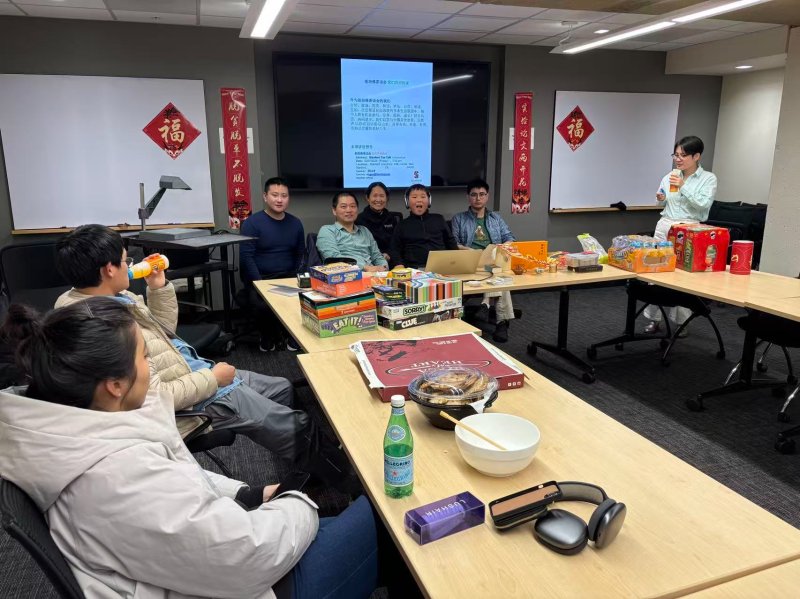
A Tea Talk hosted by Zhangin February 2025. (AMY ZHANG/The Stanford Daily)
Most evenings, Zhang invites researchers and scholars from the Bay Area to talk about their work. Past Tea Talks have welcomed experts in artificial intelligence, medical research, innovation, music and more.
Juan Zhang, a visiting scholar in the department of pathology, presented her research on cellular mechanisms at a Tea Talk in July. In a message to The Daily, she wrote that the feedback she received from fellow researchers “opened new entry points in [her] research,” including ways to incorporate AI into her work.
“Over a cup of tea, there is no boundary, only a generous willingness to share and think together,” she wrote. “ The cup is small, but the conversation is boundless.”
For students, the gatherings offer an encouraging space where their curiosity is recognized.
“Tea Talks [have] been wonderfully insightful as someone so early in her academic career,” pre-med student Almas Elayyan ’29 wrote to The Daily.
Tea Talks have also helped Elayyan better understand how knowledge connects to the real world: “I have also gotten to engage one-on-one with said professionals, which sparked my curiosity,” she wrote. “It has been extremely encouraging to see my inquiries treated with respect and engaged with in every presentation.”
But according to Zhang, even when there is no scheduled speaker, many still show up to Tea Talks — sometimes just to ask a friend how they’re doing, or to share a few things about their families and everyday life. Zhang summed up the spirit of the Tea Talks in a catchphrase he invented: “Enjoy Tea, Enjoy Life, Enjoy the Moment.”
Outside the Alway Building, Zhang is earnest about spreading the value of tea. In 2015, he launched the World Tea Organization (WTO), an initiative that brings together tea enthusiasts from all over the world to promote tea culture (WTO’s slogan, of course, is Zhang’s catchphrase). Zhang currently serves as WTO president, and has helped push for United Nations recognition of May 21 as International Tea Day. He’s also hosted public International Tea Day gatherings for years in the Bay Area, Boston and more.
After the academic portion of each Tea Talk, Zhang often will introduce his twist on traditional Chinese tea rituals to the event. Attendees often participate in what he calls “My Love Tea Ceremony.” “When you are drinking tea together, you serve the person sitting next to you, in a circle,” Zhang said. “And finally… you’ll get a cup of tea full of love, joy and respect.”
For Zhang, nature is also a source of scientific inspiration. He believes a great deal of innovation is derived from what nature has already created.
For Zhang, tea is a starting point for engineering. His own scientific research focuses on AI, natural materials and their biological mechanisms during drug delivery. Zhang has also conducted research on nano-scale tea materials and their potential applications in cancer treatment and ways to build functional nanomaterials combining tea extracts with other components.
In Zhang’s opinion, science, culture and art are all different expressions of the same harmony. In his free time, he’s also a Chinese classical poetry enthusiast, having written thousands of classical Chinese poems.
“Fine Tea (佳茗),” a poem written by Zhang to celebrate international tea culture. (Photo courtesy of Michael Xingcai Zhang)
His writing often returns to themes of nature, philosophy and cultural memory. They detail the history of tea villages in Fujian province; they chronicle mid-autumn festivals spent away from home. Zhang described writing as an impulse to identify and extract the essence of life, or the Dao — a mission not dissimilar to scientific research.
“Poetry is like tea,” he said. “You cannot force it. You have to let it steep and come naturally.”
Zhang observed that through merging science, art and culture, he has “woven together Eastern intellect and Western thought, Daoist spirit and Zen enlightenment, cultural imprint and scientific pursuit … forging a unified worldview that transcends East and West.”
Sitting on Stanford’s sprawling sandstone court, he drinks tea beneath the same moon his ancestors once gazed at in China, and finds that the two worlds do not feel so far apart.
Amid a 34 percent enrollment drop in its undergraduate programs since 2023, the Department of Computer Science is revamping its curriculum and finding new ways to appeal to students in response to developments in artificial intelligence and national enrollment headwinds.
The number of computer science majors has declined by 106 students over the last three years, according to GW enrollment data, dropping from 311 declared majors in 2023 to 205 in 2026, its lowest number since 2016. School of Engineering & Applied Science leadership and computer science faculty said they attribute the decline to uncertainty about AI’s impact on the field and national enrollment challenges, like changes in international student visa policies, prompting curriculum changes they hope will better prepare current students for the field and attract more prospective ones.
SEAS Dean John Lach said the school as a whole has “not escaped” national trends impacted by immigration policies, demographic shifts, economic constraints and AI, though officials have been “active” in mitigating the impact of these factors. The school’s undergraduate enrollment has declined by 8 percent in the past year, while graduate enrollment has declined by nearly 10 percent, according to enrollment data.
As a result, Lach said officials have increased outreach to prospective first-year, transfer and graduate students and are developing new programs within the school.
Lach said the computer science department updated its undergraduate programs this fall to include a “strong AI foundation” in the first and second year, with more AI-driven software development concepts being introduced later in the degree program. He said students can also pursue a dual bachelor of arts degree with programs like business, international affairs, public health, public policy and criminal justice because AI will likely play a “critical role” in these fields.
The computer science bachelor of arts program is designed for students who seek to combine computer science with a second major or two minors in a different discipline, according to the program website.
“Specific to computer science, no one knows exactly how artificial intelligence will impact the future,” Lach said in an email. “What we do know is that computer science professionals will be needed more with AI, not less.”
The number of undergraduate students majoring in computer science declined by 8.4 percent nationally across four-year institutions as of spring 2026, according to a report from the National Student Clearinghouse Research Center. The decline in students enrolling in computer science follows a shrinking job market in the technology sector, which has lost over 127,000 jobs so far this year, largely due to the decline of the “coding boom,” which peaked in early 2022 with a surge in software development jobs, because of the abilities of AI.
Sibin Mohan, an associate professor of computer science, said a reason for the drop in enrollment could be uncertainty caused by the rise of AI tools that can complete programming tasks that would typically require a computer science degree. He said the department’s faculty have discussed how to stay relevant despite AI advancements and find ways to communicate to students that there are jobs for computer scientists beyond programming or coding, like systems engineering and machine learning.
“There’s a little bit of improving our message in terms of outreach through the admissions office, through the college of engineering,” Mohan said. “We get a better sense out there about what computing means, what a computer science degree gets you, why you should still study some of these things in the age of AI.”
Mohan said he and other faculty have discussed how to revamp the curriculum over the past six to eight months to ensure students still learn the fundamentals they need to be computer science graduates, while also giving them the tools and capabilities they need in the age of AI. He said the department plans to emphasize the fundamentals of computer science in the redesigned curriculum to give students the skill set needed to responsibly use and understand AI’s intersection with the field.
“Sure you can use AI as a tool that can enable you, make your life better and faster, but you still need to have a good understanding of the field that you’re in to use that well,” Mohan said.
Mohan said another change to the curriculum is that classes will soon start teaching how to use AI tools and techniques, and how to use the technology responsibly. He said the department also has plans to introduce new courses centered around AI, including a course on using autonomous AI agents for programming and introducing AI into some capstone projects.
“We will focus on making those fundamentals up front and making sure the students learn them and grasp the complexities of it and the importance of it,” Mohan said. “Then we will, along the way, slowly start introducing some AI techniques and the correct use of AI and how to use some methods and tools into some courses.”
Timothy Wood, an associate professor of computer science, said the department is adapting to AI by revising the curriculum so students build a strong foundation in technical skills while also learning new AI development techniques. He said computer science has always been more than programming, teaching skills like algorithmic thinking and system design.
“We need to train the next generation of GW students to understand the capabilities and weaknesses of AI models, as well as think about how the advent of AI affects law, public policy and government decisions,” Wood said in an email.
Wood said the computer science department at GW and around the country have seen lower enrollment, which he attributed to uncertainty around AI and federal visa policies, although specialized programs like cybersecurity, AI and machine learning have garnered increased interest, which faculty plan to introduce into their curriculum.
GW has continued to face declining international enrollment following President Donald Trump’s continued visa restrictions, including a travel ban impacting international student applications from 38 countries, changing guidelines and increased vetting for student visa applicants. The number of undergraduate international students majoring in computer science declined from 20 in 2023 to 18 in 2024, rebounded to 20 in 2025, but dropped to 15 in 2026, per enrollment data.
Wood said the department has adjusted to declining enrollment by reducing the number of lab sections offered. A total of 73 undergraduate courses were offered across the department in fall 2026, including labs and discussion sections, compared to 81 in fall 2025, according to the department’s scheduleofclasses.
“We’ve adapted our course schedule based on expected enrollments, which meant removing some lab sections at the undergraduate level and reducing some of the graduate elective options,” Wood said.
Wood said the department has been able to hire new faculty despite enrollment declines because of the growing importance of AI in the field. He said that the department’s newest tenure-track faculty member, Courtney Miller, has expertise in AI.
“We hope to hire again this year, but due to several recent retirements, our department will still be smaller than it was in the past,” Wood said.
Each individual dog’s lifespan depends on many different factors, but overall, smaller breeds tend to live longer.
In a new study, researchers shed light on this phenomenon, revealing genetic insights that might help boost not just dogs’ longevity, but also our own.
The durability of small dogs may seem odd, especially since, at the species level, larger mammals generally live longer.
Within a species, however, this correlation between size and lifespan often vanishes or even flips, with smaller adults living longer than big ones.
The same is true for dogs: Large breeds typically grow faster, face a higher risk of age-related diseases, and die younger. Yet despite this pattern’s prevalence, the molecular mechanisms behind it remain poorly understood.
“Dogs provide an extraordinary model for understanding aging because they show dramatic variation in lifespan within a single species,” says senior author Noah Snyder-Mackler, an evolutionary biologist at Arizona State University.
A growing body of research has clarified some uncertainty about canine aging and refined the concept of ‘dog years,’ but questions still abound.
By digging deeper, researchers hope to learn new details about aging that could prove useful – and maybe not just for dogs.
“Because they are companion animals, they can also be a powerful model with immediate relevance to human health,” Snyder-Mackler says.
“Living with us means that we share experiences and environments, while our love for our pets means we provide them food, exercise and lifelong health care – meaning we can translate many findings in our shorter-lived pets to humans.”
For the new study, researchers analyzed data from 894 dogs enrolled in the Dog Aging Project, searching for patterns of DNA methylation across genomes.
DNA methylation is a key epigenetic mechanism, capable of adjusting gene expression without altering DNA sequences. Previous research has established DNA methylation as a useful biomarker for aging and DNA regulation.
The new study also found a broad decline in methylation as dogs aged, especially in mobile DNA sequences called transposons, or ‘jumping genes,’ which can move around within a genome or send out copies of themselves.
Differences in dog aging may arise partly from specific jumping genes known as LINE1s, the authors report. LINE1s can damage DNA as they roam the genome, a threat normally mitigated by DNA methylation.
More than 40 percent of LINE1-associated genome regions lost methylation as dogs aged, the study found, with different dogs declining at different rates.
The loss unfolded significantly faster in larger breeds, which lost about 35 percent more LINE1 methylation annually than smaller breeds did.
“What we found is that the epigenetic regulation of transposable elements – especially LINE1s – appears to be a major factor shaping how quickly different dogs age,” Snyder-Mackler says.
Genetic insights from this research might help boost not just dogs’ longevity, but also our own. grki/Canva)
“This is one of the clearest molecular signatures we’ve seen that aligns with the well-known size-lifespan trade-off in dogs,” adds co-lead author and ASU evolutionary biologist Blaise Mariner.
“It suggests that faster aging in larger dogs may be driven, at least in part, by reduced control over these ‘jumping genes.'”
More research is needed, but these findings show compelling links between DNA methylation (DNAm), aging, and canine lifespan, the authors report. They also highlight sex-specific effects of aging, concentrated on the X chromosome, that may warrant further investigation.
“We found that dogs with epigenetic ages older than expected exhibited elevated mortality risk, demonstrating that DNAm captures biologically meaningful variation in aging,” the team writes.
“Larger dogs, males, and younger individuals showed molecular profiles consistent with accelerated epigenetic aging.”
Helping dogs is always a noble cause, although we also have selfish reasons for trying to extend their healthy lifespans, given their immense importance to humanity overall and to countless individuals.
On top of that, however, the researchers suspect they’re unveiling broad secrets of mammalian aging that might also benefit us directly.
“Our work suggests that transposable elements may be a fundamental part of the aging process across mammals,” Snyder-Mackler says.
“If that’s the case, targeting these elements or the mechanisms that regulate them could be a promising avenue for future therapies to extend the health span in humans.”
Samik Upadhaya, Director of Scientific Affairs at Cancer Research Institute (CRI), shared on LinkedIn:
“A full Friday at SITC 2026 in Phoenix, with plenty of interesting science and even better conversations!
A few things that stood out to me:
Cancer vaccines are coming of age. Cathy Wu’s lecture was a great reminder of how decades of foundational science have brought us to this moment. I’m particularly interested in how we optimize combinations and sequencing with checkpoint blockade. Lots of cool data anticipated in the coming months!
Cell therapies are getting more sophisticated, and programmable. From cytokine engineering and molecular boosters to leveraging antiviral immunity, there’s exciting work exploring how to make T cells more effective, persistent, and adaptable.
The tumor microenvironment remains central. Particularly interesting to see approaches that don’t just engineer better immune cells, but also change the conditions around them to make immunotherapy work, including in challenging cancers like pancreatic cancer.
And, of course, the science is only half the reason to be here. Reconnecting with colleagues, meeting new people, and having those spontaneous conversations between sessions are just as valuable and keeps this job fun and exciting!
Looking forward to another day of learning and conversations tomorrow!”
About SITC 2026
SITC 2026 is the 41st Annual Meeting of the Society for Immunotherapy of Cancer, bringing together cancer researchers, oncologists, immunologists and healthcare professionals from around the world to share the latest developments in cancer immunotherapy.
The conference explores several key areas of cancer research and treatment, including:
Immunotherapy research: Understanding how the immune system identifies and fights cancer, along with new ways to strengthen this response.
Immune checkpoint inhibitors: Exploring treatments that help the immune system recognize and attack cancer cells more effectively.
Cellular therapies: Discussing progress in CAR T-cell therapy and other treatments that use immune cells to target tumors.
Cancer vaccines: Presenting developments in therapeutic vaccines designed to trigger the immune system to fight cancer.
Combination treatments: Examining how immunotherapy can be used alongside chemotherapy, radiation therapy, targeted treatments and other approaches.
Clinical trials: Sharing recent clinical findings, results from ongoing studies and new treatment strategies.
A beef industry-funded effort to teach teenagers about cattle’s climate impact was quietly scrapped following backlash from some ranchers, who disputed the premise that cows contribute to global heating.
The episode is the latest example of the livestock industry’s decades-long battle to determine what US children learn about cows and the climate.
The American Farm Bureau Foundation for Agriculture (AFBFA) and its Food and Agriculture Center for Science Education produce a free science curriculum used by around 1.2m students across more than 100 school districts nationwide.
Late last year, the foundation announced a new lesson exploring “how cattle produce methane and its role within the broader environmental and biological systems”.
Within months it had been removed, following online criticism from ranchers, with Brett Kenzy, prominent South Dakota farmer, telling a trade paper “it’s not fair claiming that cows are harming the environment because they’re not”. Kenzy, who chairs a committee of the Ranchers-Cattlemen Action Legal Fund United Stockgrowers of America (R-CAL USA), called the lesson a “slap in the face”.
“We did take it down,” Rick Henningfeld, the AFBFA education director, told an audience at CattleCon, the beef industry’s annual convention, in February. “We heard the feedback, and we are editing it, and our hope is to get it back up quickly,” according to a recording of the event shared with the Guardian.
It hasn’t yet returned. A new lesson on cattle digestion, published in July, makes no mention of methane or climate.
Since the 1990s, the beef industry has worked to shape what children learn about its products. Today, officials behind the curriculum say it “eliminate[s] negative perceptions” of the industry for “future consumers”.
The curriculum is funded by a mandatory levy on cattle sales called the “beef checkoff”. A foundation spokesperson said the topic “cannot be a 45-minute lesson”. The foundation said it is working on a longer version, reviewing research “related to the biogenic cycle” with help from unnamed researchers and university experts. It said the July lesson was “not a replacement”.
A severed climate connection
Animal agriculture advocates often claim the biogenic cycle – in which atmospheric methane breaks down within about 12 years into carbon dioxide that is then reabsorbed by grass – means cattle methane contributes little additional global heating.
But mainstream climate researchers point out that biogenic methane – which comes from living sources such as organic waste, rice paddies and livestock – is a leading cause of climate crisis, even when emissions aren’t rising.
“About 0.3C [roughly 20%] of global warming to date is maintained by our ongoing biogenic methane emissions,” said Carl-Friedrich Schleussner, a climate scientist at the International Institute for Applied Systems Analysis. “Cutting these emissions is essential to slow global warming and keep peak warming as low as possible.”
The lesson, “Methane & Cattle: A Climate Connection”, was designed to help high schoolers understand “how the natural digestive processes of cattle contribute to methane emissions and influence atmospheric dynamics”.
Cows graze in a field in Petaluma, California. Photograph: Justin Sullivan/Getty Images
Using figures from the UN’s Intergovernmental Panel on Climate Change, it showed that methane is a far more powerful greenhouse gas than carbon dioxide, though it has a short atmospheric life. The lesson also contained an error, stating livestock accounts for about 2% of human-caused methane emissions, when the true figure is a little over 30%, said Drew Shindell, a climate scientist at Duke University.
Shindell, who chaired the UN’s 2021 Global Methane Assessment, said it was “a shame the ranchers would block students from learning about the world they will inherit”.
“The role of methane in climate change is not controversial, having been measured in the lab long ago and confirmed in satellite observations of the energy emitted by the Earth,” he said.
Incensed farmer feedback
The backlash began with Jim Mundorf, a rancher, podcaster and longtime critic of the beef checkoff. After seeing a Facebook post promoting the curriculum, Mundorf wrote an analysis on his blog, Lonesome Lands, describing the methane lesson as “one of the most infuriating things I have laid eyes on” and attacking it as condescending to farmers.
“Blaming cattle for climate change is no different than blaming volcanos, or the oceans, or lightning strikes that cause wildfires,” he wrote.
The post was republished by the ranchers coalition of CPAC, the influential conservative group, and amplified across the farming community.
“I put [the blog] out to the world. Hopefully it catches on,” Mundorf said in an interview. “And it did. I get phone calls and emails from people involved with farm bureau who were also upset about [the lesson].” According to Mundorf, farm bureau contacts later told him “they don’t think it’ll be used anymore”.
At CattleCon, responding to an audience question about the “social media heat”, Henningfeld confirmed the lesson had been removed after “feedback from some farm bureau members and some producers”.
Henningfeld said the foundation would develop a new producer review of everything published by the program, to make sure “the science is represented, the needs of the teachers [are] represented, the needs of our awesome producers shows up”.
The foundation said its review process “invites a group of producers to suggest topics and review draft materials”.
But some aren’t convinced. “What happens when those goals conflict?” said Glenn Branch, deputy director of the National Center for Science Education. “The censorship in the recent episode suggests that the needs of the producers prevail.”
Vivayic, a Nebraska-based consultancy that develops the program for the foundation, said the curriculum’s goal is for students to make sense of real scientific data.
Previous pressure tactics
A study published in October by Jennifer Jacquet and Loredana Loy, both from the University of Miami, examined how the NCA, a precursor of today’s National Cattlemen’s Beef Association (NCBA), responded to early climate science.
Drawing on archival documents, they found that in the 1980s and 1990s the group treated global warming as a public relations problem, working to downplay US cattle’s methane emissions rather than trying to cut them.
In 1991, the study found, NCA pressure led Random House to end reprints of a Teenage Mutant Ninja Turtles children’s book that linked cattle to global warming.
“Influencing K-12 education has been part of the National Cattlemen’s strategy for decades,” Jacquet said.
NCBA declined to comment.
In September, the US Department of Agriculture (USDA), which oversees all agricultural checkoff programs, ordered them to end support for environmental, social and governance (ESG) initiatives as well as net-zero and climate-neutrality targets. The USDA said it had no role in the decision to remove the methane lesson.
“This is compatible with what I see happening,” Jacquet said. “The livestock industry is winning with the Trump administration and does not even need to fake that it cares, let alone that it is doing anything.”
The internet loves a weird animal friendship. A bird and monkey hugging, or a tiger cuddling a pig while resisting the urge to eat it. These relationships are often hallmarked by their G-rated quality, like cartoon animal friends who only get up to mischievous hijinks. We don’t often imagine the pair having sex, but that’s exactly what’s happening between a bull and a male donkey in Ethiopia.
According to a study published in Current Biology by University of Pisa researchers, ethologist Elisabetta Palagi and her team stumbled upon a whirlwind romance between a bull and a donkey, while studying monkeys in the Ethiopian highlands. The bull, named Achille, was seen repeatedly mounting a male donkey named Patroclo.
Scientists Observed a Bull and Male Donkey Having Sex 51 Times in Just Two Weeks
Achille and Patroclo belong to different owners, live on separate farms, and only meet up as they’re released for grazing. Both eligible bachelors have plenty of cows and female donkeys to choose from, yet they repeatedly choose each other.
Over the two weeks the researchers observed them, they logged 51 mountings, with 34 resulting in full penetration, often accompanied by affectionate licking, mutual grooming, and nuzzling. Sounds like human postcoital cuddling.
Whenever Achille tried to flirt with other donkeys, Patroclo would literally step in to cockblock the bull, while other male donkeys made it clear that Achille’s advances were entirely unwelcome. Patroclo willingly offered up his hindquarters and nipped at the bull in encouragement.
While there is a distinctly human urge to project romanticism onto some farm animals, it’s undeniable that the two share a deep social bond that transcends gender, sexual norms, and even species.
The star-crossed animal Farm lovers have since been moved to different pastures since the researchers observed their behavior.
Michael Guillen argues that dark matter and dark energy reveal how little science knows about the universe – and, in his view, make religion more credible.
Guillen recalls how his first microscope and telescope revealed worlds he could not see with the naked eye. He says science was long presented as a force that would dispel superstition, including religion. He points to Carl Sagan’s book The Demon-Haunted World: Science as a Candle in the Dark as an example of that outlook; Sagan was Guillen’s professor at Cornell.
But, Guillen writes, scientific discoveries have also exposed how much remains unseen. As a graduate student at Cornell, he learned about the “missing mass problem,” which dates to 1933. Swiss astronomer Fritz Zwicky used observations from the Mount Wilson Observatory’s Hooker telescope to study galaxy clusters and found that galaxies within them moved faster than conventional physics could explain. The clusters would need roughly ten times more mass to account for that speed. Zwicky called the unseen mass “dunkle materie,” German for dark matter.
Scientists still do not know what dark matter is, Guillen says. The prevailing view is that it acts through gravity, tugging on galaxies and speeding them up, but it does not emit or reflect light. He also recounts how Edwin Hubble used the Hooker telescope in 1929 to discover that the universe is expanding. Astronomers assumed the expansion would slow under the pull of gravity, until two separate teams found in 1998 that it was speeding up. At a symposium that year at the Australian Academy of Science in Canberra, University of Chicago cosmologist Michael Turner named the unknown force behind the acceleration “dark energy.” Guillen says it, too, remains unexplained.
Guillen writes that scientists estimate dark matter and dark energy together account for 95 percent of the observable cosmos, leaving the other five percent visible to our instruments. He argues that this means science’s understanding of reality rests on only a small part of what exists, and that each new discovery can reveal how much remains unknown. In his view, that makes religion more credible, rather than less.
He closes by invoking the Apostle Paul’s words, written nearly 2,000 years ago: “For now we see through a glass, darkly.”